
Are You Building a Medical Exercise Training Practice—or Just Delivering Exercise Sessions?
16 Chapters. 16 Questions. One Pathway to a More Professional, Profitable, and Sustainable Medical Exercise Training Practice.
The Question Every MedExPRO Must Eventually Answer
Let me ask you something.
Are you building a Medical Exercise Training practice that can operate professionally, generate consistent revenue, attract medical referrals, and produce measurable functional outcomes—or are you simply delivering exercise sessions to clients with medical conditions?
There is a significant difference.
You may be an excellent Medical Exercise Specialist. You may understand anatomy, pathology, biomechanics, and exercise programming. You may have invested thousands of dollars and hundreds of hours developing your professional knowledge.
But does that knowledge translate into a successful business?
Consider a few questions.
- Are you consistently receiving referrals from physicians, physical therapists, and chiropractors?
- Do you have a structured system for managing clients from ...
Your Client Improved. Could You Prove It To A Referrling Physician?

Your client says they're doing better. You're pleased with the exercise program. The sessions have gone well.
Then the referring physician or physical therapist asks: “Can you send me a progress summary?”
What would you send? A list of exercises and repetitions? Notes from several visits? Or a clear report showing the client's starting functional status, what you did within your exercise-only scope, and what changed?
If your clients improve but you cannot communicate that improvement, how clearly is your professional value being demonstrated?
This is one of the most important questions a MedExPRO can ask.
Good exercise programming is not enough
Medical Exercise Specialists spend considerable time learning how to structure exercise programs, monitor exercise tolerance, and address residual functional limitations after rehabilitation discharge.
Those skills matter. But professional practice also requires accurate records and appropriate communication.
An exercise list tells you w...
MedExPRO...Can You Take 2 Weeks Off From Your Practice??

If You Took Two Weeks Off, Would Your MedExPRO Practice Still Function?
If you stopped working in your Medical Exercise Training practice tomorrow, what would happen?
Would new-client inquiries be answered? Would follow-up calls happen? Would documentation be completed? Would someone know when a progress report should go to a referring medical professional? Or would everything wait until you returned?
Are you operating a professional MedExPRO business—or have you created a job that depends entirely on you?
That is a difficult question, especially for professionals who are proud of their exercise expertise. You may understand functional assessment, post-rehabilitation exercise programming, and how to work with appropriate clients following discharge from licensed rehabilitation services. Yet your practice may still feel disorganized, inconsistent, and difficult to grow.
The missing ingredient may not be another exercise certification. It may be an operating system.
A collection of...
The Next Standard: From Exercise Technician to Medical Exercise Professional
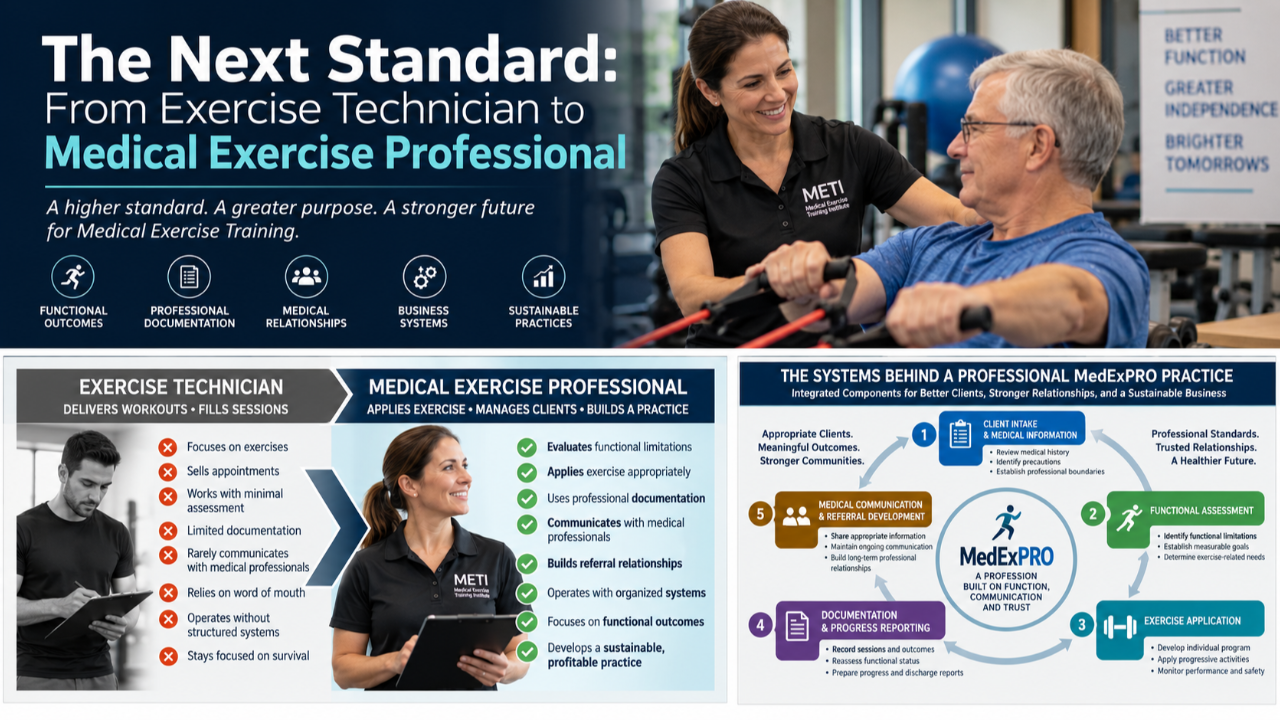
Why Certification Alone Is Not Enough—and Why the Future of Medical Exercise Training Depends on Professional Systems, Functional Outcomes, Documentation, and Medical Relationships
By Dr. Michael K. Jones, PhD, PT
Founder and President, Medical Exercise Training Institute
After 41 years as a physical therapist and 32 years teaching Medical Exercise Specialists, I believe it's time for us to have a serious conversation about the future of Medical Exercise Training.
And I want to begin with a question that may make some of my students and graduates uncomfortable.
Did you become a Medical Exercise Specialist to build a professional Medical Exercise Training practice, or did you simply want another certification that would allow you to charge more for personal training sessions?
Think about that question for a moment.
Since we conducted our first Medical Exercise Specialist (MES) workshop in Washington, DC, in July 1994, I've watched this profession grow from a relatively unfamiliar ...
The Medical Exercise Practice of 2040 Starts Today
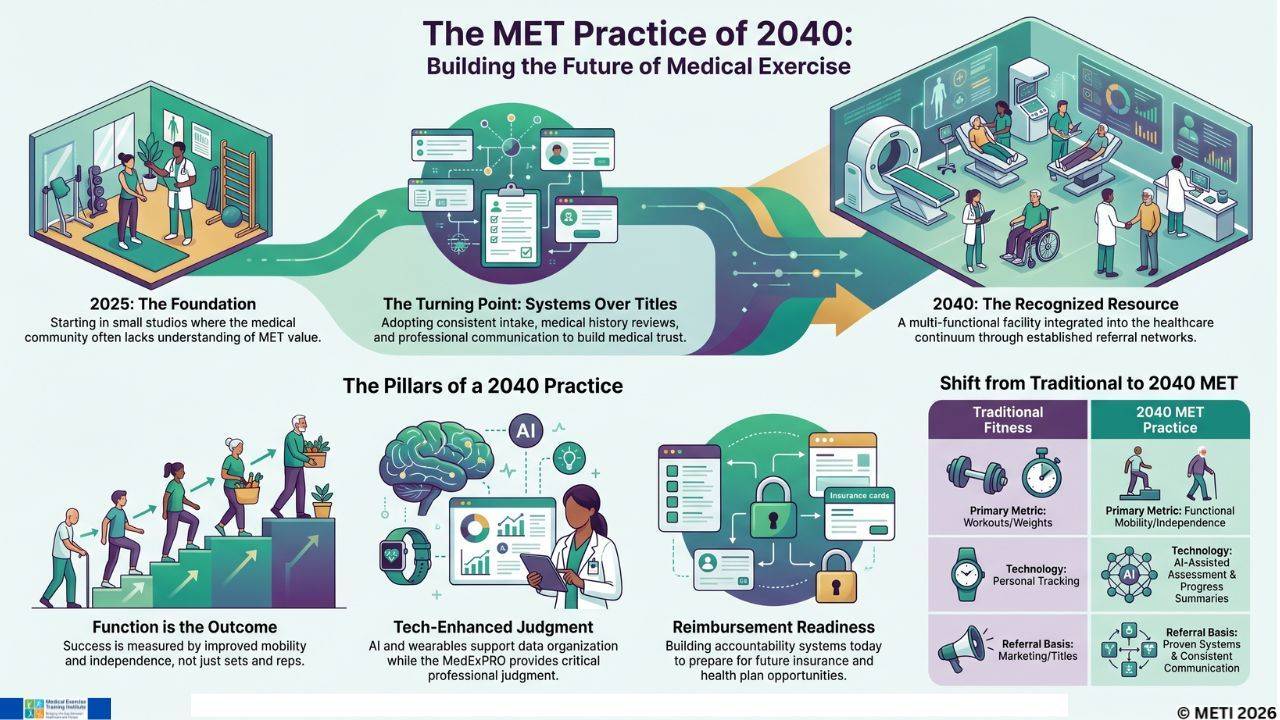
Disclaimer: This is a fictional, forward-looking article based on my personal vision of what Medical Exercise Training could become by 2040. It is not a statement of current policy, reimbursement, regulation, or future guarantees.
I want you to imagine a Medical Exercise Training practice in the year 2040.
You walk into a professional facility that does not feel like a traditional gym. One area is dedicated to assessment, another to progressive strength, mobility, stability, endurance, and functional training, and another supports hybrid or remotely monitored exercise programs. The clients are not there simply to “work out.” Many have completed physical therapy or other medical care and are now working with Medical Exercise Professionals to improve function, independence, and long-term capacity.
This is the practice of Jodie Hicks, MES.
But Jodie did not start with a large facility, a large staff, or an extensive referral network. In 2025, she operated from a small rented studio an...
Mrs. Jacobs, Medicare and the MedExPRO
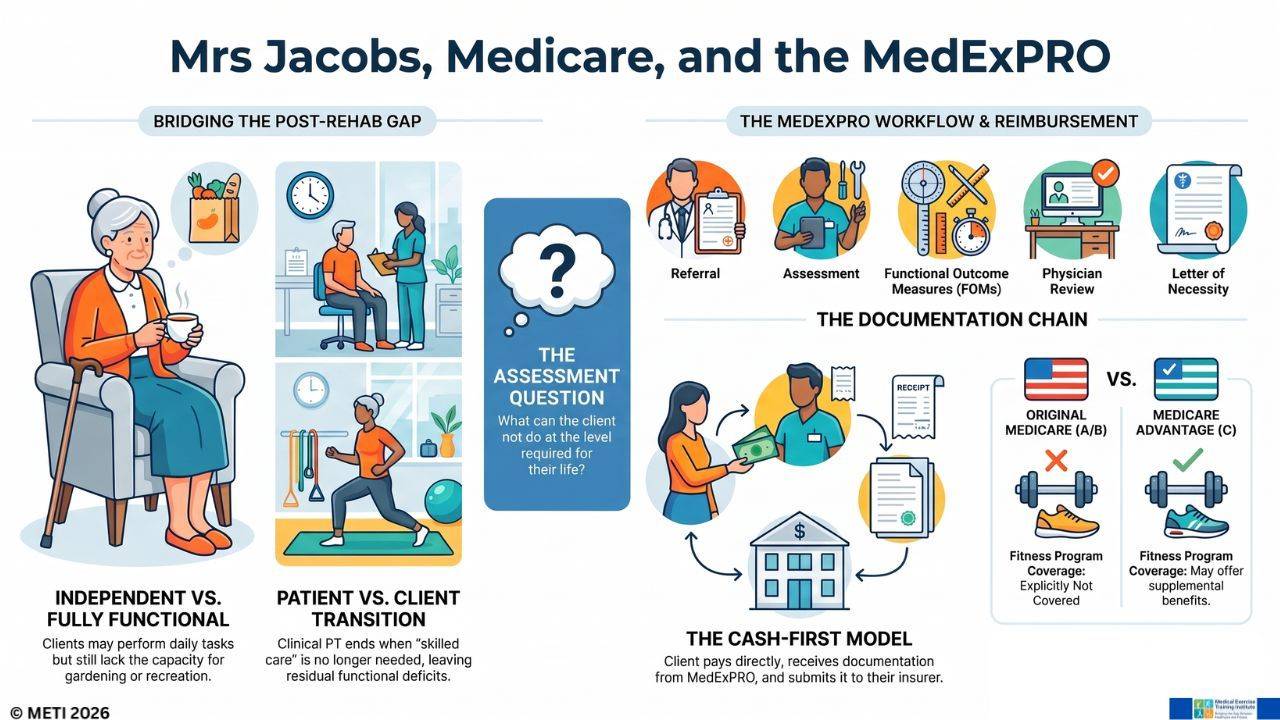
Understanding the Medicare Client, the Post-Rehabilitation Gap and Cash-First Reimbursement
Mrs. Jacobs is a 72-year-old retired professional who lives independently with her husband. She enjoys gardening, attending church, shopping, traveling, volunteering, and spending time with her grandchildren. She occasionally helps with administrative activities in a family business.
Several months ago, Mrs. Jacobs underwent a right total knee replacement. Her journey from surgery through rehabilitation and eventually into Medical Exercise Training provides an important lesson for every MedExPRO who works with Medicare-age clients.
The lesson is simple:
Being independent does not necessarily mean being fully functional.
Understanding that distinction—and understanding where Medicare ends and Medical Exercise Training begins—is essential to professional medical exercise practice.
Understanding Mrs. Jacobs' Medicare Coverage
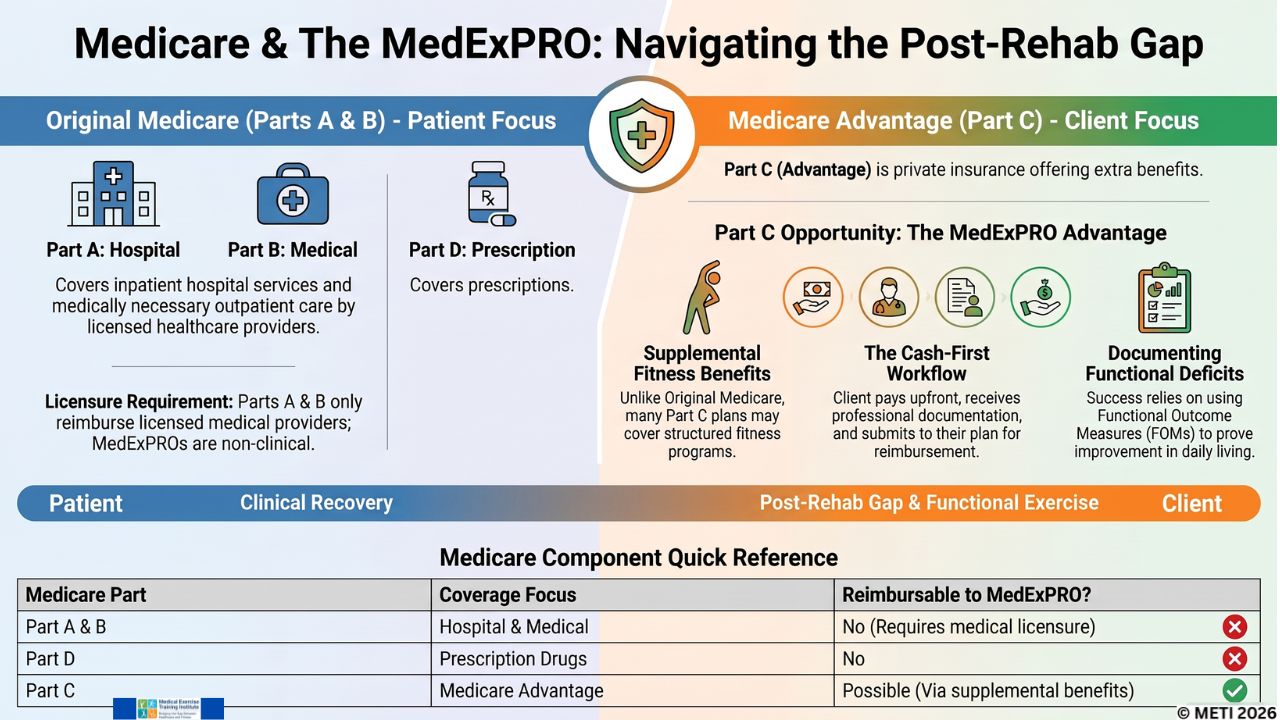
Mrs. Jacobs entered Medicare at age 65. Medicare consists of sev...
Beyond Fitness: Stop Collecting Information. Start Building Your Practice.
Beyond Fitness Will Take Your Practice to a New Level
You became a Medical Exercise Professional to do more than simply deliver exercise sessions.
You wanted to build a practice.
A practice that physicians and therapists understand.
A practice that generates referrals.
A practice that documents what you do, demonstrates functional outcomes, communicates professionally, serves clients well—and produces the income your expertise deserves.
That is exactly why I wrote Beyond Fitness: The MedExPRO Pathway to the Future of Medical Exercise Training.
This is not another book about exercises.
Beyond Fitness is a practice-building tool.
Every chapter challenges you to examine a different component of your MedExPRO practice. Every checklist helps you determine what you are already doing, what is missing, and what you need to improve next.
You don't just read it.
You use it.
READY TO START BUILDING?
Get your copy of Beyond Fitness on Amazon and begin working through your practice one...
The MedExPRO Periodic Table - The Elements of a Successful Practice
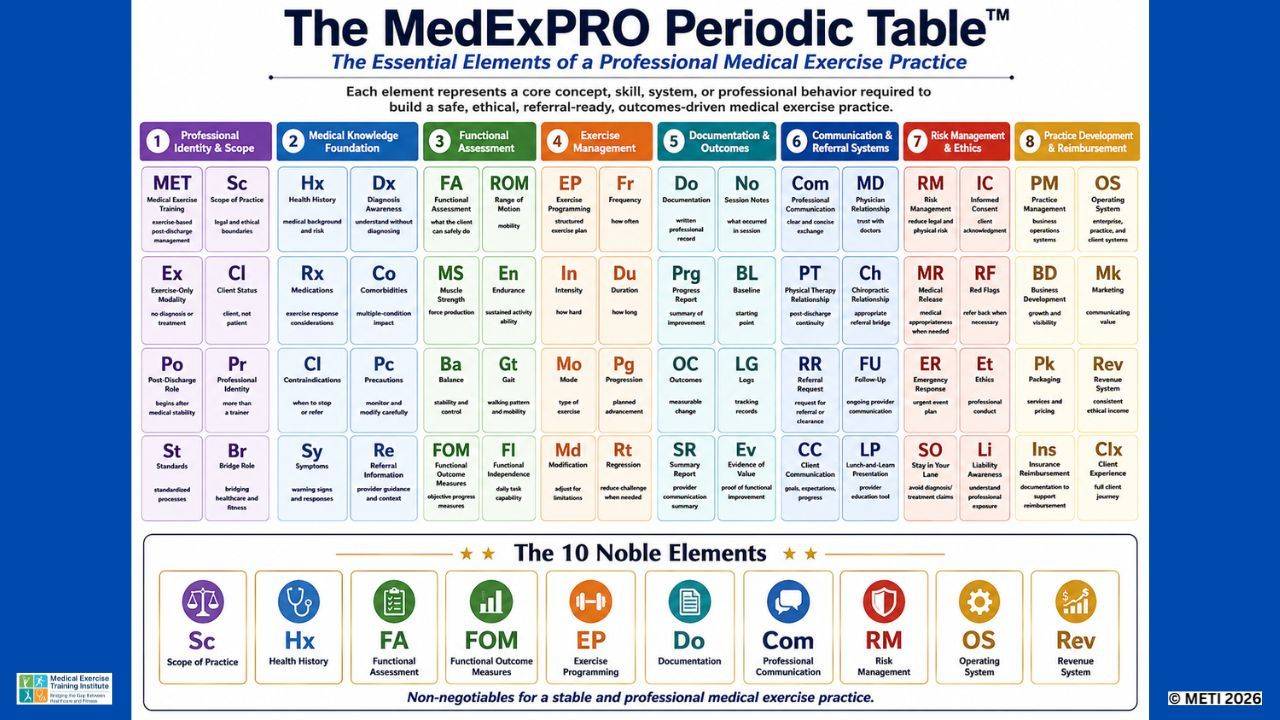
The MedExPRO Periodic Table™: The Essential Elements of a Professional Medical Exercise Practice
The fitness industry has spent decades attempting to step closer to healthcare. Personal trainers and fitness instructors routinely employ terms like "corrective exercise," "post-rehab," "medical fitness," "functional training," and "therapeutic exercise." While some of these concepts possess inherent value, their loose application often generates more confusion than clarity. If we expect physicians, physical therapists, chiropractors, senior living administrators, and insurance carriers to take our work seriously, Medical Exercise Training (MET) must be fundamentally different. We must define our role, establish clear professional boundaries, and show how assessment, programming, documentation, and business operations work together in a structured, repeatable system.
For the Medical Exercise Professional (MedExPRO) working with clients with medical conditions, professionalism is not buil...
The 10 Pillars of Professional Practice: Moving Beyond Fitness with a Medical Flavor
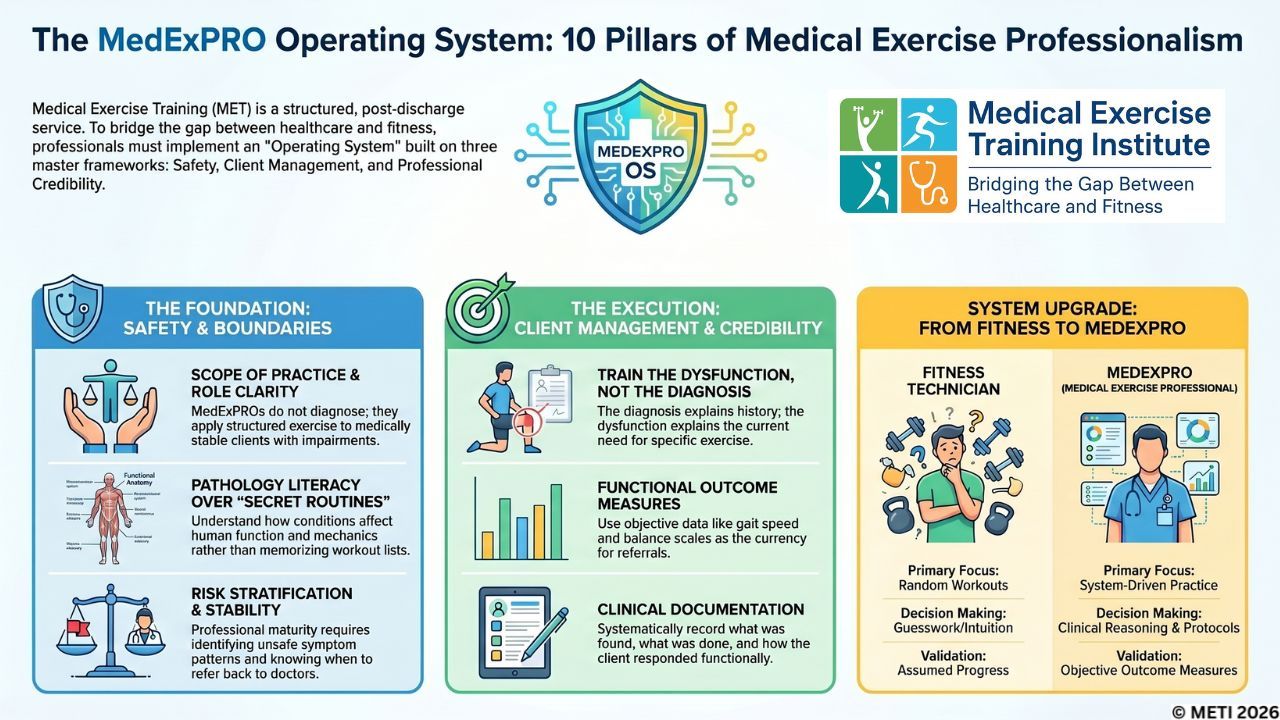
To transition fitness professionals from a "workout-centric" mindset to a system-driven, professional practice model by mastering the 10 key concepts of Medical Exercise Training.
Medical Exercise Training (MET) is not general fitness with a medical flavor. It is a structured, post-discharge, exercise-based professional service. To earn medical referrals and build a sustainable practice, the Medical Exercise Professional (MedExPRO) must move from technician thinking to professional practice ownership by installing systems for safety, client management, and professional credibility.
Professional Standard
Many fitness professionals believe that working with clients who have medical conditions simply requires knowing a few extra exercises. They look for the "secret routine" or a collection of specialized workouts.
But medical professionals do not refer to routines. They refer to systems.
If you want to bridge the gap between healthcare and fitness, you must move beyond the mentality ...
Medical Exercise Training eBook Tip 52: How & When to Discharge A MET Client
Welcome back to the MET 101 eBook series! In Tip 52, Dr. Mike addresses a transition that separates general personal trainers from true Medical Exercise Professionals (MedExPROs): How and when do you discharge a Medical Exercise (ME) client?
If you want to be fully integrated into the healthcare network, you must understand that ME clients are not meant to stay ME clients forever.
The Goal is Independence, Not Dependence: The fundamental goal of every healthcare provider—from surgeons to physical therapists—is to get the patient to a point where they no longer need intensive care, requiring only supervision or periodic check-ins. The exact same holds true for MedExPROs.
A trap that many fitness professionals fall into is wanting to hold onto a medical exercise client indefinitely because they can charge a higher premium for those specialized services. However, once a client's function, power, strength, and proprioception have significantly improved, they no longer require the advanc...