
Medical Exercise Training eBook Tip 52: How & When to Discharge A MET Client
Welcome back to the MET 101 eBook series! In Tip 52, Dr. Mike addresses a transition that separates general personal trainers from true Medical Exercise Professionals (MedExPROs): How and when do you discharge a Medical Exercise (ME) client?
If you want to be fully integrated into the healthcare network, you must understand that ME clients are not meant to stay ME clients forever.
The Goal is Independence, Not Dependence: The fundamental goal of every healthcare provider—from surgeons to physical therapists—is to get the patient to a point where they no longer need intensive care, requiring only supervision or periodic check-ins. The exact same holds true for MedExPROs.
A trap that many fitness professionals fall into is wanting to hold onto a medical exercise client indefinitely because they can charge a higher premium for those specialized services. However, once a client's function, power, strength, and proprioception have significantly improved, they no longer require the advanc...
MedExPRO….Do MET Clients Stay Clients Forever? Understanding Functional Maintenance
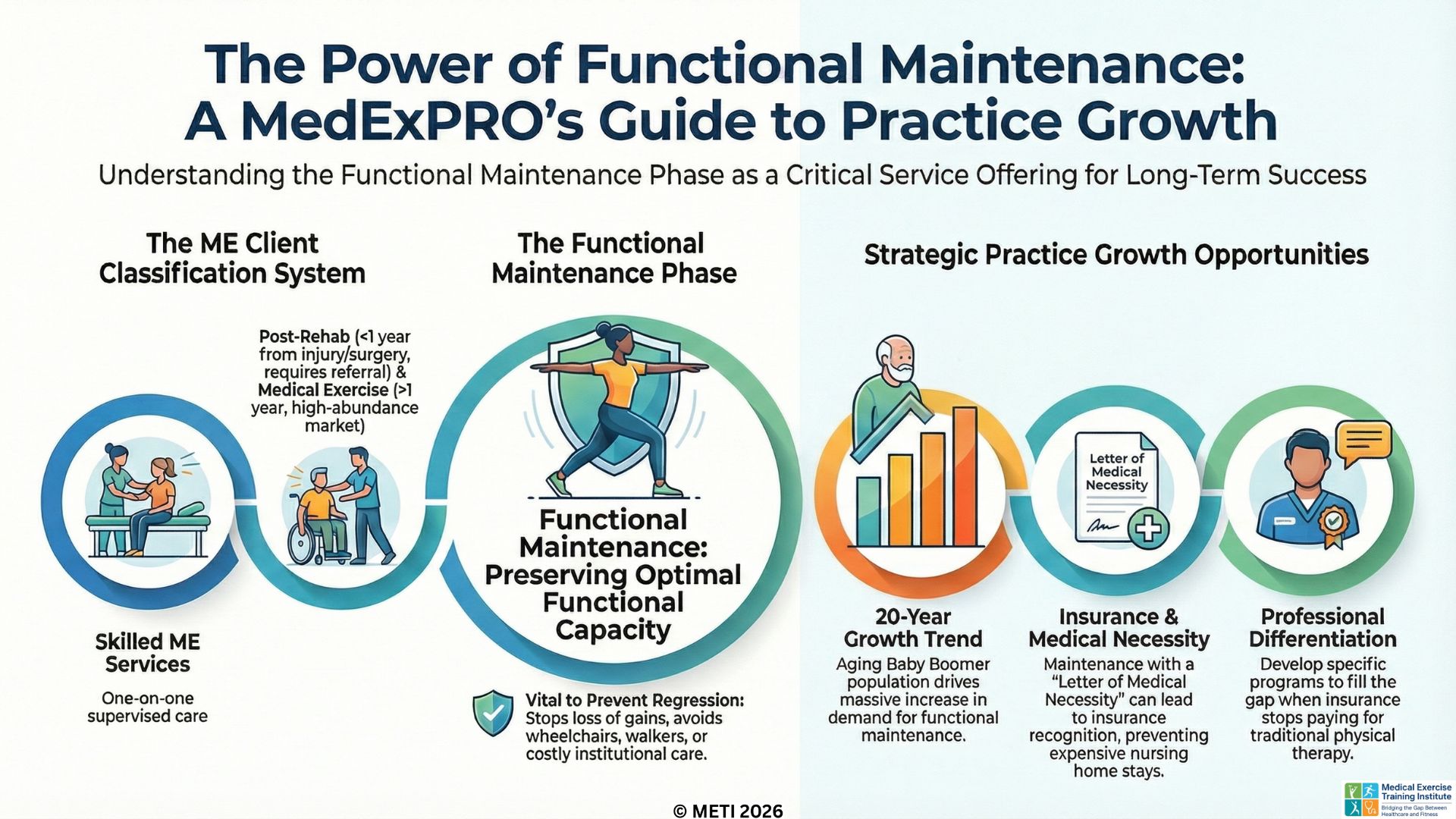
Welcome back to the MET 101 eBook series! In Tip 51, we address a very common and important question for Medical Exercise Professionals (MedExPROs): Do MET clients remain MET clients forever?
The short answer is no. Just as medical treatment eventually concludes, skilled MET services—which involve intensive one-on-one or group-based supervision—also reach a conclusion. At a certain point, a client achieves their optimal functional capacity and no longer needs primary MET services. When this happens, they transition into a critical phase known as Functional Maintenance.
The 4 Post-Rehab Client Classifications: To understand where Functional Maintenance fits in, it helps to understand the four primary classifications of clients you will see in your practice:

- The Post-Rehab Client: This client has sustained an injury, undergone surgery, or been diagnosed with a condition within the last year. They always require a medical referral before you begin working with them.
- The Medical ...
Medical Exercise Training Specialization - MET 101 eBook Tip 22
Summary of MET 101 eBook Tip 22
MET 101 Tip 22 from the Medical Exercise Training 101 ebook series emphasizes the importance of specialization within medical exercise training, explaining having specialized knowledge in certain areas does not limit a professional's ability to see clients with other conditions. Instead, it enhances overall expertise. Dr. Mike outlines several areas for potential specialization, including cancer, joint replacements, and neurological conditions. He highlights the importance of collaboration with medical professionals. He stresses the need for medical exercise professionals to be proactive in managing and recommending exercise programs tailored to clients' medical conditions. He also encourages continuous learning and sharing of knowledge and outcomes within the professional community.
Bullet Points:
- Specialization in Medical Exercise Training:
- Specialization is beneficial and does not restrict seeing clients with other conditions.
- Enhances sk ...
What is "Medical Clearance"?...MET 101 eBook Tip 14
"MET 101 Ebook - Tip 14," goes deeper into the critical aspect of liabilities and the importance of “medical clearance” in the field of medical exercise training. This installment of the series underscores the responsibility of medical exercise professionals in ensuring client safety and the appropriateness of exercise programs. The video delves into the role these professionals play, acting as the last line of defense in identifying red flags even in clients who have been medically cleared for exercise. Through practical advice and examples, the video provides a comprehensive overview of how to navigate these complex situations effectively.
Key insights from the video include:
Medical Clearance Necessity: Stresses the importance of obtaining medical clearance from a physician, physical therapist, or chiropractor before starting any exercise program.
Identifying Red Flags: Highlights the crucial role of medical exercise professionals in spotting red flags that may indicate a c...
Medical Exercise Training 101 eBook

The "MET101 eBook" is a detailed manual containing 101 tips for fitness professionals evolving into Medical Exercise Training (MET), crafted by Michael K. Jones, PhD, PT. This guide aims to integrate healthcare and fitness, providing a foundation for creating successful MET practices. It distinguishes MET from other fitness disciplines by concentrating on exercise programs for individuals recovering from medical treatments. The eBook encompasses a wide range of topics, from MET's fundamentals to the requisite skills for initiating a MET practice, making it vital for those looking to enhance patient care and build connections with the medical community.

1. Understanding MET and Its Scope:
• The focus on function in MET
• Types of MET clients
• Differences between MET services and physical therapy
• Explaining MET to clients
• Offering MET services in healthcare professional offices
• The comprehensive nature of MET beyond strengthening
• Requirements for accessing a client's medical reports
2....