
The Client Management Engine That Eliminates Random Exercise
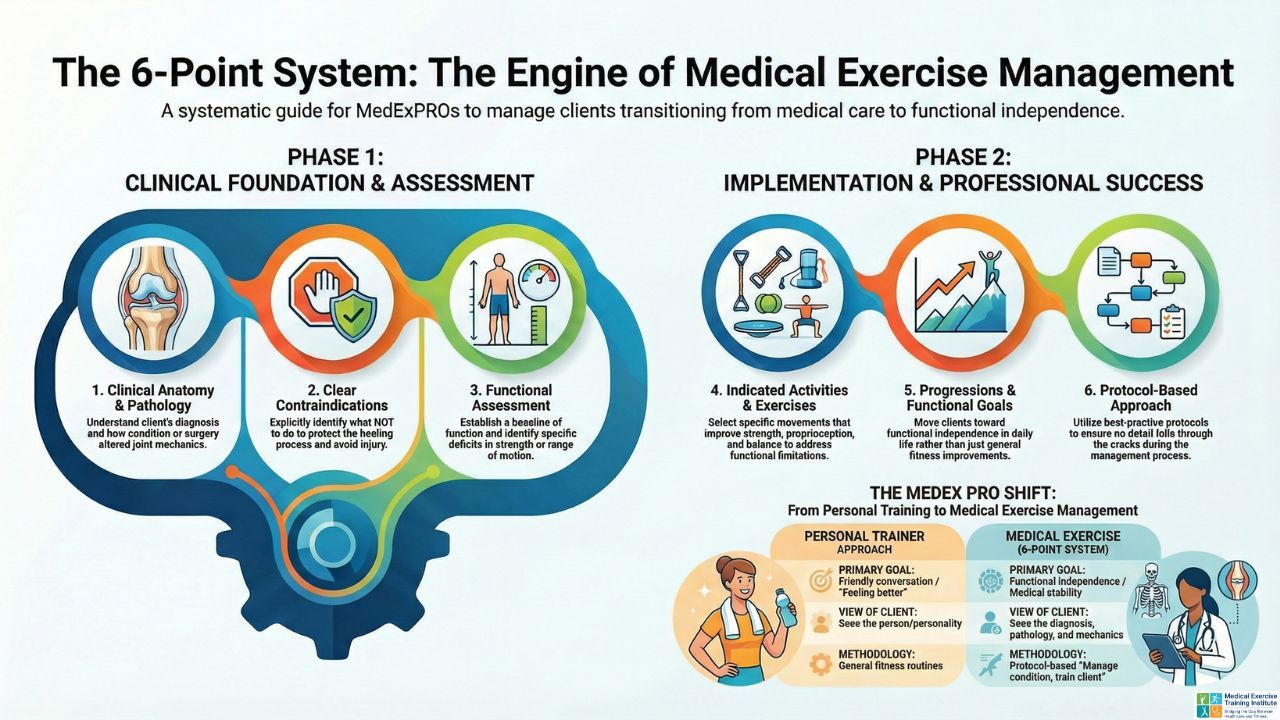
The 6-Point Client Management System
The healthcare landscape has shifted dramatically.
Decades ago, an individual recovering from a total hip replacement might receive two to three months of physical therapy. Today, many are discharged after only four to six visits. They leave therapy with lingering weakness, instability, and functional limitations—yet insurance says they are “done.”
That gap is where the Medical Exercise Professional steps in.
But let me be clear:
If you step into that gap without structure, you are not building a professional practice. You are gambling with someone’s recovery.
In the MedExPRO Operating System, the engine that drives safe, measurable, and referral-ready results is the 6-Point Client Management System.
This is not about adding more exercises.
This is about installing a system.
The Critical Mindset Shift
Before we discuss mechanics, we must discuss mindset.
A personal trainer may see “Mrs. Jacobs” — a pleasant 79-year-old who wants to get stronger.
A medical professional sees:
A 79-year-old female, status-post right total hip replacement, posterior approach.
That lens changes everything.
In medical exercise, my rule has always been:
Manage the condition. Train the client.
You respect pathology.
You respect surgical alterations.
You respect contraindications.
And then you customize within those boundaries.
That is professionalism.

- Understand Clinical Anatomy and Pathology
Every client walks in with a diagnosis from their physician.
That diagnosis is not a footnote — it is the foundation.
You must understand:
- The anatomical structures involved
- What the injury, the disease or the surgery did to the tissue
- How the surgery altered mechanics
- How healing progresses
If you do not understand the condition, you cannot design safely around it.
This is where fitness ends, and medical exercise begins.
- Identify Contraindications
The fastest way to lose a referral source is to violate a contraindication.
After a posterior hip replacement:
- Hip flexion beyond 90 degrees
- Adduction across midline
- Internal rotation
These are not suggestions. They are red flags to be avoided!!
Your first responsibility is knowing what NOT to do.
When you consistently respect contraindications, physicians begin to trust you.
- Conduct a Thorough Assessment
Never begin without a baseline.
You must evaluate:
- Strength
- Range of motion
- Balance
- Proprioception
- Functional capacity
Can they navigate stairs?
Can they safely transfer in and out of a car?
Can they stand independently without compensatory instability?
Skipping assessment is the leading cause of setbacks in this field.
Assessment is not paperwork.
Assessment is protection.
- Implement Indicated Exercises
Exercise selection must be strategic.
Because therapy visits are limited, clients depend on you to:
- Restore stability
- Improve neuromuscular control
- Rebuild strength
- Reinforce joint protection
Every exercise must have a purpose.
If you cannot explain why an exercise is indicated relative to the diagnosis, it does not belong in the program.
- Establish Progression and Functional Goals
Medical exercise is not about aesthetics.
It is about functional independence.
Function means:
- Leaving the home safely
- Navigating stairs
- Driving independently
- Performing daily activities without assistance
Sometimes it is deeply personal.
Maybe Mrs. Jacobs wants to confidently wear heels to her son’s graduation.
That matters.
You must create measurable progression toward meaningful outcomes.
Without progression, there is no system.
Without measurable goals, there is no professionalism.
- Utilize a Protocol-Based Approach
Protocols prevent chaos.
They ensure:
- Nothing is overlooked
- Contraindications are respected
- Recovery phases are structured
- Progressions are logical
You may individualize within a protocol.
But you do not abandon it.
Protocols build credibility.
Credibility builds referrals.
Referrals build sustainability.
Why This System Matters
When you apply the 6-Point System consistently:
- You reduce client setbacks.
- You protect healing tissue.
- You communicate confidently with providers.
- You elevate your identity from trainer to professional.
- You create measurable outcomes.
- You build a referral-ready practice.
Skill alone will not do that.
Systems will.
The future of medical exercise belongs to professionals who install infrastructure.
If you want to be referral-ready… reimbursement-ready… and outcomes-driven…
The engine begins here.
Dr Mike
Is your practice Referral & Reimbursement Ready?
👉 Click here: Referral-Reimbursement Readiness Checklist
Get Medical Exercise Training guidelines and updates!
Build your practice with tips learned over 28+ years teaching MedXPROs around the world!!