
The Future of Medical Exercise: Why Functional Assessment Scales Are the Ultimate Game Changer
Get the podcast here
For the last thirty plus years I have learned a simple but uncomfortable truth about medical exercise.
Most fitness professionals measure the wrong things.
They measure strength, flexibility, and endurance in isolation. They celebrate improvements in numbers that mean something inside the fitness industry but mean very little inside the healthcare system.
A physician does not care that your client improved their squat by 25 pounds.
A physician cares whether that person can safely climb stairs, walk without falling, return to work, or maintain independence.
This is the fundamental shift that is now occurring in the evolution of medical exercise training.
The future of the profession will be built not on exercises — but on measured improvements in functional capacity.
And the tool that will define this transition is the Functional Assessment Scale (FAS).
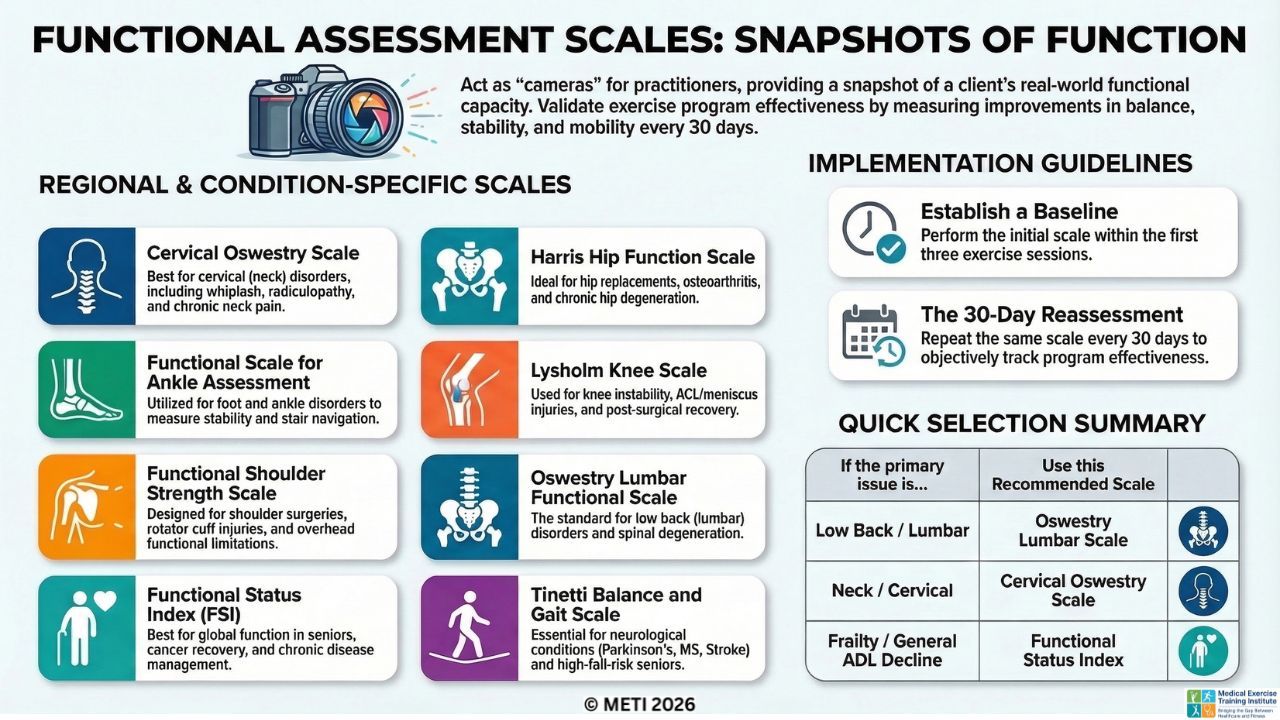
The Coming Transformation in Medical Exercise
The healthcare system is under extraordinary pressure.
...Medical Exercise Assessment - Step 3 Functional Interview

The Functional Interview — Understanding the Client’s Real Goals
A structured conversation is a critical part of the assessment process.
Medical Exercise Training is not about isolated muscle strength.
It is about improving the client’s ability to live independently.
The functional interview helps identify:
- activities the client struggles with
• activities the client has stopped doing
• activities the client hopes to regain
For example, a client may say:
“I want to be able to walk to the mailbox.”
Or
“I want to be able to play with my grandchildren.”
These statements reveal meaningful functional goals.
Once those goals are identified, the exercise program can be designed to support them.
Medical Exercise Assessment - Step 2 Observation

Step 2: The Power of Observation in Medical Exercise Assessments

One of the most valuable tools a Medical Exercise Professional possesses is simple observation.
The moment the client begins moving, the assessment has already started.
Observation allows the MedExPRO to evaluate:
- posture
- walking patterns
- balance control
- coordination
- movement hesitation
Often, subtle movement patterns reveal important functional limitations.
For example, a client may walk well in a straight line but struggle when turning or navigating obstacles.
These movement patterns provide important clues about balance, coordination, and neurological control.
Observation allows the professional to see how the body functions in real-world movement situations.
And real-world movement is what Medical Exercise Training is designed to improve.

Medical Exercise Assessment - Step 1 Preparation
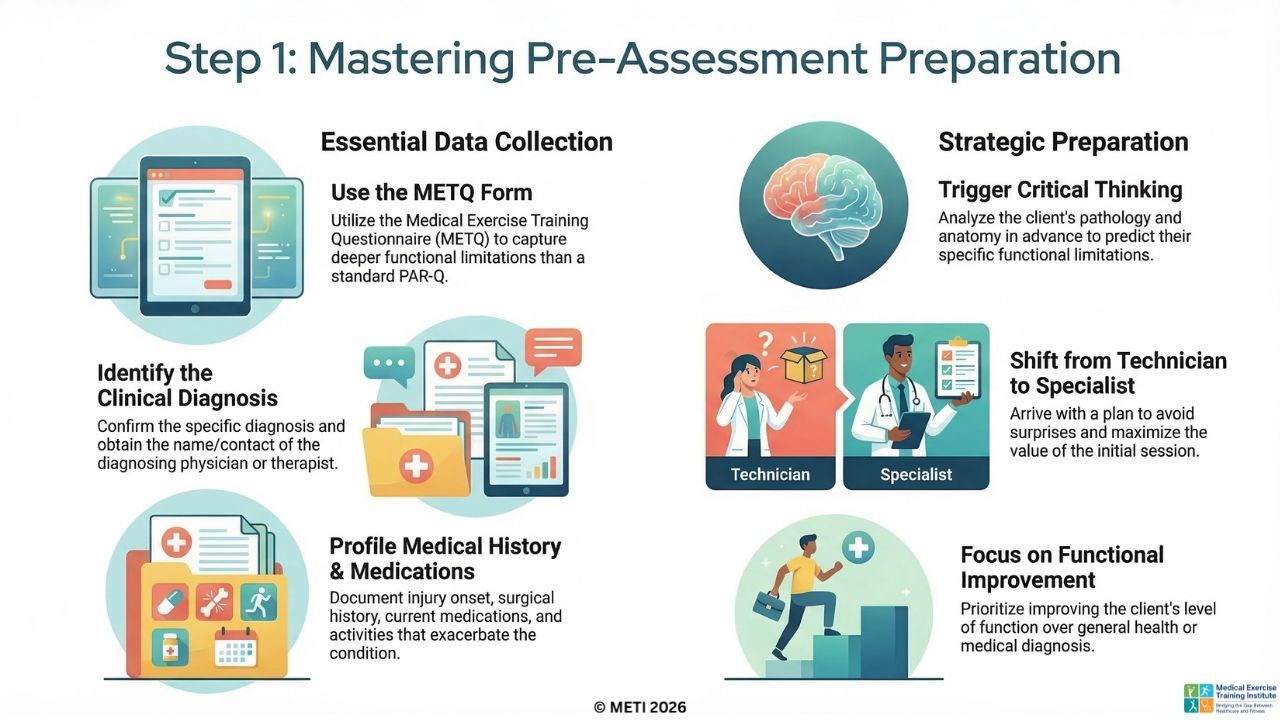
Step 1: Why Preparation Is the First Step of a Medical Exercise Assessment
Most exercise professionals begin their assessment when the client walks through the door.
But the best Medical Exercise Professionals begin much earlier.
Preparation is the first step in a professional assessment process.
Before the client ever arrives, the MedExPRO should review the client’s medical background and understand the pathology associated with their condition.
This preparation includes reviewing:
- medical diagnosis
• surgical history
• medications
• contraindicated activities
• expected functional limitations
Understanding the pathology allows the MedExPRO to anticipate what functional challenges may be present.
For example, a client with Parkinson’s disease may experience:
- reduced stride length
• balance instability
• difficulty initiating movement
By preparing ahead of time, the professional can design an assessment that focuses on the most meaningful functional indicators.
Wit...
The 7 Steps of a Medical Exercise Assessment
Download the Podcast Here
The Professional Framework That Separates MedExPROs From Personal Trainers
Most exercise professionals believe they perform assessments.
But the reality is this:
Most “assessments” in the fitness industry are simply movement warm-ups disguised as evaluation.
A true Medical Exercise Assessment is something very different.
It is a structured process designed to:
- Identify functional deficits
• Establish objective baselines
• Guide exercise prescription
• Communicate with medical providers
• Track functional improvement over time
Without a structured assessment process, exercise becomes guesswork.
And guesswork is the fastest way to lose credibility with physicians, physical therapists, and insurance carriers.
If Medical Exercise Professionals want to be recognized as part of the continuum of movement care, we must operate with the same level of structured evaluation used in healthcare.
Over the past three decades, I’ve refined what I call the Seven...