
Why Functional Outcome Measures Are Your "Currency of Trust"

These questions may make you feel uncomfortable.
If your client moves better but you can’t prove it, do you actually have progress? If your client feels stronger but you can’t measure it, do you have any real evidence?
These are uncomfortable questions, but they are essential for any fitness professional looking to bridge the gap between healthcare and fitness. According to Dr. Michael Jones, President of the Medical Exercise Training Institute, simply stating that a client "moves better" or "has less pain" is not enough when communicating with doctors, therapists, and insurance carriers.
If you want to be recognized as a true Medical Exercise Professional rather than just a personal trainer, you must learn to speak the language of healthcare. That language relies on functional outcome measures—your ultimate "currency of trust".
Exchanging Your Currency
Dr. Mike uses a travel analogy to explain this concept: If you travel to Greece to buy a meal or a souvenir, you cannot use US do...
Functional Outcome Measures (FOMs): The Currency of Trust
Most Medical Exercise Professionals believe they are outcome-driven.
They design intelligent programs.
They progress exercises appropriately.
They see improvement in their clients.
But when asked to prove it?
That’s where many practices quietly collapse.
A physician does not refer based on your passion.
An insurance carrier does not consider reimbursement based on your effort.
They respond to one thing:
Objective change
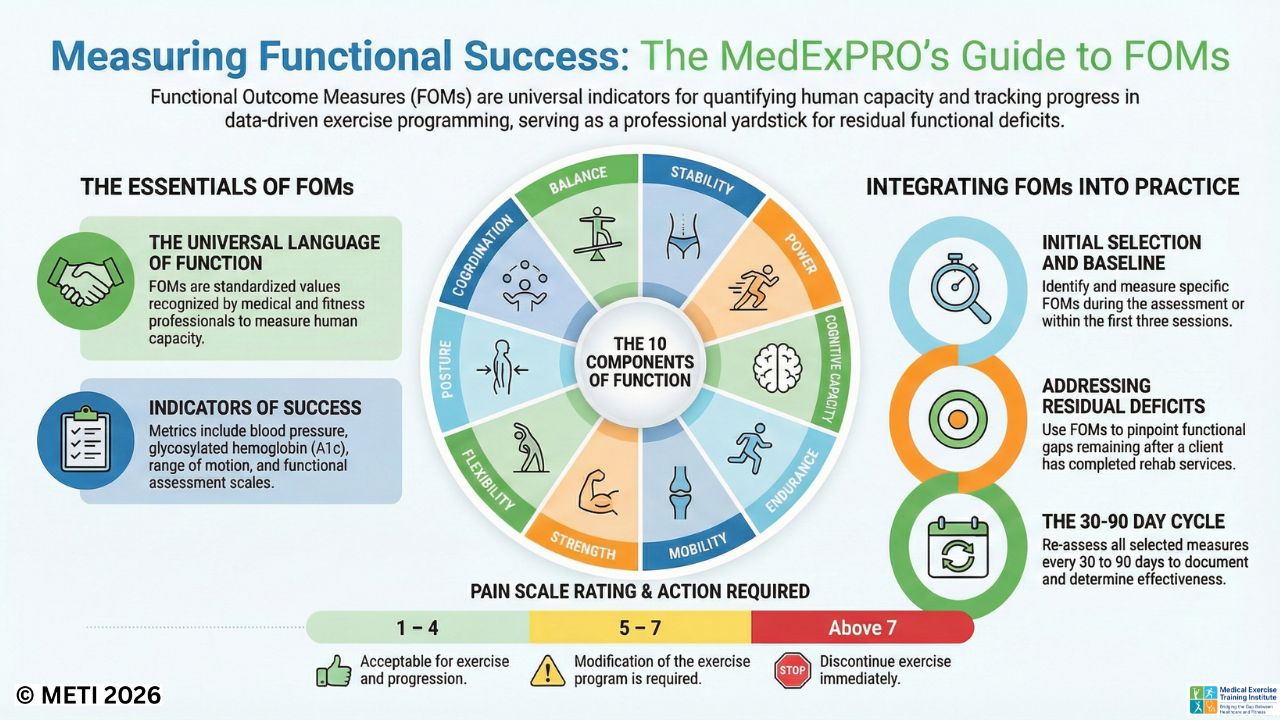
Functional Outcome Measures — FOMs — are the currency of trust in medical exercise training.
Without them, you are running sessions.
With them, you are building professional credibility.
The Core Problem: Improvement Without Proof
Many MedExPROs rely on observation and client feedback:
- “They’re moving better.”
- “Pain has decreased.”
- “They feel stronger.”
Those statements may be true.
But they are not measurable.
In a healthcare-aligned environment, improvement must be quantifiable.
If it cannot be measured, it cannot be defended.
If it cannot be def...