
You Don’t Like Protocols? Then You May Not Understand How Healthcare Works.
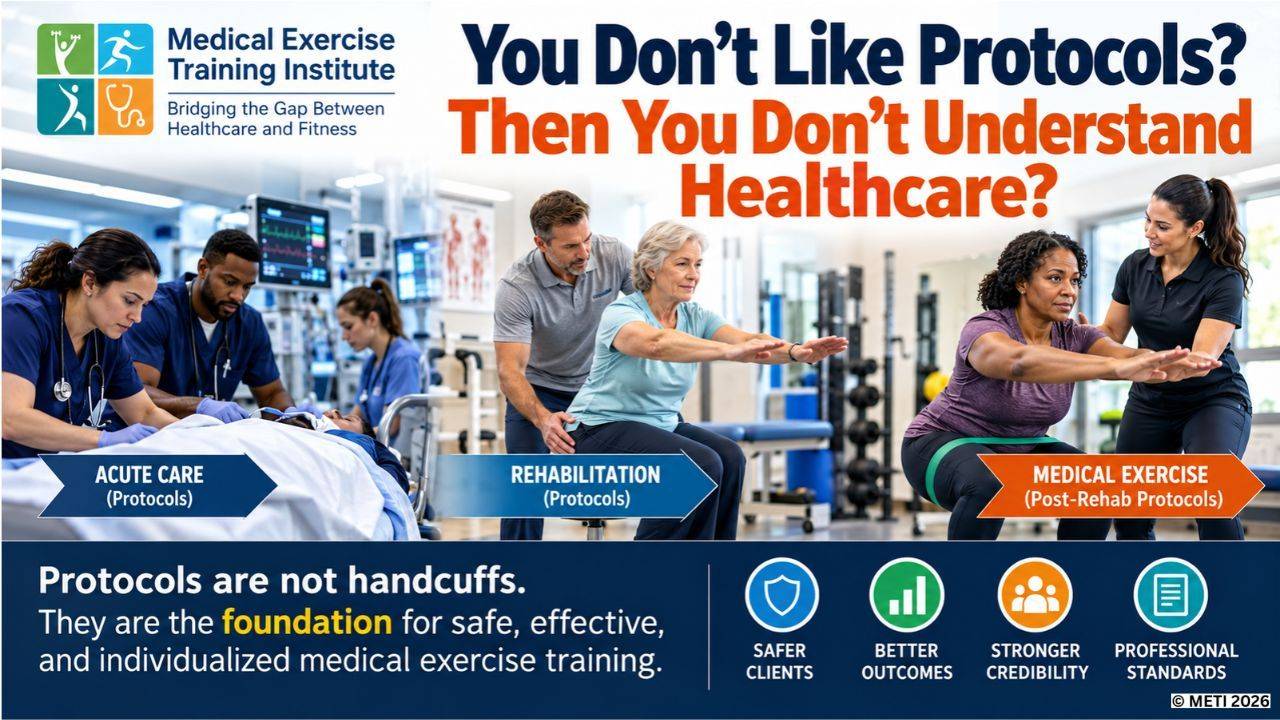
Why Medical Exercise Protocols Are Not Restrictions on Professional Judgment, but the Foundation for Developing It?
An Evening Watching Television Taught Me Something About Medical Exercise Training
Recently, I was home one evening watching television. I've become a fan of the medical drama The Pitt. As I sat there watching the emergency room physicians, nurses, and technicians managing one medical crisis after another, I received an email from one of our Medical Exercise Specialist students.
The student was questioning why they should consider using our post-rehab protocols. Why should they follow a protocol when they could develop their own exercises and individualize their client's program?
I had to laugh a little.
Not because the question was inappropriate. Actually, it was a very good question. But as I turned my attention back to the television, something struck me.
Almost everything I was watching those fictional healthcare professionals do was based on a protocol.
The physicians weren't simply making things up as they went along. The nurses weren't randomly deciding what to do next. The emergency room technicians weren't inventing procedures based on what they felt might work.
They were following established processes, clinical guidelines, and standardized approaches to the management of various medical conditions and emergencies.
Yes, it was a television dramatization. But the underlying concept was very real.
And that brings me to something I believe every current, former, and future Medical Exercise Specialist student needs to understand.
If you don't understand why protocols exist, you may not yet fully understand what it means to function as a professional in the healthcare-related environment.
Healthcare Is Built on Standards, Guidelines, and Protocols
Think about what happens when an individual enters an emergency department.
The medical team doesn't simply begin performing whatever procedures each provider prefers.
There's an organized approach to gathering information, determining the urgency of the situation, performing appropriate examinations, establishing a medical diagnosis, and selecting interventions.
Depending on the situation, the team may utilize established emergency response algorithms, clinical practice guidelines, institutional procedures, and condition-specific protocols.
Now, it's important to understand that these aren't all the same thing.
A guideline provides evidence-informed recommendations. A protocol provides a more structured approach to carrying out specific procedures. A standard establishes expectations for professional performance.
However, they share something important.
They help professionals deliver services consistently, safely, and effectively rather than relying on guesswork.
You'll find these concepts throughout healthcare.
In orthopedics, there are postoperative rehabilitation protocols. In cardiology, there are cardiac rehabilitation guidelines. In neurology, there are standardized approaches to assessing function and managing specific impairments. In primary care, there are screening procedures, diagnostic pathways, and condition-management guidelines.
Certainly, clinicians must exercise judgment. Sometimes circumstances require significant modifications. Equipment may not be available. A patient may respond unexpectedly. An existing medical condition may require an alternative approach.
But those modifications are not necessarily evidence that protocols have failed.
Often, they're examples of professionals applying their education, experience, and judgment within an established framework.
Professional judgment doesn't mean ignoring standards. It means knowing how to apply them, when to modify them, and when a situation requires an entirely different approach.
Let's Be Clear About Our Role as Medical Exercise Professionals
Before we go further, I want to make something absolutely clear.
As MedExPROs, we do not medically diagnose clients. We do not independently provide medical treatment, and we do not replace licensed healthcare providers.
Our responsibility is to provide appropriately designed, supervised, and documented exercise services within our professional scope, utilizing the medical information and recommendations available from the client's healthcare team.
The medical diagnosis comes from an appropriately licensed medical professional.
Our responsibility is to understand how the diagnosed condition, associated functional limitations, relevant precautions, and the client's current exercise tolerance influence the selection and progression of exercise.
That requires a systematic approach.
And that's one of the primary reasons we developed the original post-rehab protocols.
Why We Introduced Post-Rehab Protocols in 1994
I want some of our newer students to understand a little history.
When we began developing the Medical Exercise Specialist certification in Washington, DC, in 1994, the medical exercise training profession as we know it today did not exist.
We were entering territory that had not been clearly defined.
There were personal trainers. There were physical therapists. There were athletic trainers and other rehabilitation professionals.
But there was no widely established educational pathway preparing exercise professionals specifically to work with clients who had been discharged from rehabilitation or who needed structured exercise programming while managing chronic medical conditions.
We were, in many respects, the Lone Rangers.
And we recognized a serious problem.
An exercise professional might receive a client who had undergone a total knee replacement, experienced a lumbar disc problem, or completed treatment for a shoulder condition.
That professional might be enthusiastic, knowledgeable about fitness, and eager to help.
But what did they know about tissue healing? What did they understand about postoperative precautions? How would they recognize that exercise intensity or volume exceeded the client's current tolerance?
How would they determine which exercises were appropriate, which should be modified, and which might need to be avoided?
Without a systematic educational framework, the professional might simply do what they had always done with traditional fitness clients.
And that could create problems.
Too much resistance. Too many repetitions. Excessive range of motion. Inappropriate exercise selection. Progression that occurred before the client demonstrated adequate tolerance.
The result could be increased pain, swelling, exercise intolerance, or an unnecessary setback.
We needed to provide these professionals with a starting point.
Not a substitute for education.
Not a cookbook.
Not an excuse to avoid thinking.
We needed to give them guardrails.
That's why we developed the post-rehab protocols included in our Medical Exercise Specialist training.
They provided a structured educational approach to exercise selection, sequencing, precautions, and progression for clients with specific medical and musculoskeletal conditions.
They were never intended to eliminate professional decision-making.
They were intended to improve it.
A Protocol Is Not a Pair of Handcuffs
Now let's address the question I received from that student.
Do you have to follow every exercise in a post-rehab protocol exactly as written?
No.
Do you have to use the same equipment illustrated in the protocol?
No.
Do you have to progress every client through every phase at exactly the same rate?
Absolutely not.
That's not how these protocols were designed to be used.
Our post-rehab protocols provide examples of how to organize exercise programming around the functional and physical demands associated with particular medical conditions.
They identify relevant muscle groups, movement requirements, precautions, and progression considerations.
They demonstrate how to move from simpler, lower-demand exercise activities toward more demanding activities as the client demonstrates adequate capacity and tolerance.
But the exercises themselves aren't sacred.
Suppose a protocol recommends a particular exercise to improve hip abductor strength.
You might accomplish that objective using a resistance band, a cable system, a machine, an appropriately selected Pilates exercise, or another movement requiring controlled hip abduction.
The exercise selection may change.
The underlying exercise objective remains the same.
What matters is whether the exercise is appropriate for that client, addresses an identified functional need, respects applicable precautions, and can be performed at a level consistent with the client's current tolerance.
This is where education, assessment, and professional judgment come into play.
The protocol provides a reference.
You determine how that reference applies to the individual.
You Follow Protocols Every Day. You Just Don't Call Them Protocols.
Let me give you another example.
You got up this morning, got dressed, and eventually got into your car.
You started the engine and drove to your destination.
If you're in North America, you generally drove on the right side of the road. You stayed within marked lanes. You stopped at traffic signals. You observed road signs, speed limits, and traffic regulations.
Why?
Because those are the established rules and procedures governing how we operate vehicles on public roads.
Now, suppose you encounter a construction zone.
One lane is closed. Traffic is being redirected. A police officer signals for you to follow a temporary route.
What do you do?
You modify your driving based on the circumstances.
But you don't abandon the fundamental principles of safe driving.
You adapt within the established system.
That's professional judgment.
And that's precisely how I want you to think about medical exercise protocols.
The protocol gives you an organized approach. Your education and professional competence determine how you apply that approach to the specific circumstances in front of you.
Individualization Is Important. But Individualization Without Standards Can Become Guesswork.
Here's where I want to challenge some of our students and graduates.
We frequently hear exercise professionals say, "I individualize every program."
That's good.
You should.
But let me ask you something.
What are you individualizing the program from?
What's your starting point?
What information are you using to determine which exercises are appropriate?
How do you establish the client's current capacity?
What tells you that the client is ready to progress?
What happens when the client develops increased pain or swelling after an exercise session?
How do you determine whether to continue, modify, stop, or refer the client back to the appropriate medical provider?
If your answer is simply, "I use my experience," I want you to think a little deeper.
Experience is valuable.
But experience without a systematic process can sometimes become nothing more than repeating what you've always done.
That's not necessarily professional competence.
Professional competence requires the ability to explain and justify your decisions.
You should be able to explain why you selected an exercise, why you chose a particular resistance or movement demand, what functional objective you're addressing, and how you'll determine whether the exercise is producing an appropriate response.
That's where protocols, guidelines, assessment procedures, outcome measures, and documentation become so important.
They help move medical exercise training from personal preference toward a reproducible professional process.
And that process can still be individualized for every client.
In fact, the more clearly you understand the standards, the better equipped you become to individualize your exercise programming.
Progression Is Not About the Calendar. It's About the Client's Response.
Another important concept incorporated into our post-rehab protocols is staged progression.
We don't simply begin with the most demanding exercise a client can perform.
We consider the client's medical history, current functional limitations, movement capacity, symptoms, tissue tolerance, and applicable precautions.
For example, a client who has recently completed rehabilitation may demonstrate reduced strength, limited endurance, decreased movement confidence, or reduced tolerance to repeated loading.
We must recognize those limitations when establishing an exercise program.
That's why a phased approach can be valuable.
An appropriate program may initially emphasize mobility and controlled movement, then develop stability, strength tolerance, endurance, and functional integration as the client demonstrates readiness.
But those phases aren't rigid boxes.
Some clients may work on multiple components simultaneously. Others may require longer periods of lower-intensity exercise. Still others may progress more rapidly because their current functional capacity supports it.
The determining factor is not simply how many weeks have passed.
It's what the client demonstrates.
Does the client tolerate the exercise?
Can they maintain appropriate movement control?
Are symptoms remaining within acceptable limits established for that individual?
Are functional outcome measures improving?
Has the medical provider communicated specific restrictions or progression criteria?
These are the questions that should guide our decisions.
A protocol may suggest the pathway, but the client's response determines the appropriate pace.
And if the client's presentation raises concerns beyond our scope, the appropriate action is not to improvise a medical solution. It's to stop or modify exercise as appropriate and refer the client to a qualified healthcare professional.
The Real Purpose of a Protocol Is to Develop Your Professional Reasoning
I want our students to understand something.
When you study a post-rehab protocol, don't simply memorize the exercises.
Ask yourself why those exercises are included.
What functional limitations might they address?
Why is one exercise introduced before another?
What demands are being placed on the involved tissues?
What precautions might influence the exercise selection?
How will I know whether the client is ready for a more demanding activity?
And perhaps most importantly:
Can I explain my decisions to the referring physician or physical therapist?
Imagine receiving a referral from an orthopedic surgeon for a client who has completed rehabilitation following a total knee replacement.
The surgeon asks:
"Why did you select these exercises, and how are you determining when this client is ready to progress?"
Would you respond, "Because those exercises are in our protocol"?
I hope not.
I would expect you to explain that the exercises were selected to address specific limitations identified during your medical exercise assessment, within the applicable precautions, and that progression is based on exercise tolerance, movement quality, and measurable functional performance.
Now we're having a professional discussion.
You're not simply following a list.
You're demonstrating the reasoning behind your exercise programming.
That's what our protocols should help you learn.
Protocols Also Support Documentation, Communication, and Professional Accountability
There is another aspect of this discussion that is frequently overlooked.
Standardized processes make our work easier to explain, document, and evaluate.
Suppose you have 10 MedExPROs providing exercise services to clients following rehabilitation.
If each professional uses completely different assessment procedures, progression criteria, terminology, and documentation methods, how do we compare their results?
How do we establish whether clients are improving?
How do we communicate consistently with the referring medical professionals?
How do we evaluate whether our educational approaches are producing competent practitioners?
Standardization provides a foundation for answering those questions.
We don't need identical exercise programs for every client.
But we do need consistent professional processes.
We need clear documentation of what was assessed, what was performed, how the client responded, what changed, and what functional improvements were demonstrated.
This is why METI emphasizes assessment, exercise planning, implementation, monitoring, communication, and documentation as essential professional responsibilities.
When we combine those processes with appropriate outcome measures, we begin to create a more consistent and defensible approach to medical exercise service delivery.
And that's essential if we expect medical professionals to understand and recognize the value of medical exercise training.
From Following a Protocol to Developing Professional Competence
There's a natural progression in professional education.
When you're first learning a skill, you need structure.
You need examples, demonstrations, guidelines, and opportunities to practice.
As your understanding grows, you begin to recognize why those procedures were developed.
You become better at identifying when an exercise is appropriate, when an alternative may be preferable, and when the client's response requires modification.
Eventually, with appropriate education and experience, you may develop your own exercise progressions and condition-specific programming approaches.
There's nothing wrong with that.
In fact, that's something I encourage.
But those approaches should be based on sound principles, appropriate professional knowledge, and careful evaluation of client responses and outcomes.
They shouldn't be developed simply because you don't like using someone else's protocol.
And remember: developing your own approach does not make it inherently better or safer.
It must still be consistent with your scope, applicable medical precautions, established professional standards, and the client's needs.
The goal is not to become dependent on a protocol. The goal is to become competent enough to understand it, apply it, modify it, and explain your decisions.
That's a very different educational objective.
To Our Current Students, Graduates, and Future Medical Exercise Specialists
To our current students, I encourage you to stop looking at the post-rehab protocols as exercise lists you must memorize.
Study the principles behind them.
Understand the progression.
Understand why particular muscle groups, movements, and physical capacities are emphasized.
Learn to recognize situations that require modifications.
To our graduates, I encourage you to revisit those protocols with the benefit of your professional experience.
You may discover concepts that you didn't fully appreciate when you initially completed your training.
Ask yourself whether your current programming decisions can be supported by a systematic assessment, a clearly stated functional objective, and documented client outcomes.
And to those considering a career in medical exercise training, understand that this profession requires much more than knowing how to demonstrate an exercise.
It requires the ability to work within an established scope of practice, interpret relevant medical information, recognize exercise precautions, make appropriate programming decisions, and communicate effectively with medical professionals.
That's what our educational programs are designed to help you develop.
The Profession Doesn't Advance When Everyone Makes Up Their Own Rules
Let me close with this thought.
Since 1994, we've worked to develop medical exercise training into a recognized professional service.
We've developed education, certification, exercise protocols, assessment procedures, documentation processes, and professional standards.
Why?
Because we understood that enthusiasm and a collection of exercises would never be enough to establish a profession.
We needed a foundation.
We needed an organized approach to helping exercise professionals work more safely and effectively with clients managing medical conditions.
And we needed a way to communicate that approach to the medical community.
Today, more than three decades later, that need hasn't disappeared.
If anything, it's become even more important.
As more individuals live with chronic medical conditions, undergo joint replacement procedures, complete rehabilitation, and seek continued exercise support, medical exercise professionals must demonstrate that their services are organized, appropriate, and outcome-driven.
We cannot accomplish that if every professional simply invents a different approach without reference to established standards.
So, the next time you find yourself saying, "I don't like protocols," I want you to ask yourself a different question:
"Do I really understand what the protocol is trying to teach me?"
Because here's the point I want you to remember.
Protocols do not replace professional judgment. They provide the foundation upon which professional judgment is developed.
Learn the principles. Understand the guidelines. Respect the precautions. Individualize the exercise program. Measure the outcomes. Document your decisions.
And be prepared to explain what you're doing and why.
That's how we advance medical exercise training.
That's how we gain the confidence of medical professionals.
And that's how we move from simply providing exercises to demonstrating the value of a professional medical exercise service.
Continue Your Professional Development
If you're a current or prospective Medical Exercise Specialist student, I encourage you to use the post-rehab protocols in the MES Training Series as educational tools for developing your exercise programming and professional reasoning.
For a broader discussion of where our profession is headed, I also invite you to explore my book, Beyond Fitness: The MedExPRO Pathway to the Future of Medical Exercise Training.
If you have questions or comments, email me at drmike@postrehab.com.
All the best to you as you continue building your medical exercise training practice.
Dr. Michael Jones, PT
Founder, Medical Exercise Training Institute
Co-Developer, Medical Exercise Specialist Certification
All the best, folks. Take care.
Get Medical Exercise Training guidelines and updates!
Build your practice with tips learned over 28+ years teaching MedXPROs around the world!!