
The MedExPRO Operating System: Connecting Practice Management, Client Management, and the 14-Step Guided Workflow
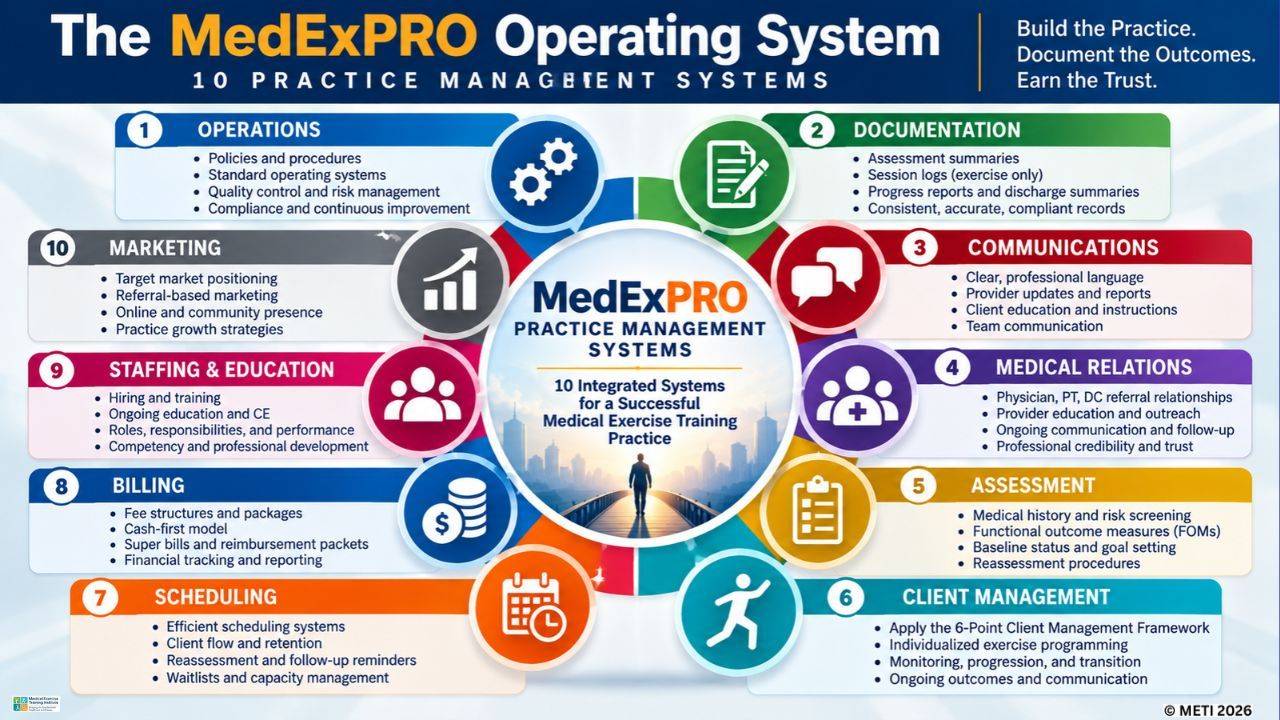
Three Interconnected Systems That Transform Exercise Sessions Into a Professional Medical Exercise Training Practice
Are You Managing a Professional Medical Exercise Training Practice—or Simply Managing Your Next Exercise Session?
Let me ask you a question.
If a physician referred five new clients to your Medical Exercise Training practice tomorrow, could you manage each client from initial referral through assessment, exercise programming, documentation, reassessment, provider communication, and eventual discharge?
Could you do it consistently?
Could another qualified MedExPRO follow your procedures and deliver the same level of professional organization?
And could you demonstrate what happened with each client without relying on your memory or reconstructing information from exercise notes?
If your answer is uncertain, you may have excellent exercise programming skills but lack something equally important.
An integrated professional operating system.
For more than three decades, I've emphasized that Medical Exercise Training requires more than knowing which exercises to use for a particular medical condition.
The MedExPRO must understand the anatomy and pathology associated with the client's condition, recognize contraindicated activities, use appropriate assessment procedures, select indicated exercises, apply progression guidelines, and follow established protocols.
But professional exercise management is only one part of the equation.
The MedExPRO must also operate a business, organize client records, communicate with medical professionals, manage referrals, schedule services, maintain documentation, and monitor financial performance.
These responsibilities are connected, but they are not identical.
At the Medical Exercise Training Institute, we have organized them into three interconnected systems:
- The 10-System MedExPRO Practice Management Framework — establishes the infrastructure needed to operate the business.
- The 6-Point Medical Exercise Client Management System — establishes the professional knowledge, safety principles, assessment procedures, exercise guidelines, and protocols necessary for managing clients.
- The 14-Step Guided Client Management Workflow — translates those professional principles into a structured sequence of client-management decisions and actions.
Each serves a different purpose.
Together, they provide the foundation for a more organized, professional, outcome-driven, and sustainable Medical Exercise Training practice.
Let's examine how they work.
- The MedExPRO Practice Management Framework: The Infrastructure Behind the Business
The First Question: Can Your Practice Operate Consistently Without Depending on Your Memory?
Think about a successful medical practice, physical therapy clinic, or other professionally operated service business.
There are established procedures for receiving referrals, scheduling appointments, collecting information, documenting services, communicating with professionals, managing financial transactions, and evaluating performance.
These activities don't happen randomly.
They are supported by operating systems.
A Medical Exercise Training practice requires the same organizational discipline, although its professional scope and services differ from those of a licensed healthcare practice.
The MedExPRO Practice Management Framework provides that structure.
The 10 Practice Management Systems
|
System |
Primary responsibility |
|
1. Operations |
Policies, procedures, daily workflows, quality control, and risk management |
|
2. Documentation |
Assessment Summaries, Session Logs, Progress Reports, Discharge Summaries, and records management |
|
3. Communications |
Consistent communication with clients, medical providers, and practice personnel |
|
4. Medical Relations |
Referral relationships, provider education, outreach, and professional follow-up |
|
5. Assessment |
Standardized intake assessments, functional measurements, and reassessment procedures |
|
6. Client Management |
Organizing each client's progression from initial contact through exercise management and transition |
|
7. Scheduling |
Appointments, reassessments, follow-up schedules, and capacity management |
|
8. Billing |
Fees, service packages, payments, financial records, and appropriate reimbursement-related administration |
|
9. Staffing & Education |
Professional qualifications, continuing education, personnel training, and competency development |
|
10. Marketing |
Practice positioning, client acquisition, educational outreach, and business development |
These ten systems establish how your practice operates.
Notice that Client Management is one of the ten systems.
It is not the entire Practice Management Framework.
That distinction is important because your practice can have excellent client management skills while still having weak scheduling, billing, marketing, or financial procedures.
Similarly, you can have an excellent website and a busy schedule while lacking the procedures necessary to manage medically referred clients professionally.
A strong Medical Exercise Training practice requires both business competence and professional exercise-management competence.
Consider this.
If you receive ten medical referrals in one week but have no consistent intake procedure, no referral tracking, no scheduled reassessment process, and no standardized progress reporting, what happens?
You may initially celebrate receiving those referrals.
But the resulting administrative confusion can interfere with your ability to manage those clients effectively.
The Practice Management Framework creates the infrastructure that makes consistent professional service delivery possible.
However, the business systems alone do not tell the MedExPRO which exercises are appropriate for a client with a particular medical condition.
That requires a different level of professional reasoning.
It requires the 6-Point Medical Exercise Client Management System.
- The 6-Point Medical Exercise Client Management System: The Professional Foundation for Managing Medical Conditions With Exercise
The Second Question: Do You Understand the Client's Condition Well Enough to Manage Their Functional Limitations Through Exercise?
Now let's move inside the practice.
A client arrives following a total knee replacement.
The client has completed the appropriate course of physical therapy and has been cleared for continued exercise. However, the individual continues experiencing difficulty climbing stairs, walking longer distances, and performing certain daily activities.
What happens next?
A traditional fitness professional might immediately begin thinking about squats, step-ups, leg presses, stationary cycling, and balance exercises.
Those activities may eventually be appropriate.
But the Medical Exercise Professional must first ask different questions.
What is the underlying pathology?
What anatomical structures were affected?
Are there continuing precautions or contraindications?
What assessment procedures are appropriate?
Which exercises are indicated?
How should the program progress?
And what established protocols should guide the process?
These questions form the foundation of METI's 6-Point Medical Exercise Client Management System.
The six points are not simply six administrative tasks.
They represent the essential professional knowledge and decision-making requirements that guide the application of exercise to clients with medical conditions.
Point 1: Clear Understanding of the Related Anatomy and Pathology of the Client's Condition
Understand the condition before selecting the exercise.
The MedExPRO must understand the anatomy, pathology, biomechanics, and functional consequences associated with the client's medically established diagnosis.
This includes recognizing the structures involved, common impairments, relevant healing considerations, and the ways the condition may influence exercise participation.
For example, a client who has undergone total knee replacement may have limitations in joint mobility, muscular strength, stability, endurance, and functional movement patterns.
However, simply knowing that the client underwent knee replacement surgery is insufficient.
The MedExPRO must understand how the condition and surgical history relate to the client's current functional limitations.
This knowledge establishes the foundation for safe and appropriate exercise decisions.
Ask yourself:
If a physician refers a client with Parkinson's disease, lumbar spinal stenosis, or a total knee replacement, do you understand the anatomy and pathology sufficiently to explain how the condition may influence exercise selection and progression?
Or are you relying on a collection of exercises commonly associated with that diagnosis?
The diagnosis provides the medical context.
Your professional knowledge helps determine how that context influences exercise management.
Point 2: Recognize the Contraindicated Activities and Exercises for That Condition
Know what the client should not do before deciding what the client should do.
The second component requires the MedExPRO to recognize activities, movements, exercise demands, and circumstances that may be contraindicated or require modification.
Some contraindications are condition-specific.
Others depend on the client's current medical status, surgical history, physician instructions, medications, symptoms, or individual exercise response.
The MedExPRO must distinguish between absolute contraindications, relative contraindications, and activities that may be appropriate only after specific restrictions have been clarified.
For example, following total knee replacement, exercise decisions must account for the surgeon's instructions, current restrictions, healing status, and individual response.
The MedExPRO should not assume that every client with the same diagnosis has identical exercise limitations.
Ask yourself:
Before initiating exercise with a medically referred client, can you identify the activities that should be avoided, modified, delayed, or clarified with the referring physician?
What is your procedure when the client reports a new symptom or presents with information suggesting that exercise may no longer be appropriate?
Recognizing contraindications is not an optional precaution.
It is a core professional responsibility.
Point 3: Use Key Assessment Procedures Appropriate for the Client's Condition and Functional Limitations
Assess the functional problem rather than simply assuming what the diagnosis means.
Assessment allows the MedExPRO to establish the client's actual functional limitations and identify the components that may be addressed through exercise.
The assessment process should be appropriate for the condition, the client's medical status, the activities the client wishes to improve, and the professional's scope.
Relevant procedures may include evaluation of mobility, strength tolerance, stability, balance, endurance, coordination, and functional task performance.
Functional Outcome Measures should be selected to establish baselines and provide a consistent method for reassessment.
For example, a client who reports difficulty rising from a chair may require assessment of sit-to-stand performance, lower-extremity strength tolerance, balance, movement control, and related functional components.
A client whose primary concern is walking endurance may require a different assessment approach.
The assessment must answer a fundamental question:
What functional limitation are we managing, and what evidence supports our exercise decisions?
Ask yourself:
Are you using standardized assessment procedures and recording objective baseline findings?
Or do you simply ask the client how they feel before beginning an exercise program?
Without appropriate assessment, exercise programming becomes difficult to individualize, progression becomes less defensible, and functional improvement becomes harder to demonstrate.
Point 4: Incorporate Indicated Activities and Exercises Based on the Client's Condition Provided by the Physician
Select exercises because they are indicated—not simply because they are familiar.
The fourth component connects the physician-established medical condition, relevant medical instructions, functional assessment findings, and appropriate exercise interventions.
The MedExPRO must determine which exercise activities are indicated for the client's current functional limitations while respecting the referring provider's precautions and recommendations.
This is where professional exercise knowledge becomes particularly important.
Exercise selection should be based on a logical relationship between the condition, the functional deficit, the client's goals, and the expected response to exercise.
For example, when managing a client who has difficulty negotiating stairs following total knee replacement, appropriate exercises may address lower-extremity strength tolerance, mobility, stability, balance, and controlled step performance.
But the MedExPRO should not select exercises simply because they appear in a generic knee replacement exercise program.
Each activity should address an identified need, be appropriate for the client's current status, and remain within the MedExPRO's scope.
Ask yourself:
Can you explain why each exercise appears in your client's program?
Can you connect that exercise to a specific functional limitation or assessment finding?
Could you communicate that rationale clearly to the referring physician or physical therapist?
Professional exercise programming is not about providing more exercises.
It is about providing the appropriate exercises for the appropriate reasons.
Point 5: Understand Progression Guidelines and Functional Goals Based on Your Client's Limitations and Goals
Exercise progression should follow demonstrated performance—not simply the calendar.
The fifth component requires understanding how exercise demands should change as the client demonstrates improved tolerance, control, capacity, and functional performance.
The MedExPRO must recognize appropriate progression criteria for the client's condition and current functional limitations.
Progression may involve changes in resistance, duration, frequency, complexity, movement demands, stability requirements, or functional activities.
However, progression should not occur simply because the client has completed several sessions.
It should occur because the client has demonstrated readiness.
The AMES five-phase progression offers an important reference:
Mobility → Stability → Strength Tolerance → Endurance/Capacity → Functional Integration
These phases help organize exercise progression, although their application must be individualized rather than treated as an inflexible sequence.
Equally important, progression must remain connected to meaningful functional goals.
If a client's primary goal is to climb stairs safely, then improved leg-press performance alone is not sufficient evidence that the functional goal has been achieved.
Stair performance must be reassessed.
Ask yourself:
What objective criteria do you use to determine whether a client is ready to progress?
Are your exercise progressions connected to functional goals, or are you simply increasing resistance and repetitions because the client appears stronger?
The professional objective is not simply increasing exercise difficulty.
It is improving function.
Point 6: Use a Protocol-Based Approach to Ensure Nothing Falls Through the Cracks
A professional system should not depend entirely on what the MedExPRO remembers.
The sixth component brings the preceding five points together.
A protocol-based approach establishes a repeatable process for applying condition-specific knowledge, recognizing contraindications, conducting assessments, selecting indicated exercises, monitoring progression, and evaluating outcomes.
Protocols should incorporate appropriate checkpoints, required information, documentation procedures, and decision criteria.
They help the MedExPRO maintain consistency without eliminating professional judgment.
For example, a protocol-based total knee replacement exercise management process may establish expectations for medical information review, precautions, assessment selection, functional goals, exercise progression, reassessment, and provider communication.
The protocol should also identify circumstances requiring modification, additional medical information, or referral back to the medical professional.
The objective is to establish a reliable professional process.
Not to apply the same exercise routine to every client with the same diagnosis.
Ask yourself:
If you were unavailable tomorrow, could another qualified MedExPRO follow your established client-management protocol and understand what information has been collected, which precautions apply, what exercises have been used, and what should happen next?
Or does your entire client management process exist primarily in your memory?
That is the purpose of the protocol-based approach: ensuring that the essential components of professional exercise management are consistently addressed.
- The 14-Step Guided Client Management Workflow: Turning the Six Points Into a Repeatable Process
The Third Question: Do You Know the Next Required Action for Every Client?
The 6-Point Medical Exercise Client Management System establishes the professional principles needed to manage clients with medical conditions.
But knowing those principles does not automatically create an organized daily process.
Consider the MedExPRO who understands anatomy, pathology, contraindications, assessments, and exercise progression.
That professional may still encounter difficulties because essential information was not obtained, the baseline was not recorded, the reassessment was not scheduled, or the referring physician was never updated.
The missing element is often workflow control.
That is the purpose of the METI 14-Step Guided Client Management Workflow.
It translates the professional principles into an organized sequence that guides the MedExPRO from the initial medical context through functional assessment, exercise programming, reassessment, outcome documentation, and referral continuity.
The following fourteen actions organize the developing METI guided workflow into a practical client-management sequence.
Phase One: Establish Medical Context and Safety
Step 1 — Verify the medical context. Establish the diagnosis documented by the medical provider, referral information, medical history relevant to exercise, and appropriate clearance or discharge status.
Step 2 — Confirm safety and exercise appropriateness. Review precautions, contraindications, red flags, restrictions, and information that may require provider clarification before proceeding.
Step 3 — Identify expected functional limitations. Consider the common functional difficulties associated with the client's established medical condition and history without assuming that every client experiences the same limitations.
Phase Two: Identify and Measure the Functional Problem
Step 4 — Identify actual functional limitations. Determine what the client specifically reports difficulty performing, particularly activities of daily living and meaningful functional tasks.
Step 5 — Prioritize the functional problem. Identify which limitation should receive primary attention based on client goals, safety, relevance, and exercise-management appropriateness.
Step 6 — Select Functional Outcome Measure candidates. Identify measures appropriate for documenting the prioritized functional limitation and tracking meaningful change.
Step 7 — Complete functional assessment and establish the baseline. Gather objective performance information using appropriate procedures and establish the client's starting status.
Phase Three: Establish the Evidence for Exercise Planning
Step 8 — Analyze functional-component deficits. Determine which components—such as mobility, stability, strength tolerance, balance, and endurance—contribute to the client's difficulty.
Step 9 — Identify functional movement requirements. Connect the identified component deficits to the demands of the actual functional task, such as stair negotiation, walking, transfers, or other daily activities.
Step 10 — Develop the Plan of Exercise. Select appropriate exercises, dosage, starting conditions, progression criteria, and functional goals based on the information already established.
Phase Four: Manage and Evaluate the Exercise Program
Step 11 — Implement and monitor exercise sessions. Deliver the program while observing tolerance, performance, symptoms, assistance requirements, and exercise response; document what actually occurs.
Step 12 — Reassess and evaluate progression. Repeat relevant measures at appropriate intervals and determine whether the exercise program should progress, remain unchanged, or be modified.
Phase Five: Demonstrate Outcomes and Close the Professional Loop
Step 13 — Determine and document functional outcomes. Compare reassessment findings with baseline performance, evaluate goal achievement, and prepare an accurate Progress Report or Discharge Summary as appropriate.
Step 14 — Communicate outcomes and maintain referral continuity. Provide authorized professional updates, communicate remaining functional limitations, document provider follow-through, and establish the appropriate transition or discharge process.
These fourteen actions provide a structured working sequence for the Guided Client Management Workflow. They organize the activities described in METI's developing workflow materials; they should be treated as an implementation outline rather than a verbatim reproduction of a separately finalized numbered standard.
Why This Workflow Is Different
The objective is not simply to complete fourteen boxes on a form.
The objective is to create a reliable decision-making process.
For example, a MedExPRO should not begin designing a new exercise program when the client's medical restrictions are unknown.
Nor should the professional declare that a client has improved functionally simply because the client can lift more weight.
A professionally managed case requires evidence that the function being addressed has actually changed.
The workflow also must allow the MedExPRO to return to earlier steps when necessary.
New medical information may require another safety review.
A change in the client's functional priorities may require a different outcome measure.
A lack of progress may require reassessment of functional components and exercise programming.
The workflow is a guide to professional reasoning—not a rigid calendar or permission to exercise without adequate information.
- How the Three Systems Work Together
One Business. One Client. Three Different Levels of Management.
Let's return to our client following total knee replacement.
The referring physician provides information indicating that the individual has completed therapy and is appropriate for continued exercise-based functional conditioning.
The client's primary limitation is difficulty negotiating stairs.
Here's how the three systems connect.
|
Management Level |
What Happens |
|
10-System Practice Management Framework |
The practice receives and tracks the referral, schedules the assessment, maintains records, manages payments, and organizes provider communication. |
|
6-Point Client Management System |
The MedExPRO understands the relevant anatomy and pathology, recognizes precautions, selects appropriate assessments, incorporates indicated exercises, applies progression guidelines, and follows established protocols. |
|
14-Step Guided Workflow |
The MedExPRO follows the specific decision sequence from verifying medical context and safety through identifying stair limitations, establishing baselines, planning exercise, reassessing performance, and reporting results. |
Notice what each level contributes.
The Practice Management Framework makes the business operationally capable of serving the client.
The 6-Point System establishes the professional principles required to manage that client.
The 14-Step Workflow guides the sequence of information gathering, decisions, service delivery, reassessment, and follow-through.
None replaces the others.
And none is sufficient by itself.
Consider What Happens When One Level Is Missing
Without the Practice Management Framework: The MedExPRO may deliver excellent exercise services but struggle with scheduling, documentation consistency, referral tracking, and business sustainability.
Without the 6-Point Client Management System: The business may be well organized, but professional exercise decisions may not be adequately grounded in condition knowledge, contraindication awareness, assessment findings, appropriate progression, and protocols.
Without the 14-Step Guided Workflow: The MedExPRO may understand the six principles but lack a consistent sequence for gathering information, identifying missing requirements, making exercise decisions, and completing the client-management process.
This is why we must stop discussing practice management, client management, and exercise programming as though they were separate activities.
They belong to one integrated professional operating system.
- The Critical Connection: How the Six Points Govern the Fourteen Steps
One of the most important concepts for the MedExPRO to understand is that the 6-Point System and 14-Step Workflow are not competing models.
They operate at different levels.
The six points establish the professional knowledge and principles.
The fourteen steps provide the sequence in which those principles are applied.
For example:
|
6-Point Client Management Component |
Application Within the 14-Step Workflow |
|
1. Anatomy and Pathology |
Informs medical context verification, expected functional limitations, assessment interpretation, and exercise planning |
|
2. Contraindicated Activities |
Guides safety screening, exercise selection, monitoring, and decisions to modify or hold activities |
|
3. Key Assessment Procedures |
Guides identification of actual limitations, outcome measure selection, baseline assessment, and reassessment |
|
4. Indicated Activities and Exercises |
Guides functional-component analysis, Plan of Exercise development, and exercise implementation |
|
5. Progression Guidelines and Functional Goals |
Guides exercise planning, monitoring, progression decisions, reassessment, and outcome evaluation |
|
6. Protocol-Based Approach |
Provides the consistent process that connects all fourteen steps and prevents required actions from being overlooked |
Notice that a single six-point component may influence several workflow steps.
For example, recognizing contraindications does not occur only during the initial safety screen.
The MedExPRO must remain alert to precautions and contraindications throughout exercise implementation and progression.
Likewise, understanding anatomy and pathology influences more than the initial review of medical information.
It helps inform assessment selection, interpretation of functional limitations, and appropriate exercise planning.
And the protocol-based approach provides the structure connecting the entire client-management process.
The six points guide professional reasoning. The fourteen steps organize professional action.
This distinction is fundamental to understanding how the MedExPRO Operating System functions.
- From Exercise Provider to Professional Client-Management Specialist
Are You Managing Exercises—or Managing Functional Outcomes?
Let's examine another important distinction.
A conventional exercise provider may focus primarily on the activities performed during a session.
How many repetitions?
How much resistance?
How long did the client exercise?
Did the client complete the workout?
Those questions have value.
But they are not sufficient for professional Medical Exercise Training.
The MedExPRO must also ask:
What functional limitation are we addressing?
What anatomy and pathology must be considered?
Which activities are contraindicated?
What assessment findings support the exercise selection?
What progression criteria apply?
What functional change occurred?
What information should be documented and communicated?
The difference is not simply one of terminology.
It is a difference in professional responsibility.
A client who increases leg-press resistance from 50 pounds to 80 pounds may demonstrate improved exercise capacity.
But if the client's primary limitation is difficulty climbing stairs, the MedExPRO must determine whether stair performance has improved.
Can the client negotiate the stairs with greater control?
Is less assistance required?
Has functional tolerance improved?
Are the changes demonstrated through appropriate reassessment?
These are the questions that connect exercise programming to meaningful functional outcomes.
The 6-Point System provides the professional reasoning behind those questions.
The 14-Step Workflow ensures that the relevant information is collected and evaluated.
The Practice Management Framework ensures that the process is documented, scheduled, communicated, and supported by the business.
This is what transforms a collection of exercise sessions into a professionally managed Medical Exercise Training case.
- How an Integrated Operating System Changes Your Daily Practice
From Remembering Everything to Managing a Repeatable Professional Process
Imagine starting your workday knowing exactly which clients are scheduled, which assessments are due, which progress reports must be completed, and which referring medical professionals require communication.
Imagine opening a client record and immediately knowing where that individual is in the exercise-management process.
The medical context has been established.
Safety considerations have been reviewed.
Functional limitations have been identified.
Assessment findings have been recorded.
The Plan of Exercise has been developed.
Sessions have been documented.
Reassessment requirements are visible.
And the next required action is clear.
Now imagine another qualified MedExPRO joining your practice.
Instead of explaining every procedure from memory, you could provide documented operating procedures, condition-specific guidelines, standardized assessment processes, and a guided client-management workflow.
That is how professional systems begin to reduce operational dependence on the practice owner.
It is also how a practice becomes better prepared for growth.
A professionally organized business does not eliminate the need for sound exercise judgment.
It creates the conditions in which that judgment can be applied more consistently.
Where MES AI Fits Into the Process
The developing MES AI applications offer another important opportunity to support this approach.
MES AI can serve as a professional learning, planning, and workflow-navigation resource for MedExPROs using METI's established methodologies.
For example, MES AI can help a professional:
- Review the six-point requirements relevant to a particular condition.
- Identify information that may be missing from a client-management process.
- Organize condition-specific assessment and exercise-planning considerations.
- Examine the relationship between functional limitations and appropriate exercise progressions.
- Develop standard operating procedures for the practice.
- Review the documentation requirements associated with particular workflow stages.
However, MES AI should not independently establish medical diagnoses, invent assessment findings, make unauthorized clinical decisions, or replace professional judgment.
Identifiable client information must also be handled only through systems with appropriate privacy and security safeguards.
The governing principle remains:
The MedExPRO is responsible for professional decisions. The frameworks establish the methodology. The workflow supports consistency. Technology assists implementation.
We should never allow technology to become a substitute for professional understanding.
- What This Means for Medical Referrals, Client Outcomes, and Business Sustainability
Medical Professionals Need More Than Your Assurance That You Do Good Work
Let me ask another difficult question.
Why should a physician or physical therapist refer someone to your practice?
Is it because you have a certification?
Because you have impressive equipment?
Because you have years of experience?
Those factors may contribute to professional confidence.
But the more meaningful question is whether you can consistently demonstrate that your practice is prepared to receive, manage, document, and communicate about medically referred clients.
Can you explain your client-management process?
Can you demonstrate that you understand the client's condition and precautions?
Can you justify your assessment and exercise decisions?
Can you show baseline measurements and functional changes over time?
Can you recognize when exercise should be modified or when the client should return to the medical provider?
Can you communicate those findings professionally?
An integrated operating system allows you to answer these questions with more than assurances.
It allows you to explain your procedures and present evidence of your work.
This does not guarantee referrals.
But it provides a stronger professional foundation for earning and maintaining medical relationships.
Better Systems Also Support a More Sustainable Business
There is another important benefit.
When your practice has clear procedures, you can more effectively evaluate its operating capacity, service costs, client retention, reassessment schedules, and revenue requirements.
You can develop structured exercise service packages rather than relying exclusively on unrelated individual sessions.
You can determine whether your pricing reflects the professional time required for assessment, exercise management, documentation, and communication.
And you can begin identifying activities that could be standardized, delegated, or improved.
Profitability does not automatically result from implementing an operating system.
But profitability becomes more difficult to manage when you lack reliable operational and financial information.
A sustainable Medical Exercise Training business requires both positive functional outcomes and disciplined business management.
The three systems help establish the foundation for achieving both.
- Your Next Step: Evaluate the Systems You Already Have
I want you to conduct a simple review of your practice.
Start with three questions.
First: Is Your Business Operationally Organized?
Can you identify established procedures for each of the ten Practice Management Systems?
Are those procedures documented, consistently followed, and regularly reviewed?
Second: Are You Consistently Applying the Six Professional Client-Management Principles?
Do you understand the client's anatomy and pathology?
Do you recognize contraindicated exercises and activities?
Are you using appropriate assessment procedures?
Are your exercises indicated for the client's condition and functional limitations?
Do you understand progression criteria and functional goals?
Are you following a protocol-based approach?
Third: Can You Trace a Client Through the 14-Step Workflow?
Can you explain how the client's medical context and functional limitations led to assessment, exercise planning, implementation, reassessment, outcome documentation, and communication?
Can you identify the next required action for each active client?
If you cannot confidently answer these questions, you have identified an opportunity for professional improvement.
Don't attempt to overhaul your entire business in one weekend.
Choose one weakness.
Develop a procedure.
Put it into practice.
Evaluate whether it works.
Then move to the next component.
That's how professional operating systems are established.
Conclusion: The MedExPRO of the Future Will Manage More Than Exercise Sessions
The future of Medical Exercise Training will not be determined solely by our technical knowledge or the number of exercises we can teach.
It will depend on our ability to build professional practices that manage clients systematically, demonstrate measurable functional outcomes, communicate appropriately with medical professionals, and operate as sustainable businesses.
The 10 Practice Management Systems provide the business infrastructure.
The 6-Point Medical Exercise Client Management System establishes the professional knowledge, safety principles, assessment procedures, indicated exercises, progression guidelines, and protocols necessary to manage clients with medical conditions.
The 14-Step Guided Client Management Workflow organizes how those principles are applied throughout the client's exercise-management experience.
Together, they transform Medical Exercise Training from a collection of exercise sessions into a coordinated professional service.
This is the direction we must move as a profession.
Not toward adopting the titles or terminology of other healthcare disciplines.
Not toward providing services outside our scope.
But toward establishing our own professional standards, demonstrating the effectiveness of our services, and earning recognition through consistent performance and measurable outcomes.
Our professional recognition will not come from what we call ourselves. It will come from what we can consistently demonstrate.
Begin Building Your MedExPRO Operating System
My book, Beyond Fitness: The MedExPRO Pathway to the Future of Medical Exercise Training, introduces the professional and business principles behind this transformation.
It explains why certification alone is not enough, why operating systems matter, how documentation and communication support professional credibility, and why every MedExPRO needs a structured pathway for building a successful business.
If you are serious about developing a more organized, profitable, and sustainable Medical Exercise Training practice, begin by understanding the systems that make it possible.
Get your copy of Beyond Fitness:
https://www.BeyondFitnessBook.com
And remember:
Build the Practice. Document the Outcomes. Earn the Trust.
Get Medical Exercise Training guidelines and updates!
Build your practice with tips learned over 28+ years teaching MedXPROs around the world!!