
The Workshop is Over. Now the Real Learning Begins.
How Medical Exercise Professionals Turn Advanced Education Into Professional Competence, Client Confidence, and Measurable Functional Outcomes
By Dr. Michael Jones, PT
Founder, Medical Exercise Training Institute | Co-Developer, Medical Exercise Specialist Certification
Taking Another Workshop Does Not Automatically Make You a Better Medical Exercise Professional
I want to share something with you that I learned very early in my physical therapy career.
There is a tremendous difference between attending a workshop, understanding the information presented, and actually developing the ability to apply that information effectively.
Those are three very different things.
Over the years, I've encountered medical exercise professionals who have attended numerous workshops, completed multiple certifications, and accumulated extensive continuing education hours. Yet some of those same professionals struggle when they must apply their knowledge to a client with a medical condition.
They understand the terminology. They recognize the techniques. They may even remember the exercises demonstrated by the instructor.
But when they're standing in front of a client, they aren't always confident about which exercise to select, why they're selecting it, how much exercise to prescribe, what response to expect, or when to modify the program.
Folks, that is where professional education must become professional competence.
If you want to develop into a highly proficient Medical Exercise Specialist or advanced MedExPRO, you must learn to do more than collect information.
You must learn to understand it, visualize it, explain it, apply it, monitor its effects, and ultimately connect it to a positive functional outcome for your client.
That's what I want to discuss with you.
And much of what I'm about to share comes from the process I used during my own professional development.
- Your Foundation Determines How Much You Can Learn
One of the greatest advantages I had when I started attending advanced physical therapy workshops was a strong educational foundation.
My education in anatomy, pathology, physiology, biomechanics, kinesiology, and exercise physiology gave me the ability to understand advanced concepts at a much deeper level.
As an instructor demonstrated a technique, I wasn't simply watching where the hands were placed or how an exercise was performed.
I was thinking about the anatomy underneath.
I was visualizing the muscle groups, the joints, the connective tissue, the neurological structures, and the mechanical forces associated with the movement.
I was thinking about what might happen physiologically when the exercise was performed.
And I was considering how a particular pathology or medical condition might alter the individual's response.
In many instances, it was almost as though I could see the anatomy and the movement occurring together inside the person's body.
That ability made an enormous difference in how quickly I could understand, retain, and eventually apply advanced information.
The stronger your foundation in the medical exercise sciences, the greater your ability to understand and apply what you learn.
For the MedExPRO, I consider five foundational areas essential:
- Clinical Anatomy: Understanding the anatomical structures involved in movement and how those structures relate to injury, surgery, and medical conditions.
- Pathology: Understanding the nature and functional implications of medical conditions, including how they may affect exercise tolerance and performance.
- Physiology and Exercise Physiology: Understanding how the body's systems function, respond to exercise, adapt to training, and recover from physical stress.
- Kinesiology: Understanding human movement, muscle actions, joint interactions, and the coordination necessary to perform functional activities.
- Biomechanics: Understanding the forces, loads, leverage, and mechanical demands placed on the body during movement and exercise.
I don't want you to have just a cursory understanding of these sciences.
I want you to become so comfortable with them that when you're evaluating a client's functional performance, you can mentally visualize what structures and movement systems are involved.
When you prescribe an exercise, you should be able to explain why that particular exercise is appropriate, what functional adaptation you're seeking, and how you will determine whether the client is responding appropriately.
That level of understanding is not developed through memorizing exercise routines.
It comes from mastering the sciences that support medical exercise training.
- Medical Exercise Professionals Must Move Beyond Basic Gross Anatomy
I want to make an important distinction about anatomy.
During my career, I came to think of anatomy from three different perspectives.
These aren't separate credentials or universally established levels of anatomical education. They're useful ways to appreciate the depth of anatomical understanding required in different professional settings.
Basic Gross Anatomy
This is the anatomy most individuals encounter in introductory courses.
You learn the major bones, muscles, joints, organs, nerves, and anatomical relationships.
You learn where muscles originate and insert, and their primary actions.
That information is essential.
But for professionals working with individuals who have medical conditions, it is only the beginning.
Clinical Anatomy
Clinical anatomy takes that foundational anatomical knowledge and connects it to the functional implications of injuries, medical conditions, surgical procedures, and altered movement patterns.
Now we're asking different questions.
What happens to movement when a particular muscle group is weak?
How does joint degeneration affect loading and functional movement?
How might a neurological condition affect motor control, balance, or movement sequencing?
How does a surgical history influence the selection and progression of exercise?
What anatomical structures are likely involved when a client has difficulty rising from a chair, climbing stairs, or walking safely?
This is the level of anatomical reasoning I want MedExPROs to develop.
It is not about diagnosing medical conditions. That remains the responsibility of appropriately licensed medical professionals.
It is about understanding how a client's established medical condition and documented functional limitations influence the safe application of exercise.
Surgical Anatomy
The third perspective is surgical anatomy.
Now, folks, I'm not a surgeon.
But during my physical therapy career, I spent time observing surgical procedures, looking over the shoulders of surgeons, and seeing firsthand how anatomical structures actually appear in the human body.
I can tell you that the beautiful, clearly separated anatomical illustrations in your textbooks don't always resemble what you see during surgery.
Tissues overlap. Anatomical relationships vary. Pathology, scarring, and previous surgical procedures can change the appearance and relationships of structures.
That experience gave me an even greater appreciation for the complexity of human anatomy.
I'm not suggesting that MedExPROs need surgical training or surgical expertise.
I am suggesting that your understanding of clinical anatomy must extend beyond memorizing pictures in a textbook.
You must be able to connect anatomical knowledge to the actual functional demands placed on a person with a medical condition.
Your knowledge of anatomy should help you understand the exercise. Your knowledge of pathology should help you understand the client.
When you combine the two with biomechanics, kinesiology, and exercise physiology, you begin developing a much stronger foundation for professional decision-making.
- Learn to Visualize What Is Happening During the Exercise
Here's an exercise I want you to begin practicing mentally.
Imagine you're working with a client who has completed physical therapy following a total knee replacement and has been appropriately cleared to continue an exercise program.
The client's primary functional complaint is difficulty rising from a low chair.
You decide to incorporate a sit-to-stand exercise.
Now, I don't want you to think of that simply as performing three sets of ten repetitions.
I want you to visualize the exercise.
What is happening at the hip, knee, and ankle?
Which muscle groups are contributing to the movement?
How is the client shifting their center of mass?
What mechanical demands are placed on the lower extremities?
What role do mobility, muscle strength, balance, movement coordination, and endurance play?
How might the client's surgical history, current functional status, and remaining limitations affect exercise selection?
What would happen if you raised the chair height? Lowered it? Changed the speed of movement? Increased the repetitions?
Which changes might increase the client's functional capacity, and which might exceed their present tolerance?
Now you're beginning to think like an advanced MedExPRO.
Instead of simply prescribing an exercise, you're reasoning through its application.
You should also understand the client's expected exercise responses.
Some muscular fatigue may be appropriate. A change in performance may indicate that the exercise dosage needs modification. Unexpected pain, dizziness, unusual shortness of breath, or other concerning symptoms may require stopping the session and following appropriate medical referral procedures.
You aren't making a medical diagnosis.
You're using your scientific knowledge to understand the response, manage exercise exposure, and recognize when additional medical guidance is necessary.
And here's what makes that knowledge particularly valuable.
You can begin explaining to the client what the exercise is intended to accomplish, what normal exertion might feel like, and which responses should be reported immediately.
That creates confidence.
Not because you're promising exactly what will happen, but because the client understands that you have a reason for what you're doing and a system for monitoring their progress.
Confidence begins when the professional understands the purpose, application, expected response, and limitations of an exercise.
- The Workshop Is Only the First Phase of Learning
Let's return to the workshop.
You've just spent two days attending an excellent continuing education course.
The instructor was outstanding.
You learned new assessment concepts, exercise progression strategies, and client management techniques.
You're excited about everything you've learned.
But Monday morning arrives.
Your schedule is full.
Clients are waiting.
There are phone calls, documentation responsibilities, and business matters to address.
You tell yourself you'll review your workshop notes sometime later in the week.
Then two weeks pass.
By the time you finally return to the material, you realize that many of the details you thought you understood are difficult to recall.
Does that sound familiar?
I've seen that happen repeatedly.
The problem isn't necessarily the quality of the workshop.
It's the absence of a structured process for transferring newly acquired knowledge into professional application.
You should begin planning how you're going to apply workshop information before you ever attend the workshop.
That means identifying what you want to learn, scheduling time to review the material, and arranging opportunities to practice and discuss the techniques when you return.
Don't leave the application process to chance.
Make it part of your continuing education plan.
- Every MedExPRO Needs a Professional Application Partner
One of the most valuable things I did throughout my career was maintain a professional colleague with whom I could review and discuss new information.
My longtime colleague and business partner, Dr. Jeffrey Wright, and I were what I like to call physical therapy nerds.
We were fascinated with anatomy, pathology, biomechanics, kinesiology, exercise physiology, and advanced treatment concepts.
One of us would attend a workshop and come back excited about something new.
We would sit down during lunch or after work and discuss the information in detail.
We would explain the concepts to each other.
We would practice appropriate techniques on each other.
We would create case study scenarios.
And we would challenge each other to explain why a particular technique was being selected.
We weren't simply asking, "How do you do this?"
We were asking, "Why would you do this? When would it be appropriate? What response would you expect? What would make you change your approach?"
That dialogue made us better professionals.
And it became one of the most important components of our ongoing professional development.
I want every MedExPRO to establish that same type of professional relationship.
Find a colleague who is interested in learning, developing their skills, and becoming more proficient.
They don't necessarily have to attend the same workshop.
In fact, there's an advantage when they haven't attended.
Now you must explain the information to someone who hasn't heard it before.
And believe me, when you have to teach something to someone else, you quickly discover which parts you understand and which parts require further study.
Arrange opportunities to practice applicable exercise demonstrations, positioning, movement observation, and cueing with that professional partner.
Have them give you feedback.
Was your explanation clear?
Were your instructions understandable?
Could they follow the movement?
Did the exercise produce the intended movement pattern?
Then switch roles.
Let them challenge your reasoning.
All practice should remain within your professional scope and the participant's comfort and safety. A peer practice session is not a substitute for competency verification or supervised training when either is required.
A professional application partner helps turn passive learning into active understanding.
And that's something every developing MedExPRO needs.
- Don't Use Your Clients as Your First Opportunity to Learn a Technique
I want to make an important distinction.
When you return from a workshop, your first opportunity to practice an unfamiliar skill should generally not be with a paying client who has a medical condition.
Practice the applicable technique with your professional colleague first.
Understand it.
Rehearse your instructions.
Review its indications, precautions, limitations, and progression criteria.
Determine whether the technique is within your scope of practice and consistent with the client's medical guidance.
Once you have established sufficient competence, an appropriate client may benefit from incorporating that exercise or progression into their established program.
During my physical therapy career, there were occasions when I had excellent rapport with a patient and introduced a newly learned approach that was appropriate to their condition and within my professional capabilities.
I would explain what I intended to do, why I believed it could help, and ask whether they were comfortable proceeding.
But that approach required sound professional judgment.
For the MedExPRO, a client's willingness to try something new does not justify using an unfamiliar, unvalidated, or out-of-scope technique.
The new exercise must be appropriate, safely understood, consistent with medical guidance, and directed toward an established functional goal.
You should be able to explain why you selected it and how you intend to monitor its effect.
The goal is not experimentation.
The goal is competent, individualized exercise application.
- Visit Advanced Facilities and Learn From the Best Professionals You Can Find
Here's something else I did throughout my physical therapy career that made an enormous difference.
When I attended an advanced workshop, I made an effort to spend time with the instructor.
Sometimes that meant arriving early.
Sometimes it meant talking during lunch, asking questions during breaks, or staying after the course ended.
And whenever possible, I would ask a simple question:
"Would you mind if I came to visit your facility and observed how you apply these concepts in your everyday practice?"
You might be surprised how many excellent professionals are willing to share their knowledge.
On several occasions, I stayed an extra day after a workshop so I could visit the instructor's facility.
I wanted to see how advanced professionals operated in their own environment.
I wanted to observe their decision-making.
I wanted to see the techniques from the workshop being used in real situations.
And that's often where I learned some of the most valuable information.
You see, there are details that may not come across during a workshop demonstration.
Sometimes it's a small adjustment in positioning.
Sometimes it's the way the professional explains an exercise.
Sometimes it's the way they evaluate a movement response or determine when to progress an individual.
These are the little details that I call the special sauce.
They're often difficult to appreciate in a classroom.
But when you observe an experienced professional working in their environment, those details begin to make sense.
I visited some of the top physical therapy and sports medicine facilities in the country through those opportunities.
In a few instances, I was even offered employment.
And do you know what else those visits accomplished?
They improved my confidence.
I discovered that my knowledge and skills were often stronger than I had realized.
At the same time, I saw areas where I could improve.
Both experiences were valuable.
I encourage MedExPROs to identify outstanding professionals and facilities within their region.
Request an opportunity to visit, discuss professional development, or observe appropriate operations and exercise programming.
A half-day visit can be valuable.
An hour of focused conversation can be valuable.
For observation involving clients or patients, appropriate facility permission, individual consent, privacy protections, and professional boundaries are essential.
I realize there may be financial or scheduling barriers.
I experienced those myself.
But don't underestimate the professional value of occasionally putting yourself in an environment where you can learn from someone operating at a higher level.
Sometimes your greatest professional lesson comes from watching an excellent professional apply what you have only learned in the classroom.
- Use Case Studies to Develop Decision-Making Skills Before Working With Clients
Another strategy Dr. Wright and I used regularly was developing case study scenarios.
This is something I'd like every MedExPRO to incorporate into their continuing education process.
Let's say you've just returned from a workshop on exercise programming for individuals with neurological conditions.
Instead of immediately trying to apply every new concept, sit down with your professional application partner and construct a fictional client scenario.
For example:
A 68-year-old individual with an established diagnosis of Parkinson's disease has completed a course of physical therapy and has been referred for continued, non-clinical exercise training.
The individual has difficulty with walking endurance, transitioning from sitting to standing, and maintaining balance during everyday activities.
Now begin asking questions.
What information must be obtained from the referring medical professional?
What are the relevant medical precautions and exercise considerations?
What functional activities are most important to the client?
Which functional outcome measures are appropriate for your training and scope?
What exercises might help improve the client's ability to perform those activities?
What initial dosage would be reasonable based on the information available?
What responses would you monitor?
When would you modify the program, and when would you refer the client back for medical evaluation?
How would you document the exercise sessions?
What information would you communicate to the referring professional after 30 days?
Now you're developing the ability to apply your knowledge to a realistic client management situation.
You're also learning to recognize when you don't have enough information to make an appropriate exercise programming decision.
That is an important part of professional competence.
Not every question needs an immediate answer.
Sometimes the correct professional decision is to obtain additional information, seek appropriate guidance, or refer the matter to the client's healthcare professional.
As you repeatedly work through case studies, you become more comfortable integrating the medical exercise sciences with exercise programming, monitoring, documentation, and communication.
That confidence can make a tremendous difference when you begin working with actual clients.
- Turn Your New Knowledge Into a Repeatable Client Management Process
Now, folks, here's where all of this begins to come together.
I don't want you to simply become more knowledgeable about exercise.
I want that knowledge to improve the way you manage clients.
The more advanced your understanding becomes, the better you should be able to connect your exercise programming decisions with the client's functional needs.
For every client, begin thinking about six responsibilities:
Assessment: Determine the client's baseline functional capabilities, limitations, exercise tolerance, goals, and relevant medical precautions within your scope.
Planning: Develop an individualized exercise program based on the client's established medical information, functional priorities, and current exercise capacity.
Implementation: Apply the exercise program using appropriate techniques, instructions, dosage, and safety precautions.
Monitoring: Observe the client's response, including performance, exertion, tolerance, symptoms, and functional changes.
Communication: Explain the program and its purpose to the client while providing relevant functional updates to the referring medical professional.
Documentation: Record the exercise dosage, client response, progressions, modifications, and changes in functional performance.
These are the six components of effective MET client management.
And here's something I want you to appreciate.
Your understanding of clinical anatomy, pathology, physiology, kinesiology, and biomechanics should influence every one of those responsibilities.
It helps you identify the functional demands of an activity.
It helps you select appropriate exercises.
It helps you determine the initial exercise dosage.
It helps you understand whether an exercise should be progressed, modified, or discontinued.
And it helps you communicate the rationale for your exercise program using terminology the medical professional will understand.
That last point is particularly important.
Because professional recognition isn't simply about obtaining another credential.
It's about demonstrating that you can manage an exercise program responsibly and produce meaningful results.
- Your Functional Outcomes Are What Medical Professionals Need to See
Let's return to our client who has completed physical therapy following a total knee replacement.
The client reports difficulty rising from a chair.
You've completed an appropriate baseline functional assessment and selected a sit-to-stand exercise progression.
You've established a starting level based on the client's demonstrated capacity, medical guidance, and exercise tolerance.
Over the next several weeks, you monitor the client's exercise response and modify the program as appropriate.
Now imagine that after 30 days, you can report that the client:
- Increased their 30-second sit-to-stand repetitions from 7 to 11 using a consistent testing procedure.
- Progressed from requiring upper-extremity assistance to performing the task without using their hands.
- Demonstrated improved tolerance for repeated sit-to-stand practice.
- Reported greater confidence getting out of chairs at home.
Those are hypothetical findings, but they illustrate the type of functional information a MedExPRO should strive to collect.
The key isn't simply that the individual performed more repetitions in the gym.
It's that the performance change relates to an activity the client needs to accomplish in everyday life.
And now you can communicate that information to the referring medical professional.
You can describe the baseline functional limitation, the exercise approach, the client's response, and the measured changes over time.
You can also identify the next functional goals and any concerns requiring medical follow-up.
That kind of communication demonstrates professional accountability.
You aren't claiming to have diagnosed or treated the client's medical condition.
You're demonstrating that you appropriately managed an exercise program and documented the client's functional progress.
And you can begin developing a referral relationship based on something far more meaningful than promotional brochures or professional titles.
You're giving the medical professional evidence of what happens after the patient transitions into your medical exercise program.
That is how education, exercise science, client management, and professional communication begin working together.
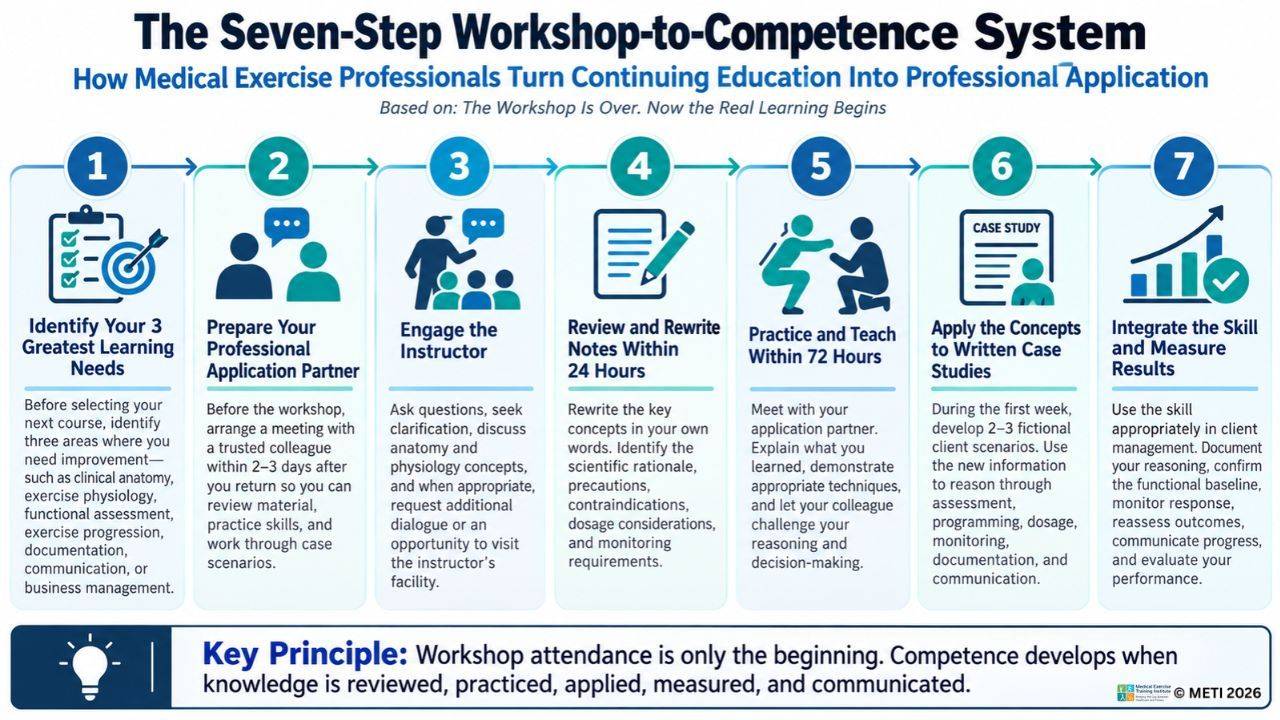
- My Seven-Step System for Turning Workshop Education Into Competence
Let me bring these ideas together into a practical system.
I encourage you to begin using this process with your next continuing education workshop.
Step 1: Identify Your Three Greatest Professional Learning Needs
Before selecting your next course, identify three areas where you need improvement.
These might include clinical anatomy, exercise physiology, functional assessment, exercise progression, documentation, professional communication, or business management.
You don't have to be embarrassed about these deficiencies.
Every professional has areas that need further development.
The important thing is to identify them and create a plan for improvement.
Select workshops based on the capabilities you need to develop, not simply on the credentials you can add after your name.
Step 2: Prepare Your Professional Application Partner Before the Workshop
Let your colleague know what you'll be studying.
Arrange a time to meet within two or three days after your return.
Explain that you want to review the material, practice appropriate exercise applications, and work through several case studies.
Get that meeting on your calendar before you attend the workshop.
Step 3: Engage the Instructor and Seek Opportunities for Additional Learning
Don't simply sit in the back of the room and listen.
Ask questions.
Discuss clinical anatomy and physiological concepts.
Ask how the instructor makes exercise progression decisions.
Request clarification when you don't understand a concept.
And when appropriate, ask whether you can visit the instructor's facility or schedule additional professional dialogue.
Step 4: Review and Rewrite Your Notes Within 24 Hours
As soon as possible after the workshop, review your notes.
Don't simply reread them.
Rewrite the major concepts in your own words.
Identify the scientific rationale behind the techniques.
Make note of the appropriate applications, precautions, contraindications, exercise dosage considerations, and monitoring requirements.
If there's something you cannot explain clearly, identify it as an area for further study.
Step 5: Practice and Teach Within 72 Hours
Meet with your professional application partner.
Explain what you learned.
Demonstrate applicable techniques.
Practice exercise instruction and movement observation.
Ask your partner for feedback.
Then have them challenge you with questions.
Why would you select this exercise?
When would you use it?
What response would you expect?
What would make you modify it?
What circumstances would require referring the client back to a medical professional?
This step helps strengthen both understanding and recall.
Step 6: Apply the Concepts to Written Case Studies During the First Week
Develop two or three fictional client scenarios that reflect the populations you serve.
Use the new information to reason through exercise assessment, program design, dosage, monitoring, documentation, and medical communication.
Identify which concepts are ready for appropriate implementation and which still require practice, clarification, or supervised development.
Step 7: Integrate Competent Skills Into Client Management and Measure the Results
Once you've sufficiently developed the skill and verified that it is appropriate to your scope and the client's needs, integrate it into an established exercise program.
Document your reasoning.
Establish or confirm the relevant functional baseline.
Monitor the client's response.
Reassess using consistent outcome measures.
Communicate meaningful progress to the referring medical professional.
Then evaluate your own performance.
Did you make an appropriate decision?
Was the exercise dosage suitable?
Did the client tolerate the program?
Did functional performance improve?
What would you change next time?
This final step closes the loop between education and professional application.
Without it, workshop attendance remains an educational event.
With it, continuing education becomes part of your professional development system.
- Professional Mastery Requires More Than Confidence
There's one more point I want to make.
Confidence is important.
But confidence by itself doesn't establish professional competence.
You can be extremely confident and still make an inappropriate exercise programming decision.
What I want you to develop is confidence supported by knowledge, preparation, professional reasoning, practical experience, and measurable outcomes.
When a client asks why you're selecting a particular exercise, you should be able to explain your reasoning.
When a referring physician asks what progress the client has made, you should be able to provide objective information.
When a client demonstrates an unexpected response, you should know how to stop or modify the activity and determine whether medical guidance is required.
When an exercise is no longer challenging enough to support the client's functional goals, you should understand the principles involved in progressing the dosage.
And when you're uncertain, you should have sufficient professional judgment to recognize your limitations and seek guidance.
True professional confidence comes from knowing what you're doing, why you're doing it, how you're monitoring it, and when you should change course.
That's the difference between memorizing exercises and becoming a highly proficient medical exercise professional.
Conclusion: Don't Just Attend the Workshop. Become the Professional the Workshop Was Intended to Develop.
Throughout my career, I've had the opportunity to work with and observe outstanding professionals across healthcare, sports medicine, athletics, business, and other fields.
One characteristic I've consistently observed among highly proficient professionals is their commitment to applying, refining, and continually improving their skills.
They don't simply attend a course and move on to the next one.
They study.
They ask questions.
They seek mentors.
They practice.
They review their performance.
They learn from their mistakes.
And they work to understand the underlying principles that make their professional decisions effective.
That's the approach I want you to take as a MedExPRO.
Become a student of clinical anatomy.
Become a student of pathology.
Become a student of physiology and exercise physiology.
Become a student of kinesiology and biomechanics.
Learn to visualize human movement and understand how medical conditions may influence exercise tolerance and functional performance.
Find a professional colleague who will challenge you.
Visit outstanding professionals and facilities whenever the opportunity arises.
Take the information you've learned and apply it first in safe professional practice sessions and fictional case scenarios.
Then, when you are sufficiently prepared, integrate that information into appropriate client exercise programming.
Monitor the responses. Measure the functional outcomes. Document the changes. Communicate the results.
And remember something I've emphasized throughout my years of teaching Medical Exercise Specialists:
The best medical exercise professional isn't necessarily the one who has attended the most workshops or earned the most certifications.
The best medical exercise professional is the one who can consistently take the knowledge they've acquired, apply it safely and appropriately, manage the exercise process, and help clients achieve meaningful functional outcomes.
That is what creates professional credibility.
That is what strengthens relationships with medical professionals.
That is what builds client trust.
And that is what will ultimately elevate the profession of medical exercise training.
Folks, don't just become a collector of professional education.
Become a master of professional application.
That's when your education truly begins to make a difference.
To learn how to integrate your learning into a system to increase your clients and revenue, read: The MedExPRO Operating System: Connecting Practice Management, Client Management, and the 14-Step Guided Workflow.
Dr. Michael Jones, PT, is the founder of the Medical Exercise Training Institute (METI) and co-developer of the Medical Exercise Specialist certification, established in 1994. With more than four decades of experience in physical therapy, rehabilitation, professional education, and practice management, he has helped thousands of professionals worldwide develop their medical exercise knowledge, client management skills, and professional practices.
Get Medical Exercise Training guidelines and updates!
Build your practice with tips learned over 28+ years teaching MedXPROs around the world!!