
Our Words Define Our Scope. Our Outcomes Define Our Value.
Why Medical Exercise Professionals Must Stop Borrowing Healthcare Titles and Start Building Professional Recognition
Folks, we need to have a serious conversation about something that has been bothering me for quite some time.
It involves the words we use to describe ourselves, the services we provide, and the people we serve.
I recently came across another discussion about whether fitness and medical exercise professionals should refer to themselves as therapists, describe their services as therapy, or use terminology traditionally associated with licensed healthcare providers.
This is not a new discussion. In fact, it is one we were having more than three decades ago when we developed the original Medical Exercise Specialist workshop and certification.
I understand why medical exercise professionals want greater recognition. I understand the desire to demonstrate that our knowledge, skills, and services extend far beyond those associated with traditional personal training.
But I want to make something absolutely clear:
We do not become more professional by adopting the titles and terminology of another profession. We become more professional by demonstrating competence, respecting our scope of practice, and producing measurable outcomes for the clients we serve.
That distinction is fundamental to the future of medical exercise training.
Why We Developed the Medical Exercise Specialist in 1994
Let me provide some historical context.
In 1994, I was a physical therapist and owner of physical therapy facilities. We began seeing a disturbing trend.
Many patients were being discharged from physical therapy before achieving their full functional potential.
These individuals no longer necessarily required skilled physical therapy, but many still needed structured, supervised exercise to improve strength, endurance, mobility, stability, and everyday functional capabilities.
There was a gap between the conclusion of medical rehabilitation and the individual's ability to return to the physical demands of daily living.
We developed the Medical Exercise Specialist to help bridge that gap.
But we did not develop another form of physical therapy.
We developed a professional who understood the medical implications of exercise.
The Medical Exercise Specialist needed knowledge of anatomy, pathology, medical precautions, contraindications, exercise progression, functional assessment, and professional communication.
Equally important, the Medical Exercise Specialist needed to know where medical exercise training ended and licensed healthcare services began.
We were intentional about that distinction in 1994.
Thirty-two years later, I believe that distinction is even more important.
The Problem Is Not What We Call Ourselves. It Is What We Represent to the Public.
Over the years, the medical exercise and medical fitness industries have expanded considerably.
We now have numerous certifications, specialty designations, educational programs, and professional titles.
Some have contributed meaningfully to the development of exercise professionals. Others have created confusion about what a certification actually authorizes someone to do.
I have also encountered Medical Exercise Specialists who completed additional certifications and adopted professional titles that raised regulatory concerns.
In some situations, these individuals subsequently faced inquiries or complaints involving state licensing authorities.
The lesson is important.
A professional certification does not grant a healthcare license, expand a legally defined scope of practice, or authorize a professional to provide regulated healthcare services.
It may validate that you completed a particular educational program. It may demonstrate knowledge or competency within defined standards.
But the certificate hanging on your wall does not supersede the laws governing healthcare practice in your state, province, or country.
And changing your terminology does not change what you are legally permitted to do.
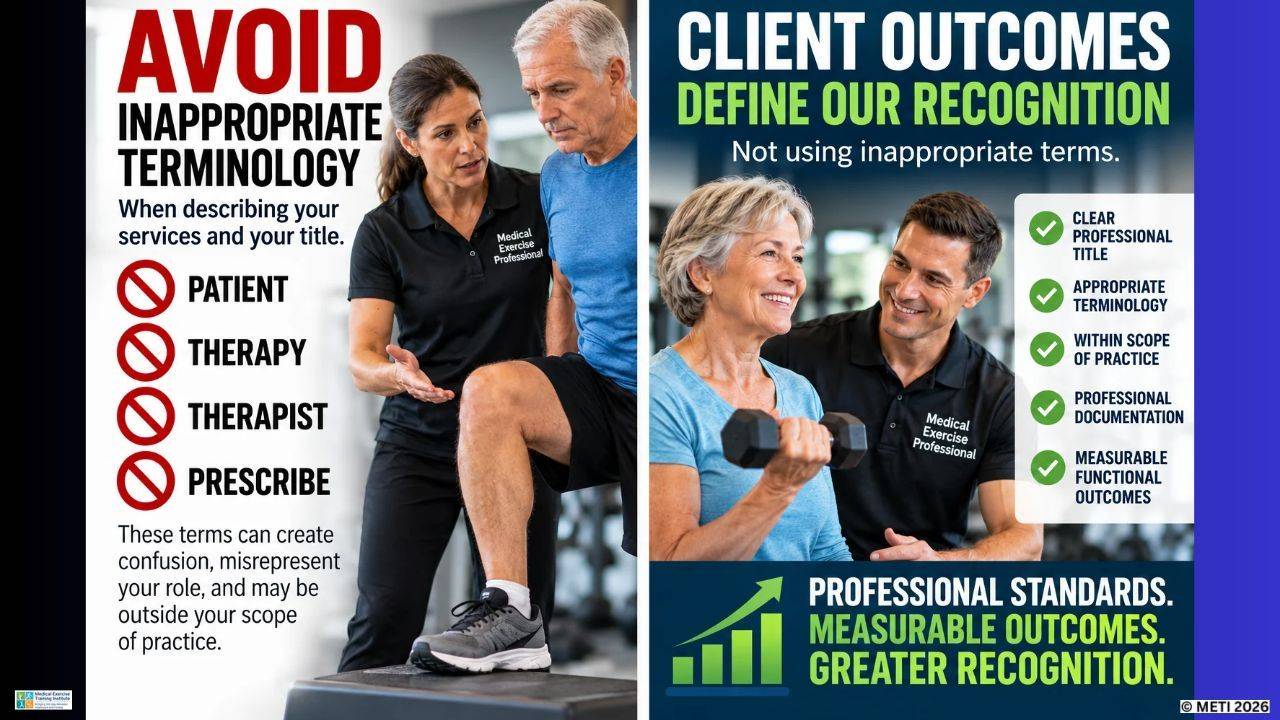
Four Terms Every MedExPRO Should Carefully Reconsider
There are four terms I believe deserve particular attention.
- Patient: You Are Working With a Client
I have consistently encouraged medical exercise professionals to use the word client.
Why?
Because it helps establish the nature of the professional relationship.
A person recovering from total knee replacement may have been a patient of an orthopedic surgeon and physical therapist.
After discharge from skilled rehabilitation, that same individual may become a client of a Medical Exercise Specialist.
The medical history does not disappear. The diagnosis remains relevant. Precautions, limitations, and communication with the referring medical provider remain important.
But the professional relationship is different.
The Medical Exercise Specialist is not independently diagnosing the condition or delivering physical therapy treatment.
The Medical Exercise Specialist is developing and supervising an appropriate exercise program, within their scope and competency, to improve the client's physical and functional capabilities.
Now, using the word patient does not automatically make someone a healthcare provider or constitute a legal violation. The laws and circumstances matter.
Nevertheless, I believe client is the clearer and more appropriate professional term for non-licensed medical exercise and fitness services.
It communicates the distinction we should be trying to preserve.
- Therapy: Do Not Describe Exercise Services as Healthcare Treatment
Here is another term that creates unnecessary confusion.
Therapy.
We hear phrases such as exercise therapy, corrective therapy, rehabilitation therapy, and therapeutic exercise.
Some of those terms are legitimate in particular healthcare, research, and professional contexts.
The problem arises when a non-licensed exercise professional uses them to suggest they are providing regulated healthcare services.
Physical therapy and occupational therapy are legally regulated professions. Their scope includes activities that require specific professional qualifications and licensure.
A Medical Exercise Specialist must not imply that their services constitute physical therapy or occupational therapy unless those services are being lawfully delivered by appropriately authorized personnel.
The actual activities performed matter as much as the terminology used.
We cannot simply replace physical therapy with medical exercise while continuing to deliver services that legally constitute physical therapy.
That is not professional evolution. It is potential scope-of-practice encroachment.
Our role is to use exercise to improve physical capacity and functional performance, not to represent ourselves as providers of licensed rehabilitation treatment.
- Therapist: A Certification Is Not a License
I know there are certification programs that incorporate the term exercise therapist into their professional designations.
Some professionals may use this terminology legally in particular jurisdictions. The word therapist, standing alone, is not universally prohibited.
However, there is an important distinction between what may be legally permissible and what is professionally prudent.
When a client, physician, physical therapist, or other medical professional sees the term therapist, what does that individual reasonably believe?
Do they believe they are dealing with a licensed healthcare professional?
Do they assume that you provide diagnosis or treatment?
Do they interpret your title as authorization to deliver clinical rehabilitation?
If your professional title creates that impression and you do not possess the appropriate license, you may be creating problems for yourself and your practice.
My recommendation is straightforward.
Use a professional designation that accurately describes your training and credentials without implying healthcare licensure.
Medical Exercise Specialist, Medical Exercise Professional, Medical Fitness Professional, and appropriately described Post-Rehab Specialist are examples of terminology that may better communicate an exercise-focused role.
But remember: no title is automatically acceptable everywhere. Verify applicable regulations, and describe your actual services accurately.
Our credentials should clarify our professional identity, not create confusion about it.
- Prescribe: Why I Prefer a Plan of Exercise
This fourth term has generated discussion for decades.
Exercise prescription is a well-established scientific term. Exercise physiologists, researchers, universities, and professional organizations routinely use it when discussing the selection of exercise intensity, frequency, duration, mode, and progression.
I recognize and respect that terminology.
However, when communicating with physicians, rehabilitation providers, and clients, I prefer the phrase Plan of Exercise.
Why?
Because it communicates what the MedExPRO has developed without unnecessarily suggesting that the professional is issuing a medical prescription.
When a physician develops a plan of treatment, the healthcare provider is responsible for medical management within their professional authority.
When a MedExPRO develops a Plan of Exercise, the document describes the client's exercise goals, selected exercises, frequency, intensity, progression, monitoring, and functional objectives.
The distinction is easy to understand.
Using Plan of Exercise does not mean exercise prescription is universally illegal. It means we have deliberately chosen terminology that helps clarify our professional role.
I believe that is a worthwhile standard for our profession.
Our Scope of Practice Should Be a Professional Strength, Not a Limitation
Some professionals view scope-of-practice boundaries as restrictions on their potential.
I view them differently.
Clearly defining what we do and what we do not do is part of building a legitimate profession.
The Medical Exercise Specialist should be competent to evaluate exercise readiness within appropriate limits, identify relevant precautions, perform suitable functional assessments, implement individualized exercise programs, monitor the client's response, and communicate meaningful findings.
The MedExPRO should also recognize changes that require referral back to a qualified medical provider.
That may include unexpected deterioration in function, concerning symptoms, new neurological findings, or other indicators that continued exercise requires medical review.
We should not independently diagnose conditions, replace medically necessary rehabilitation, or provide regulated healthcare treatment outside our professional authority.
Nor should we assume that discharge from physical therapy automatically makes every subsequent exercise activity appropriate for us to provide.
Our services must remain within our professional competency, applicable law, and the client's medical precautions.
The more clearly we establish these boundaries, the easier it becomes for medical providers to understand when, why, and how to refer appropriate individuals to us.
Stop Trying to Look Like Healthcare Providers. Start Demonstrating Your Value to Healthcare.
This is where I believe our profession needs to change its focus.
For too long, we have concentrated on professional titles, additional certifications, and increasingly complicated descriptions of the services we provide.
Meanwhile, we have paid insufficient attention to the very activities that demonstrate our value to medical professionals.
Documentation. Communication. Functional outcomes.
Let me give you an example.
A client completes physical therapy following total knee replacement.
The client has been medically cleared for an appropriate exercise program but continues to experience difficulty with stairs, prolonged walking, rising from lower chairs, and performing everyday household activities.
A traditional training record might state:
Leg press: 3 sets of 12 repetitions.
Step-ups: 3 sets of 10 repetitions.
Stationary bicycle: 15 minutes.
That information is useful for recording exercise participation and progression.
But is that enough information to communicate meaningful functional improvement to the referring orthopedic surgeon?
I would argue that it is not.
Now consider a Medical Exercise Specialist who documents the client's initial ability to rise from a chair, negotiate stairs, tolerate walking, and complete specific activities of daily living.
At the next reassessment, the MedExPRO repeats standardized functional outcome measures and documents improvements in the client's performance.
The report describes changes in functional capacity, exercise tolerance, relevant precautions, and the next phase of the exercise plan.
That information gives the physician a clearer understanding of what the client has accomplished.
The difference is not the professional title.
The difference is the professional process.
Functional Outcomes Are the Language That Healthcare Understands
I believe this represents one of the greatest opportunities for the medical exercise profession.
Healthcare providers are interested in what their patients can do, what limitations remain, and whether appropriate interventions and support are improving meaningful outcomes.
Our documentation should speak that language.
Not simply how much weight a client can lift, but whether that strength translates into better daily performance.
Not simply how many minutes the client can walk on a treadmill, but whether the client can complete community mobility activities with improved endurance.
Not simply an improvement in joint mobility, but whether that improvement helps the client perform dressing, transfers, stair negotiation, household activities, or other important functional tasks.
This is why our professional assessments should increasingly connect exercise capacity with Activities of Daily Living (ADLs), instrumental activities of daily living, and other meaningful functional demands.
We are not performing an occupational therapy evaluation or independently determining medical impairment.
We are documenting the functional activities relevant to the client's exercise goals, within our scope of practice, using appropriate and repeatable measures.
That is how we begin to demonstrate the practical value of medical exercise training.
Certification Is the Beginning. Professional Competence Must Follow.
This brings me to another concern.
We have developed an industry in which some individuals believe the answer to professional growth is simply another certification.
Another course.
Another set of initials.
Another designation on a business card.
Education is important. Continuing professional development is essential.
But collecting certifications is not the same as developing professional competence or building a sustainable practice.
A medical exercise professional must understand how to manage more than an exercise session.
They need systems for assessment, exercise planning, client management, documentation, medical-provider communication, scheduling, billing, marketing, and professional operations.
They need to know how to establish referral relationships, maintain appropriate records, document functional outcomes, and operate ethically.
They must become proficient in the business and professional processes that help the medical community understand, trust, and use their services.
That is why we emphasized developing the MedExPRO Operating System, which integrates our Client Management, Practice Management, and Enterprise Frameworks.
It is not enough to know which exercise to perform.
You must understand how the exercise fits into an appropriate program, how the client's response will be monitored, how progress will be documented, and how meaningful findings will be communicated.
That is professional practice.
The Future of Medical Exercise Training Will Be Built on Standards, Not Titles
I have spent more than three decades promoting the professional development of medical exercise training.
I want this field to gain greater recognition.
I want physicians, physical therapists, occupational therapists, nurses, case managers, and other healthcare professionals to understand the value of appropriately trained MedExPROs.
And I want medical exercise professionals to build sustainable businesses that help clients continue improving their functional capabilities after skilled medical rehabilitation is no longer indicated.
But we will not accomplish these objectives simply by calling ourselves therapists.
We will not accomplish them by referring to every client as a patient.
And we will not accomplish them by presenting routine exercise programming as medical treatment.
We accomplish them by doing the work necessary to establish a credible profession.
That means respecting the law.
It means understanding our scope.
It means maintaining appropriate relationships with medical providers.
It means documenting and communicating measurable functional outcomes.
And it means developing the systems and professional standards necessary to deliver our services consistently.
My Challenge to Every MedExPRO
Take a serious look at your practice.
Review your professional title, website, business cards, intake forms, assessment documents, marketing materials, and client communications.
Ask yourself whether those materials accurately communicate your credentials, your scope of practice, and the services you provide.
Then examine your professional documentation.
Can a physician reviewing your progress report understand what the client has accomplished?
Can the client recognize meaningful improvement in everyday function?
Can a medical provider understand what exercise services were actually provided, without confusing them with licensed healthcare treatment?
And can you demonstrate that your practice operates using consistent professional standards rather than simply a collection of exercise routines?
If the answer is no, you have identified an important opportunity for professional growth.
Folks, we do not need to become physical therapists, occupational therapists, or physicians to justify our place in the continuum of care and wellness.
We need to become better medical exercise professionals.
We have a distinct and valuable role.
Now we must demonstrate that value.
Our words define our scope. Our outcomes define our value. Our documentation and communication demonstrate our professionalism.
That is how we earn recognition.
And that is how we build the future of medical exercise training.
By Dr. Michael Jones, PT
Founder, Medical Exercise Training Institute
Founder and Developer of the Medical Exercise Specialist — 1994
Get Medical Exercise Training guidelines and updates!
Build your practice with tips learned over 28+ years teaching MedXPROs around the world!!