
The MedExPRO Periodic Table - The Elements of a Successful Practice
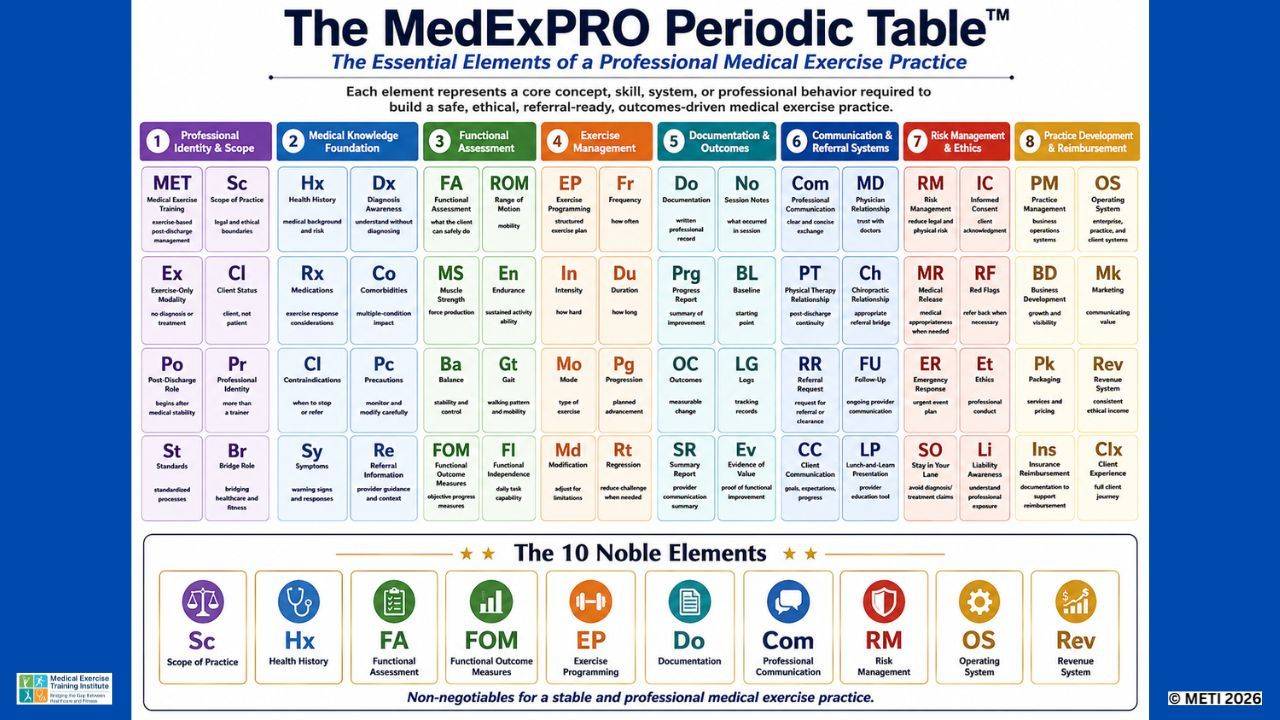
The MedExPRO Periodic Table™: The Essential Elements of a Professional Medical Exercise Practice
The fitness industry has spent decades attempting to step closer to healthcare. Personal trainers and fitness instructors routinely employ terms like "corrective exercise," "post-rehab," "medical fitness," "functional training," and "therapeutic exercise." While some of these concepts possess inherent value, their loose application often generates more confusion than clarity. If we expect physicians, physical therapists, chiropractors, senior living administrators, and insurance carriers to take our work seriously, Medical Exercise Training (MET) must be fundamentally different. We must define our role, establish clear professional boundaries, and show how assessment, programming, documentation, and business operations work together in a structured, repeatable system.
For the Medical Exercise Professional (MedExPRO) working with clients with medical conditions, professionalism is not built on exercise selection alone. A list of exercises does not make a profession, nor does a social media post establish credibility with a physician. True professional credibility requires a shift from "What exercise should I give this person?" to a comprehensive understanding of client pathology, movement mechanics, and functional baselines.
To bridge this gap and standardize the transition from clinical rehabilitation to post-discharge physical activity, the Medical Exercise Training Institute (METI) has developed the MedExPRO Periodic Table™. This framework serves as a professional standards map, organizing the essential "building blocks" of a referral-ready, outcome-driven practice.
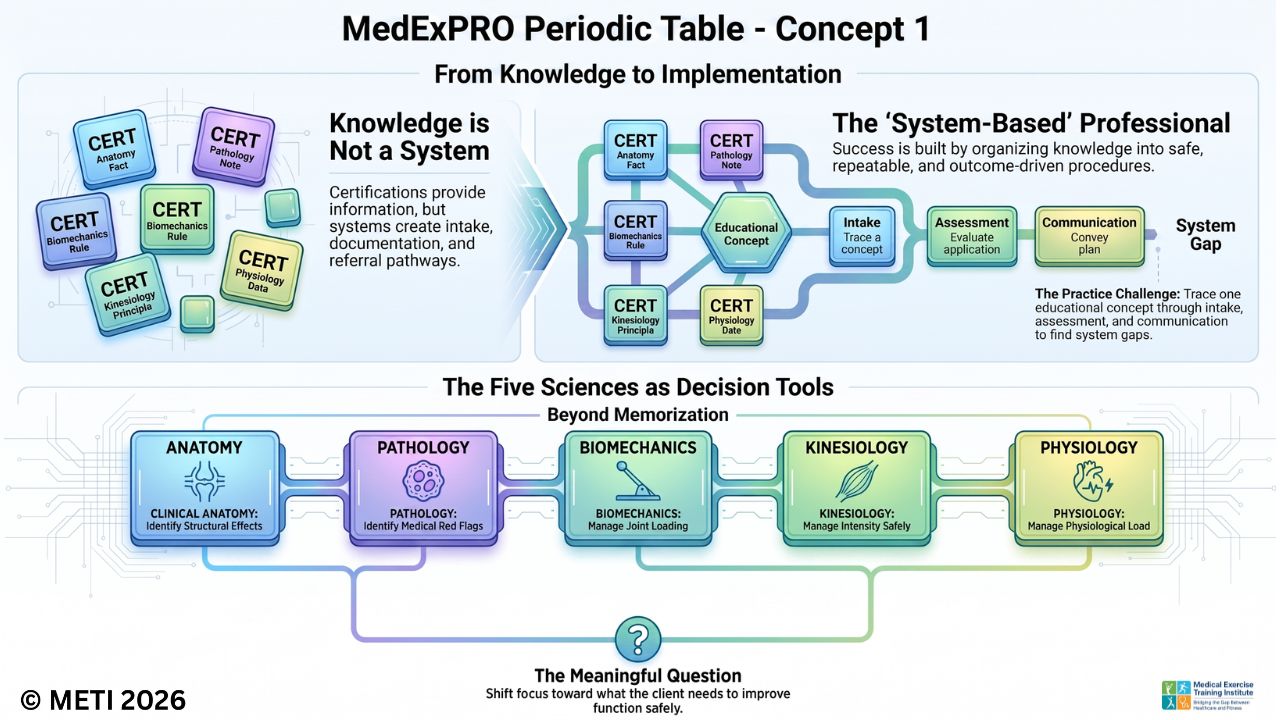
1. The Foundation: The Five Medical Exercise Sciences
While the MedExPRO Periodic Table™ organizes the structural elements of a practice, the five medical exercise sciences provide the deep knowledge foundation that informs professional decision-making. Mastering these sciences allows the MedExPRO to apply the periodic elements safely, ethically, and with sound professional judgment rather than relying on rote protocols or chasing endless certifications.
- Clinical Anatomy: Underpins the structure of movement. Rather than studying anatomy merely to memorize muscle names, the MedExPRO studies clinical anatomy to understand how musculoskeletal structure influences movement limitations, structural compensations, and overall functional capacity.
- Clinical Pathology: Teaches the MedExPRO to understand medical conditions, medications, precautions, contraindications, and comorbidity interactions. This knowledge does not enable the MedExPRO to diagnose or treat disease, but rather to respect safety boundaries and identify critical red flags.
- Exercise Physiology: Provides an understanding of how clients with chronic conditions adapt and respond to physical stress. Managing intensity, fatigue, cardiovascular responses, and metabolic recovery is critical before exposing a medically complex client to exercise.
- Biomechanics: Analyzes movement forces, joint loading, structural alignment, and mechanical stress. This is essential when customizing programming for clients recovering from joint replacements, chronic arthritis, spine conditions, or neurological disorders.
- Kinesiology: Bridges anatomy, biomechanics, and function. Kinesiology enables the MedExPRO to observe gait, squats, stair climbing, and daily lifting with a highly trained, functional eye.
Mastering these five sciences changes the practitioner's internal dialogue from "What certification should I take next?" to "Which science do I need to understand more deeply to improve this client's functional outcome?".
2. The Professional Map: The 8 Families of Medical Exercise Training
The traditional periodic table organizes the basic elements of matter; the MedExPRO Periodic Table™ organizes the basic building blocks of a professional practice. Each of the eighty-one elements represents a core competency, responsibility, or operational system. These elements are organized into eight distinct families:
Family 1: Professional Identity & Scope (MET, Sc, Ex, Cl, Po, Pr, St, Br)
This family defines who the MedExPRO is and where they fit in the healthcare continuum. It establishes that the MedExPRO operates as a Bridge Role (Br) utilizing an Exercise-Only Modality (Ex), managing Clients (Cl) rather than patients, specifically in a Post-Discharge Role (Po). Adhering to standard Scope of Practice (Sc) parameters prevents crossing into diagnosis or therapy.
Family 2: Medical Knowledge Foundation (Hx, Dx, Rx, Co, CI, Pc, Sy, Re)
Provides the clinical understanding required to work safely. It focuses on gathering a complete Health History (Hx), maintaining Diagnosis Awareness (Dx), understanding Medications (Rx) and Comorbidities (Co), and recognizing Contraindications (CI) and Precautions (Pc) to guide exercise modification.
Family 3: Functional Assessment (FA, ROM, MS, En, Ba, Gt, FOM, FI)
Moves the practitioner away from guessing and toward objective measurement. The MedExPRO evaluates Range of Motion (ROM), Muscle Strength (MS), Endurance (En), Balance (Ba), and Gait (Gt) to determine a client's level of Functional Independence (FI) and establish objective Functional Outcome Measures (FOM).
Family 4: Exercise Management (EP, Fr, In, Du, Mo, Pg, Md, Rt)
Covers the precise design and adaptation of exercise. Programs are structured around appropriate Frequency (Fr), Intensity (In), Duration (Du), and Mode (Mo), utilizing standardized criteria for safe Progression (Pg), Modification (Md), and Regression (Rt).
Family 5: Documentation & Outcomes (Do, No, Prg, BL, OC, LG, SR, Ev)
Provides professional proof of value. MedExPROs must establish a functional Baseline (BL), maintain clinical Session Notes (No), write comprehensive Progress Reports (Prg), and generate Summary Reports (SR) that compile Evidence of Value (Ev).
Family 6: Communication & Referral Systems (Com, MD, PT, Ch, RR, FU, CC, LP)
Standardizes relationships with the medical community. This family details professional communication pathways with Physicians (MD), Physical Therapists (PT), and Chiropractors (Ch) via formal Referral Requests (RR) and structured Follow-Up (FU) protocols.
Family 7: Risk Management & Ethics (RM, IC, MR, RF, ER, Et, SO, Li)
Protects the client, the professional, and the industry. It demands rigorous adherence to Informed Consent (IC), Medical Releases (MR), Liability Awareness (Li), and the recognition of Red Flags (RF) that require immediate referral back to a medical provider.
Family 8: Practice Development & Reimbursement (PM, OS, BD, Mk, Pk, Rev, Ins, CIx)
Supports professional clinical skill with a sustainable, ethical business architecture. It outlines how a MedExPRO manages their Operating System (OS), designs service Packaging (Pk), maintains a reliable Revenue System (Rev), and prepares for Insurance Reimbursement (Ins).
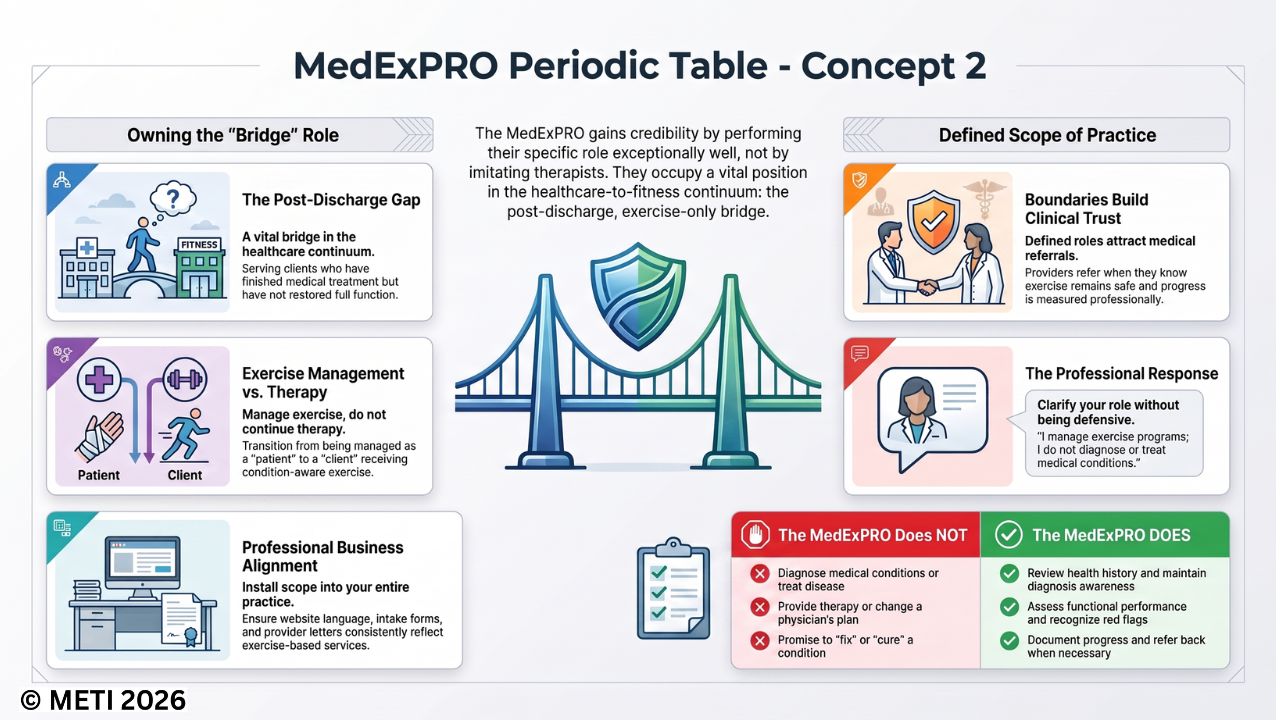
3. From Elements to Systems: The 10 "Noble Elements"
In chemistry, elements combine to form stable compounds. In Medical Exercise Training, individual practice elements must be integrated into repeatable, documented practice systems.
For example, a MedExPRO cannot simply understand "scope of practice" conceptually; they must install it into written intake documents, marketing copy, and physician correspondence. To ensure clinical safety and business viability, the MedExPRO must master the 10 "Noble Elements"—the non-negotiable pillars of a stable practice:
- Scope of Practice (Sc): Establishes clear boundaries and prevents crossing into diagnosis or therapy.
- Health History (Hx): Gathers vital background data to determine cardiovascular and metabolic exercise risk.
- Functional Assessment (FA): Establishes an objective functional baseline, moving the practice beyond guessing.
- Functional Outcome Measures (FOM): Provides measurable, scientific proof of movement improvements.
- Exercise Programming (EP): Translates clinical assessment findings into a structured, condition-aware exercise plan.
- Documentation (Do): Protects the practitioner legally and tracks client progress systematically.
- Communication (Com): Builds clinical trust and professional credibility with the healthcare team.
- Risk Management (RM): Implements protocols to minimize client injury and professional liability.
- Operating System (OS): Standardizes the entire client journey into a repeatable, step-by-step business workflow.
- Revenue System (Rev): Ensures a consistent, ethical income model that keeps the practice sustainable.
When these noble elements are synthesized, they generate highly effective systems:
- Hx + Pathology + Medications + Red Flags >>>>>>Client Safety Screening System.
- FA + Baseline + FOM + Progress Reports>>>>>>>Outcomes Documentation System.
- EP + Exercise Physiology + Mode + Progression>>>>>>>Safe Exercise Management System.
- Com + Referral Requests + Follow-Up + Summary Reports >>>>>>>Referral Relationship System.
4. Announcing: Beyond Fitness – The MedExPROs Pathway to the Future
The days of operating in isolation as "just a trainer" are coming to an end. The integration of medical fitness into mainstream healthcare is accelerating, and the future belongs to those who can speak the clinical language of medicine while delivering the functional results of exercise.
To guide you through this professional evolution, we are proud to announce the launch of Beyond Fitness — The MedExPROs Pathway to the Future of Medical Exercise Training.
This landmark publication is your complete operational blueprint. Your success in the future will not depend on your ability to memorize a new workout trend or collect another weekend certificate. It will depend entirely on your capacity to master the essential elements of the MedExPRO Periodic Table™, utilize them to manage clients safely, build robust referral relationships with medical providers, and scale an ethical, profitable practice. Beyond Fitness provides the step-by-step pathway to transition from a certification collector to a highly respected, systemized medical exercise practice owner.
3 Major Takeaways for the MedExPRO
- Sciences and Systems Over Certifications: Credibility with physicians and client safety cannot be bought through a collection of random weekend certificates. It must be earned through deep mastery of the five medical exercise sciences and the consistent execution of standardized practice systems.
- Every Element Must Become a System: Knowing the elements is only the starting point. To build a credible practice, you must convert concepts like scope, documentation, and assessment into written forms, scripts, templates, and repeatable workflows.
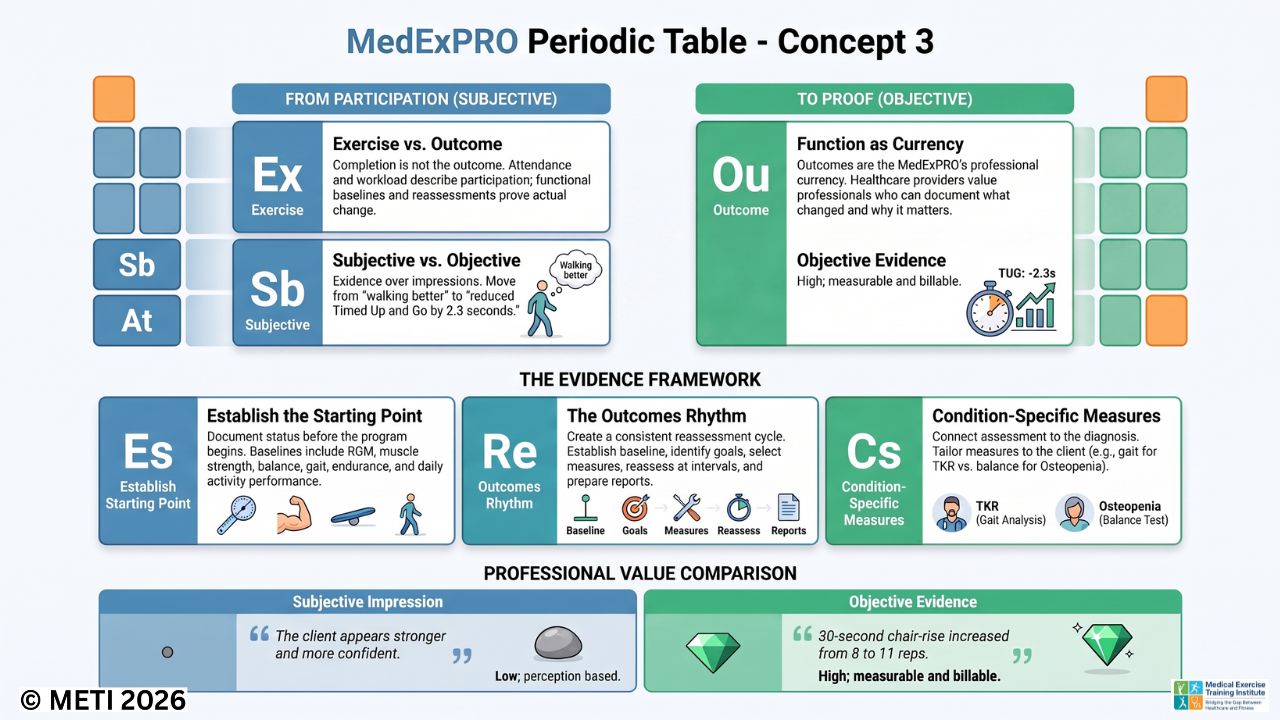
- Outcomes are Your Currency: Healthcare providers do not refer to trainers because of their personality or workout style. They refer because of objective, documented outcomes. Measurable functional improvement is your evidence of value and the foundation of referral trust.
3 Actionable Next Steps
- Conduct a Practice Readiness Self-Audit: Download the MedExPRO Periodic Table Checklist™ and grade your practice on a 1–5 scale across all eighty-one elements to locate critical gaps in your documentation, scope language, and assessment protocols.
- Systematize Three Gaps in 30 Days: Identify your three lowest-scoring elements from the 10 "Noble Elements". Over the next 30 days, develop one clear form, checklist, script, or procedure for each to build a more stable professional foundation.
- Secure Your Blueprint for Practice Growth: Bridge the gap between theory and clinical business success by acquiring your copy of Beyond Fitness today. Use it as your daily implementation manual to transition your business into a referral-ready, sustainable medical exercise practice.
Click Here for MedExPRO Periodic Table Checklist to Review Your Practice

Click the Image Above to Purchase Your Copy of Beyond Fitness
Get Medical Exercise Training guidelines and updates!
Build your practice with tips learned over 28+ years teaching MedXPROs around the world!!