
5 Major Future Opportunities for MedExPROs — Are You Overlooking Them?
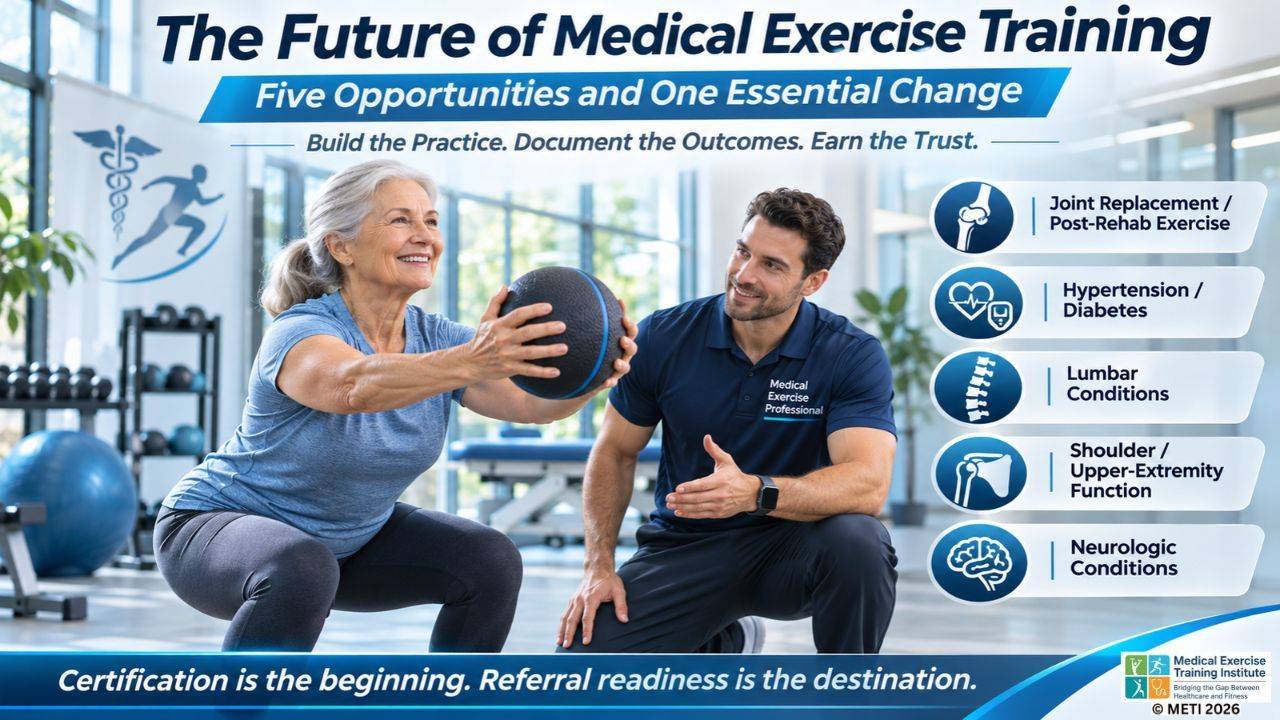
Five opportunities could shape your future. Discover why building a professional practice—not just delivering exercise sessions—is the key.
When we introduced the Medical Exercise Specialist (MES) certification in July 1994, we were responding to a problem we could see firsthand as physical therapists.
Patients recovering from total joint replacements, spinal surgery, strokes, and neurological conditions were often reaching the end of authorized physical therapy before achieving their desired functional capabilities. They still needed structured exercise to improve strength, mobility, endurance, and confidence in everyday activities.
Who would help them after discharge?
We believed properly educated exercise professionals could bridge that gap without practicing physical therapy or other licensed healthcare services. That conviction helped establish Medical Exercise Training (MET).
Now, as we approach 2027, the original opportunity remains—and the aging population and prevalence of chronic conditions make continued functional exercise increasingly important.
But opportunity does not automatically produce a successful practice.
What Medical Exercise Training Is—and Is Not
MET is the development and delivery of safe, structured exercise for appropriate clients with medical histories who have completed rehabilitation or received medical clearance.
The MedExPRO reviews available provider guidance, assesses exercise-related functional limitations, develops a Plan of Exercise, monitors the client's response, reassesses relevant measures, documents progress, and communicates appropriately with medical providers.
We do not diagnose diseases, provide medical treatment, or extend licensed therapy under another name. Our focus is exercise and functional capability.
That distinction is essential to professional credibility.
Five Opportunities for MedExPROs
I see five particularly promising service areas for qualified professionals.
- Total joint replacements. Following hip, knee, or shoulder replacement and discharge from rehabilitation, some clients still struggle with walking endurance, stair negotiation, reaching, or other everyday activities. Appropriate continuing exercise may help improve the physical capacity needed for those tasks.
- Hypertension and diabetes. These common chronic conditions frequently call for sustained physical activity. With appropriate medical guidance, MedExPROs can deliver individualized exercise while physicians manage medical care and registered dietitians address nutrition. The opportunity is long-term exercise participation—not medical management of blood pressure or glucose.
- Lumbar conditions. Clients with medically evaluated lumbar disorders, including some who have completed rehabilitation after surgery, may require continued exercise to improve functional strength, mobility, and activity tolerance. Programming must respect current precautions and distinguish exercise conditioning from treatment of spinal pathology.
- Shoulder and upper-extremity disorders. For older adults especially, reaching, carrying, dressing, and managing household tasks are central to independence. After appropriate discharge or clearance, structured exercise may address relevant strength, endurance, and movement-capacity limitations.
- Neurological conditions. Some clients living with Parkinson's disease, multiple sclerosis, or the effects of stroke may benefit from ongoing exercise focused on appropriate mobility, strength, endurance, and participation goals. These clients require additional competence, close attention to precautions, and clear referral-back procedures. Exercise does not replace neurological rehabilitation.
Across all five populations, one principle remains constant: we should connect exercise selections to meaningful functional goals and measure what changes.
Stop Building Only a Training Business. Build a Practice.
Here is where many talented MedExPROs fall short.
They complete a certification, attract clients, schedule sessions, collect fees, and repeat the process. Their exercise knowledge may be excellent, but their operations look little different from a conventional personal training business.
A professional Medical Exercise Training practice needs more.
It needs consistent intake and exercise-readiness procedures; functional assessment and planning; session monitoring; periodic reassessment; clear documentation; authorized provider communication; and reliable scheduling, billing, and follow-up.
A physician or physical therapist considering a referral should be able to understand exactly how the client will enter the practice, how exercise will be managed, and what information the provider can expect to receive.
That predictability helps build professional trust. Trust creates the conditions for sustainable referral relationships.
Document Function, Not Just Attendance
Imagine telling a physician, "Your former patient has been exercising twice weekly."
Now compare that with an accurate report describing the client's initial sit-to-stand performance, current walking tolerance, exercise response, remaining limitations, and next functional goal.
The second communication demonstrates a professional process.
MedExPROs should maintain meaningful MET Session Logs, use consistent functional outcome measures, prepare progress reports, and document when concerns warrant medical referral.
Accurate records also support business oversight. Where a client's insurance plan permits consideration of reimbursement, documentation may support an inquiry or submission—but a referral or report never guarantees coverage or payment. A cash-first model can protect the practice from relying on unverified reimbursement.
The Future Belongs to Systems-Driven MedExPROs
As we move into the 2030s and 2040s, I expect digital tools, outcome dashboards, and AI-assisted workflows to make organized practice management increasingly practical. METI's MES AI and MedExPRO Wiki are being developed to help professionals apply structured methods—not replace their judgment.
Technology cannot make an unprepared professional competent. It can help a prepared professional work more consistently.
The essential investment is an operating system that connects METI's Client Management, Practice Management, and Enterprise Frameworks. Such a system makes it possible to improve service consistency, build referrals, and consider expansion without depending on the owner's memory for every task.
Your Next Step: Build the Practice
On November 14–15, 2026, I'll present The MedExPRO Business Practice Blueprint in Houston and live via Zoom. We'll address the operating system, documentation and communication, medical referral development, and reimbursement readiness. The objective is a practical roadmap for implementation, not merely another certificate of attendance.
Learn more: www.MedExPROBlueprint.com
My book, Beyond Fitness: The MedExPRO Pathway to the Future of Medical Exercise Training, provides the companion framework and practice-readiness checklists.
Explore the book: www.BeyondFitnessBook.com
The opportunity that inspired MES in 1994 still lies ahead. Our responsibility is to meet it with competence, scope clarity, reliable systems, and measurable outcomes.
Certification is the beginning. Referral readiness is the destination.
Build the Practice. Document the Outcomes. Earn the Trust.
Get Medical Exercise Training guidelines and updates!
Build your practice with tips learned over 28+ years teaching MedXPROs around the world!!