
Medical Exercise Assessment - Step 3 Functional Interview

The Functional Interview — Understanding the Client’s Real Goals
A structured conversation is a critical part of the assessment process.
Medical Exercise Training is not about isolated muscle strength.
It is about improving the client’s ability to live independently.
The functional interview helps identify:
- activities the client struggles with
• activities the client has stopped doing
• activities the client hopes to regain
For example, a client may say:
“I want to be able to walk to the mailbox.”
Or
“I want to be able to play with my grandchildren.”
These statements reveal meaningful functional goals.
Once those goals are identified, the exercise program can be designed to support them.
Medical Exercise Assessment - Step 2 Observation

Step 2: The Power of Observation in Medical Exercise Assessments

One of the most valuable tools a Medical Exercise Professional possesses is simple observation.
The moment the client begins moving, the assessment has already started.
Observation allows the MedExPRO to evaluate:
- posture
- walking patterns
- balance control
- coordination
- movement hesitation
Often, subtle movement patterns reveal important functional limitations.
For example, a client may walk well in a straight line but struggle when turning or navigating obstacles.
These movement patterns provide important clues about balance, coordination, and neurological control.
Observation allows the professional to see how the body functions in real-world movement situations.
And real-world movement is what Medical Exercise Training is designed to improve.

Stop Chasing Claims: A Better Insurance Reimbursement Model for MedExPROs
Click the Arrow Above to Watch the Video
Get Paid Now. Submit Later. The Cash First Reimbursement Model for MedExPROs
For Medical Exercise Professionals (MedExPROs), navigating the healthcare system can feel like learning a foreign language. However, as the industry enters the "Golden Era" of Medical Exercise Training (MET), mastering the insurance reimbursement process is no longer just an option—it is a critical competitive advantage.
One of the most effective ways to operate a profitable practice while ensuring clients can afford long-term care is the Cash-First Reimbursement Model. In this model, the client pays you directly at the time of service, and you provide them with the clinical documentation they need to independently seek out-of-network reimbursement from their insurance carrier.
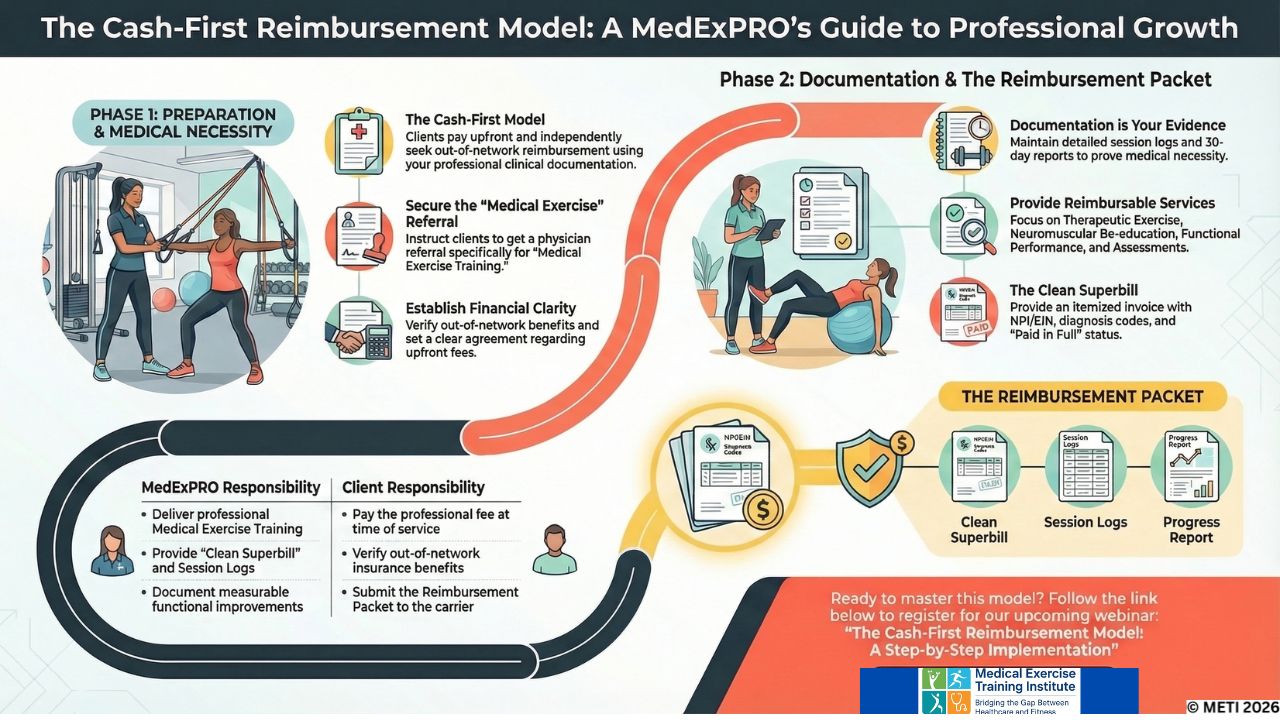
Here is how you can implement this model to create a win-win scenario for your practice and your clients.
Phase 1: Establish Medical Necessity and Financial Clarity An insurance carrier wi...
Medical Exercise Assessment - Step 1 Preparation
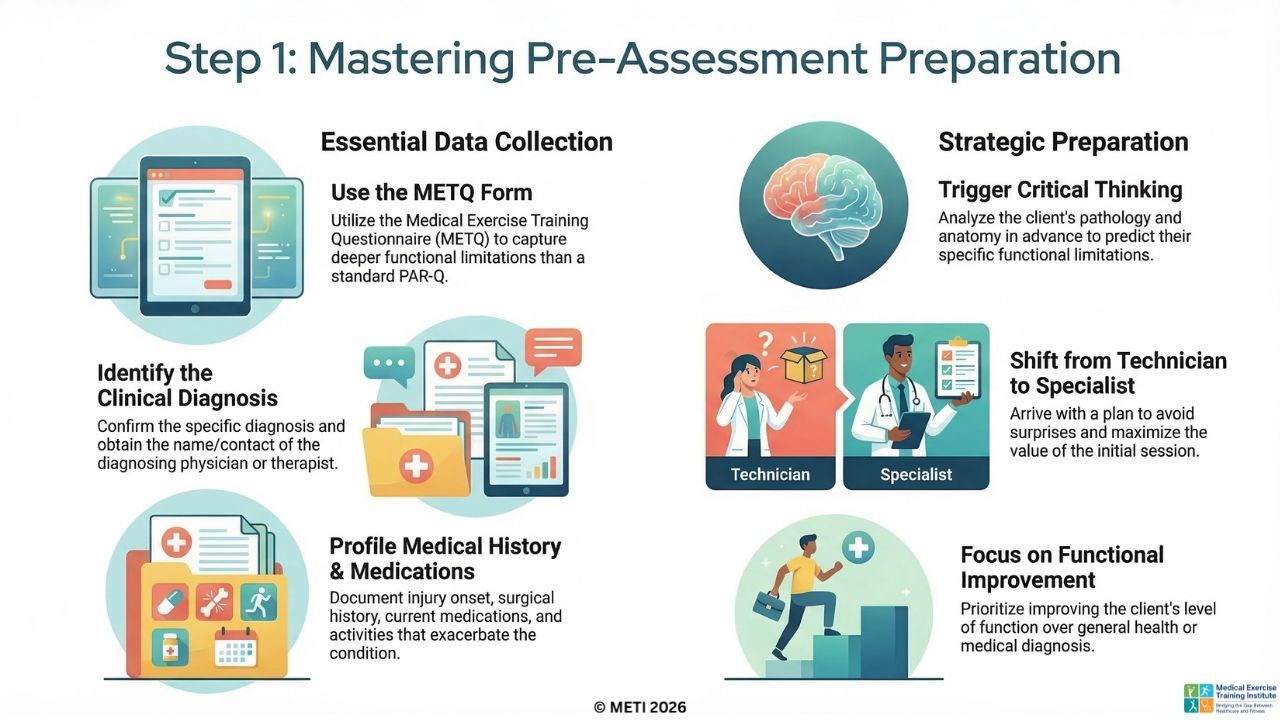
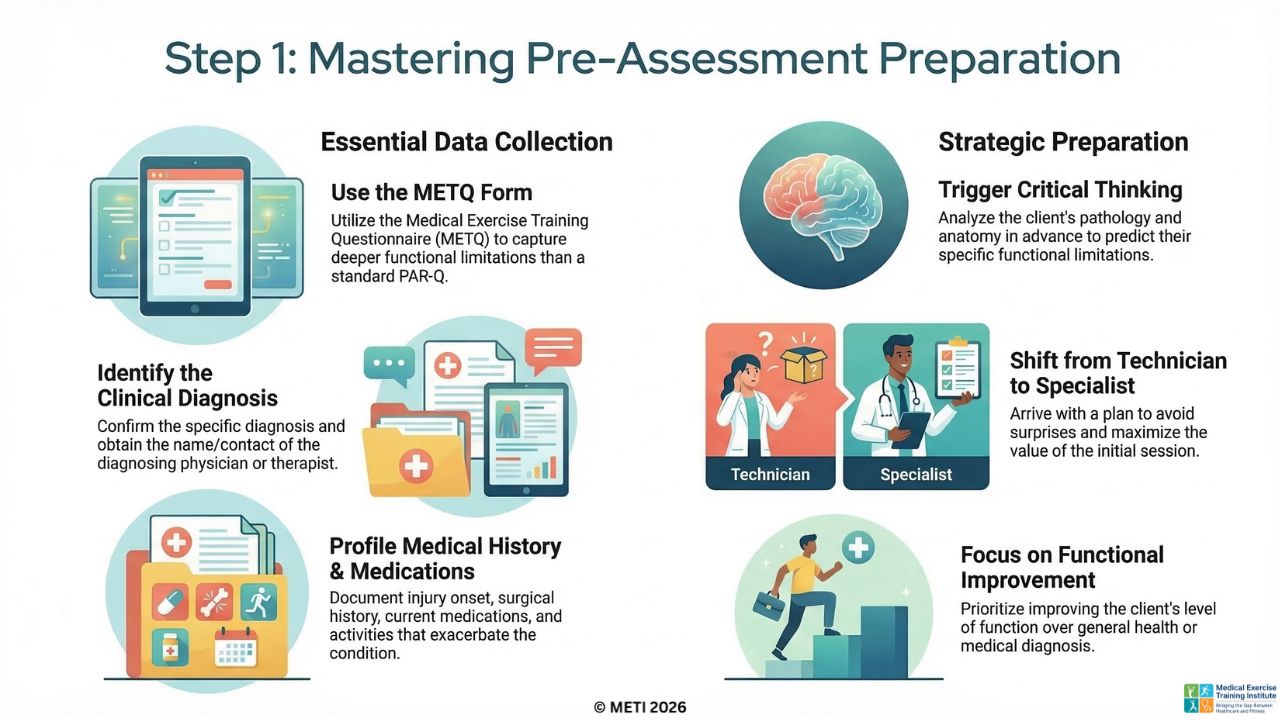
Step 1: Why Preparation Is the First Step of a Medical Exercise Assessment
Most exercise professionals begin their assessment when the client walks through the door.
But the best Medical Exercise Professionals begin much earlier.
Preparation is the first step in a professional assessment process.
Before the client ever arrives, the MedExPRO should review the client’s medical background and understand the pathology associated with their condition.
This preparation includes reviewing:
- medical diagnosis
• surgical history
• medications
• contraindicated activities
• expected functional limitations
Understanding the pathology allows the MedExPRO to anticipate what functional challenges may be present.
For example, a client with Parkinson’s disease may experience:
- reduced stride length
• balance instability
• difficulty initiating movement
By preparing ahead of time, the professional can design an assessment that focuses on the most meaningful functional indicators.
Wit...
The 7 Steps of a Medical Exercise Assessment
Download the Podcast Here
The Professional Framework That Separates MedExPROs From Personal Trainers
Most exercise professionals believe they perform assessments.
But the reality is this:
Most “assessments” in the fitness industry are simply movement warm-ups disguised as evaluation.
A true Medical Exercise Assessment is something very different.
It is a structured process designed to:
- Identify functional deficits
• Establish objective baselines
• Guide exercise prescription
• Communicate with medical providers
• Track functional improvement over time
Without a structured assessment process, exercise becomes guesswork.
And guesswork is the fastest way to lose credibility with physicians, physical therapists, and insurance carriers.
If Medical Exercise Professionals want to be recognized as part of the continuum of movement care, we must operate with the same level of structured evaluation used in healthcare.
Over the past three decades, I’ve refined what I call the Seven...
Stop Guessing, Start Tracking: Systematizing Assessments for Medical Exercise Referrals
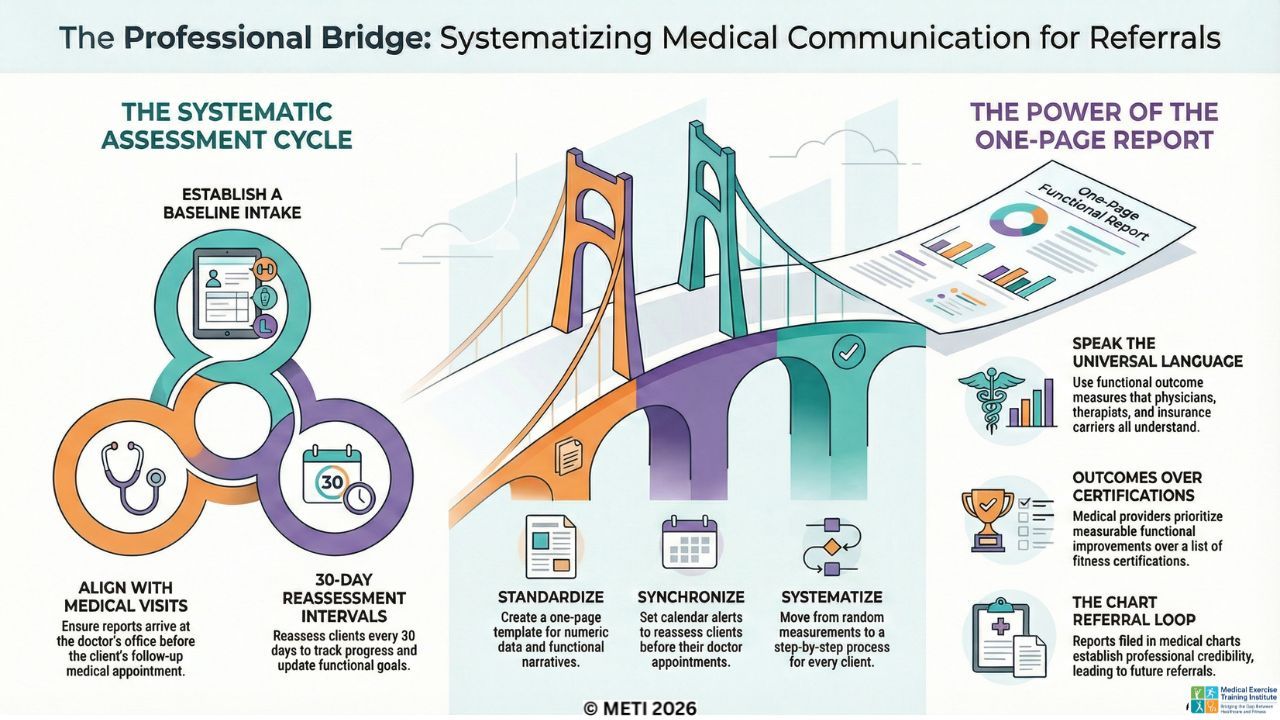
If you want to build a thriving medical exercise practice, you might think the secret lies in collecting more fitness certifications to impress local doctors. But here is the hard truth: most medical professionals do not know what your certifications mean, and honestly, they do not care.
What doctors, therapists, and chiropractors actually care about are positive functional outcomes. They want to know that if they send a patient to you, that patient will safely improve. To prove this, you must stop guessing and start tracking by systematizing your assessment and communication processes.
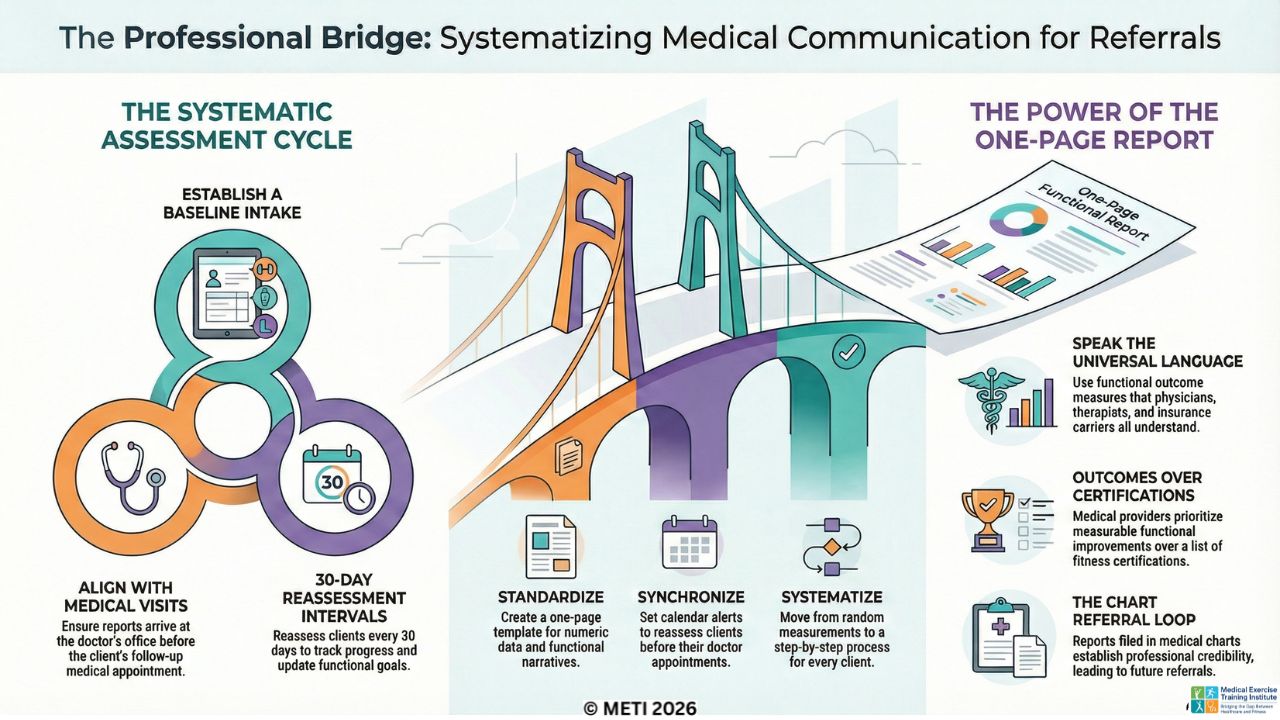
The Power of the One-Page Progress Report Dr. Michael Jones frequently shares a story from his time owning physical therapy clinics. A young personal trainer started working with one of his recently discharged patients. A few weeks later, Dr. Jones received a simple, one-page progress report from this trainer. It wasn't a Pulitzer Prize-winning document, but it was professional and clear. Because it...
Why Functional Outcome Measures Are Your "Currency of Trust"

These questions may make you feel uncomfortable.
If your client moves better but you can’t prove it, do you actually have progress? If your client feels stronger but you can’t measure it, do you have any real evidence?
These are uncomfortable questions, but they are essential for any fitness professional looking to bridge the gap between healthcare and fitness. According to Dr. Michael Jones, President of the Medical Exercise Training Institute, simply stating that a client "moves better" or "has less pain" is not enough when communicating with doctors, therapists, and insurance carriers.
If you want to be recognized as a true Medical Exercise Professional rather than just a personal trainer, you must learn to speak the language of healthcare. That language relies on functional outcome measures—your ultimate "currency of trust".
Exchanging Your Currency
Dr. Mike uses a travel analogy to explain this concept: If you travel to Greece to buy a meal or a souvenir, you cannot use US do...
Functional Outcome Measures (FOMs): The Currency of Trust
Most Medical Exercise Professionals believe they are outcome-driven.
They design intelligent programs.
They progress exercises appropriately.
They see improvement in their clients.
But when asked to prove it?
That’s where many practices quietly collapse.
A physician does not refer based on your passion.
An insurance carrier does not consider reimbursement based on your effort.
They respond to one thing:
Objective change
Functional Outcome Measures — FOMs — are the currency of trust in medical exercise training.
Without them, you are running sessions.
With them, you are building professional credibility.
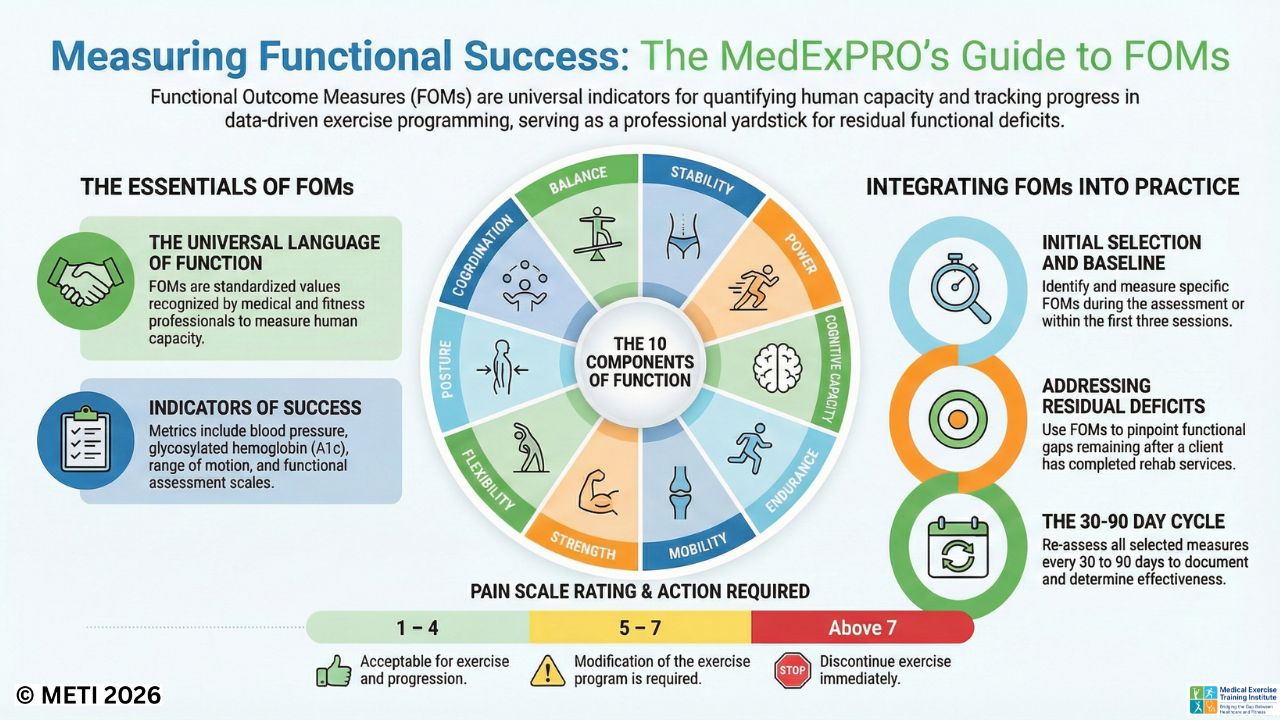
The Core Problem: Improvement Without Proof
Many MedExPROs rely on observation and client feedback:
- “They’re moving better.”
- “Pain has decreased.”
- “They feel stronger.”
Those statements may be true.
But they are not measurable.
In a healthcare-aligned environment, improvement must be quantifiable.
If it cannot be measured, it cannot be defended.
If it cannot be def...
MET 101 Tip #48 - Why Medical Exercise Protocols Are Non-Negotiable
Welcome back to the ME 101 series! In Tip 48, Dr. Mike tackles a foundational question for any Medical Exercise Professional (MedExPRO): What exactly is a Medical Exercise Training (ME) protocol?
If you want to transition successfully from general fitness to medical exercise, understanding and utilizing protocols is your absolute key to gaining credibility and building referral relationships.
What is an ME Protocol? At its core, a medical exercise training protocol is a defined set of guidelines and procedures used to manage exercise programming and progressions for a specific medical condition. Every aspect of medicine operates on protocols and standards. Therefore, if medical exercise is to be fully embraced by doctors, therapists, and healthcare systems, we must speak their language and utilize protocols.

The 8 Core Components of an ME Protocol: A proper ME protocol is not just a list of exercises. It is a comprehensive, step-by-step process that moves a client from initial ass...
The Client Management Engine That Eliminates Random Exercise
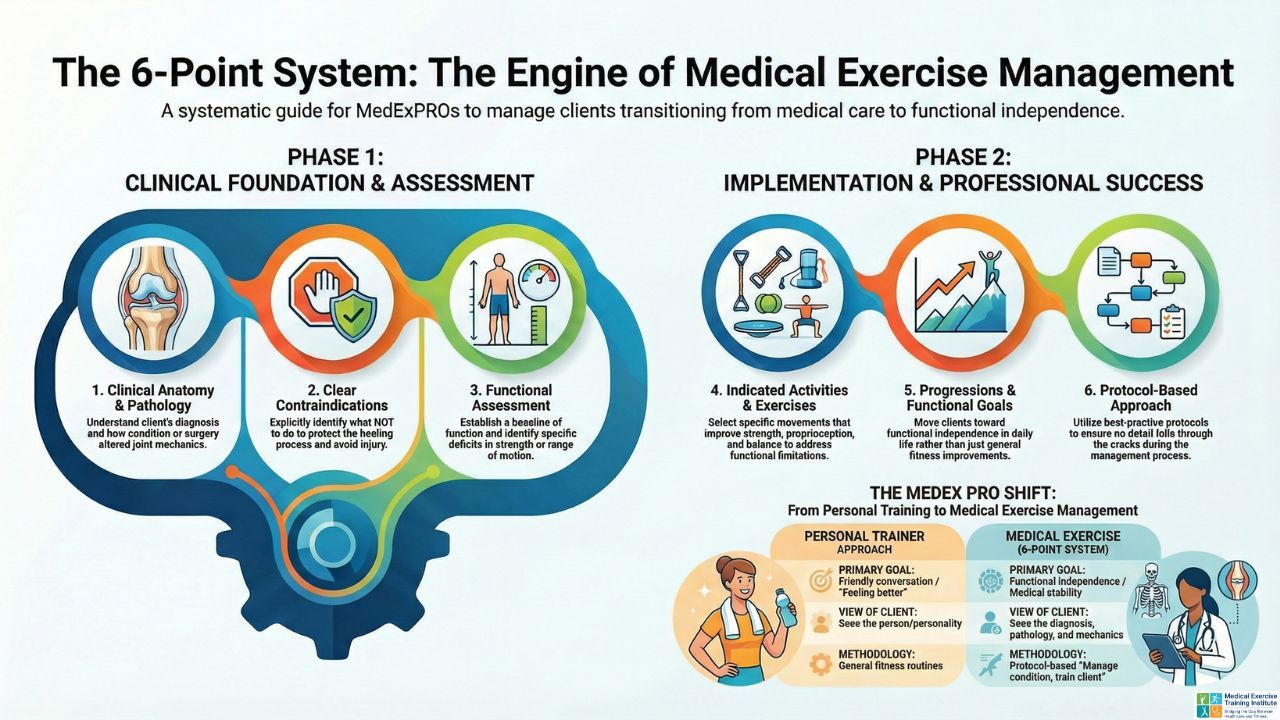
The 6-Point Client Management System
The healthcare landscape has shifted dramatically.
Decades ago, an individual recovering from a total hip replacement might receive two to three months of physical therapy. Today, many are discharged after only four to six visits. They leave therapy with lingering weakness, instability, and functional limitations—yet insurance says they are “done.”
That gap is where the Medical Exercise Professional steps in.
But let me be clear:
If you step into that gap without structure, you are not building a professional practice. You are gambling with someone’s recovery.
In the MedExPRO Operating System, the engine that drives safe, measurable, and referral-ready results is the 6-Point Client Management System.
This is not about adding more exercises.
This is about installing a system.
The Critical Mindset Shift
Before we discuss mechanics, we must discuss mindset.
A personal trainer may see “Mrs. Jacobs” — a pleasant 79-year-old who wants to get st...