
MedExPRO....Are You Actually Referral and Reimbursement-Ready? Complete the Checklist
Hello MedExPRO,
Let me ask you a direct question.
Do you believe your practice is referral-ready?
Do you believe you are reimbursement-ready?
Most Medical Exercise Professionals think they are.
You manage complex clients.
You understand pathology.
You care deeply about safety.
You communicate professionally.
But here is the uncomfortable truth:
Good intentions and strong exercise knowledge do not make a practice referral-ready or reimbursement-ready.
Systems do.
Why This Matters (And Why Most Don’t Realize They’re Not Ready)
Most MedExPROs fear three things:
- Approaching physicians and being dismissed
- Talking about reimbursement and saying the wrong thing
- Accidentally stepping outside scope
So what do they do?
They avoid the conversation.
They hope referrals will “just happen.”
They tell clients, “You can try to submit this,” without structured documentation.
And they quietly wonder why medical professionals don’t consistently refer.
That is not a competence problem.
It is a systems problem.
We’ve developed a professional self-assessment tool:
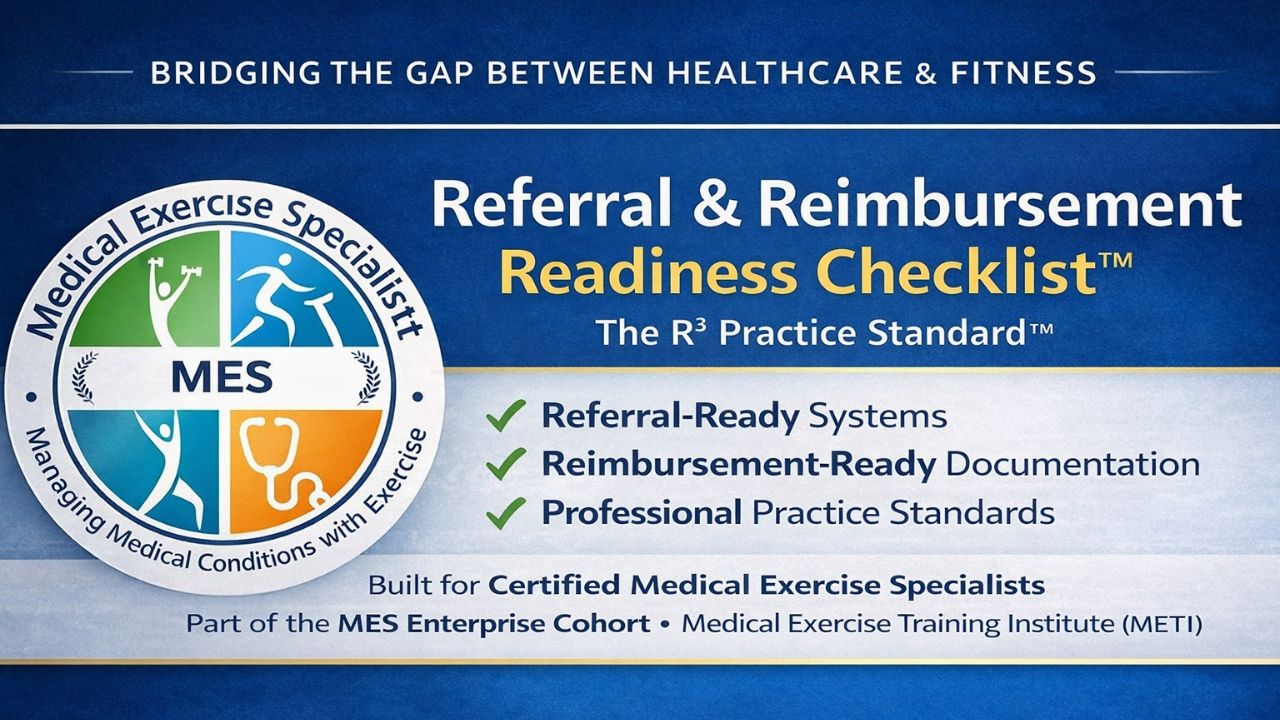
Click the Image Above to Download the Checklist
The Referral-Ready & Reimbursement-Ready Checklist for MedExPROs
This checklist is not marketing fluff.
It is a standards audit.
Here is what I want you to do:
- Read every section slowly.
- Check each box only if you can confidently say:
“Yes, this exists in my practice right now.” - Be objective.
Do not check a box because you could do it.
Check it only if it is installed and operational.
___________________________________________________________________
The more boxes you can confidently check, the stronger your professional foundation already is. Each box represents a structural element of a true medical exercise practice. This is not about perfection — it is about identifying where your systems are solid and where they need reinforcement.
___________________________________________________________________
PART I — REFERRAL-READY
1. Medical Referral Requirements (Non-Negotiable)
Ask yourself:
☐ Practice requires a written referral from a licensed physician
☐ Referral specifies Medical Exercise Training or Functional Conditioning
☐ Referral includes a medical diagnosis
☐ Referral includes an ICD-10 code
☐ Referral confirms discharge or transition from formal medical treatment
If any of these are missing, the referral is incomplete—not “close enough.”
This is where most MedExPROs realize they are assuming readiness instead of proving it.
2. Referral Intake Systems
Now examine your intake process:
☐ Standardized referral intake form exists
☐ Diagnosis and ICD-10 code are documented in the client record
☐ Functional limitations are identified relative to the diagnosis
☐ Scope of practice is clearly defined and documented
☐ Client is transitioned from “patient” (medical care) to “client” (exercise services)
If this is not structured, your referral process depends on memory—not systems.
3. Assessment & Programming Alignment
Now look at your assessments and programming:
☐ Assessment is framed around functional capacity, not fitness goals
☐ Exercise selection aligns with diagnosed condition and limitations
☐ Progressions are defensible and documented
☐ Language avoids diagnosis, treatment, or therapy terminology
This is where fitness businesses reveal themselves.
Medical exercise practices document defensibility.
4. Provider Communication Systems
Finally, evaluate your communication structure:
☐ Initial intake summary prepared for referring provider
☐ Progress reports scheduled at defined intervals
☐ Documentation uses medical-appropriate, functional language
☐ Communication is consistent, professional, and expected
If physicians don’t clearly understand what you do, that is not their fault.
It is a communication system gap.
PART II — REIMBURSEMENT-READY
Now let’s move to the part most MedExPROs avoid.
Reimbursement.
1. Reimbursement Clarity (Scope Protection)
Ask yourself honestly:
☐ Practice does not bill insurance
☐ Clients are clearly informed they are responsible for submission
☐ No guarantees of reimbursement are made
☐ Role as a Medical Exercise Professional is clearly explained
If this conversation feels uncomfortable, your scope is not fully defined.
2. Documentation Standards
Review your session documentation:
☐ Each session log includes:
- Date
- Duration
- Service and exercise description
- Functional focus tied to diagnosis or functional limitations
☐ Language aligns with the original medical referral
☐ Progress is tracked objectively (capacity, tolerance, function)
If documentation is vague, reimbursement conversations become fragile.
3. Client-Ready Reimbursement Packet
Evaluate what you provide clients:
☐ Session summaries prepared in client-friendly format
☐ Progress reports available upon request
☐ Clear service description provided for insurance submission
☐ Documentation is consistent, legible, and professional
Professional systems create calm reimbursement discussions.
4. Professional Confidence
Finally, assess yourself:
☐ MedExPRO can clearly explain the reimbursement support role
☐ MedExPRO can confidently answer client questions
☐ No fear of overstepping scope
☐ No avoidance of reimbursement conversations
If fear still exists, the system is incomplete.
Final Self-Assessment
☐ I am referral-ready
☐ I am reimbursement-ready
☐ My systems—not my personality—carry my practice
Why This Checklist Is So Important
If you cannot check every box, your practice is still operating like fitness.
Fitness relies on:
- Personality
- Motivation
- Energy
- Sales conversations
A medical exercise practice relies on:
- Written referrals
- Documented diagnoses
- ICD-10 clarity
- Defined scope
- Structured communication
- Defensible documentation
- Measurable functional outcomes
That is the difference between:
“Trainer who works with special populations”
and
“Medical Exercise Professional integrated into the continuum of care.”
Am I truly referral-ready?
Am I truly reimbursement-ready?
Or am I assuming I am?
Download the "Referral-Reimbursement Readiness Checklist" by clicking the link below:
Get Medical Exercise Training guidelines and updates!
Build your practice with tips learned over 28+ years teaching MedXPROs around the world!!