
The Next Standard: From Personal Trainer to Medical Exercise Professional
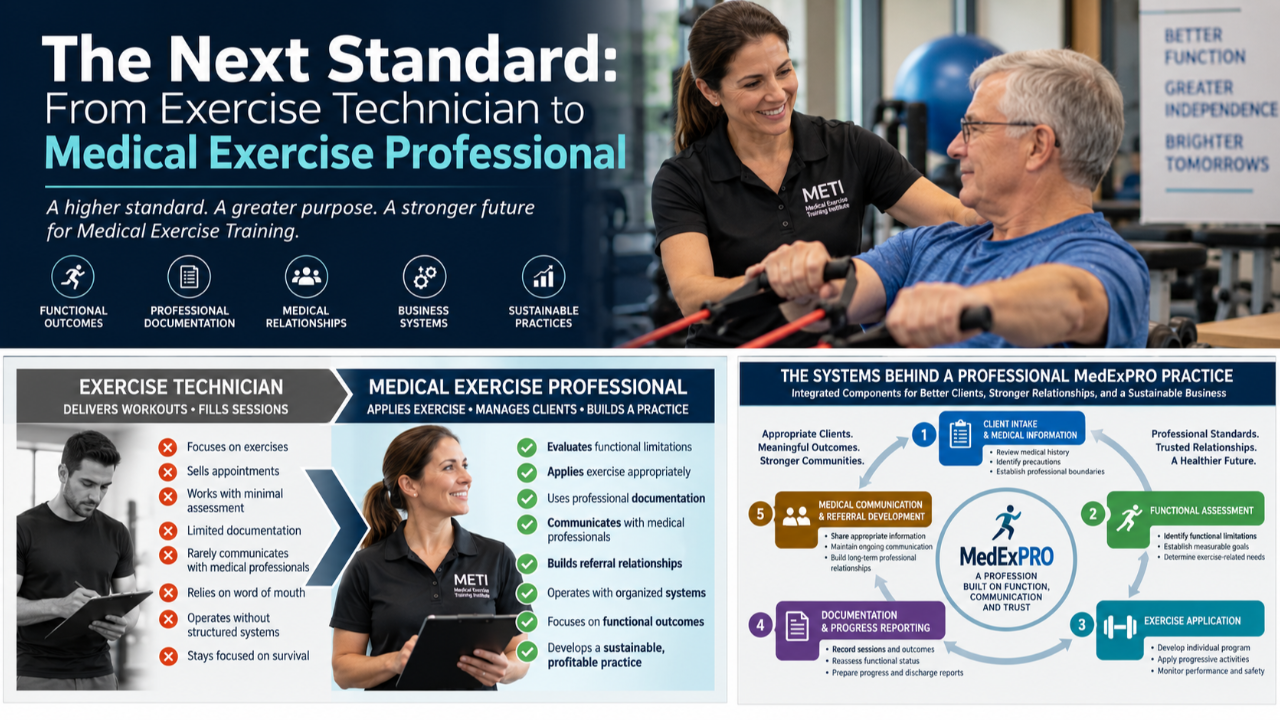
Why Certification Alone Is Not Enough—and Why the Future of Medical Exercise Training Depends on Professional Systems, Functional Outcomes, Documentation, and Medical Relationships
By Dr. Michael K. Jones, PhD, PT
Founder and President, Medical Exercise Training Institute
After 41 years as a physical therapist and 32 years teaching Medical Exercise Specialists, I believe it's time for us to have a serious conversation about the future of Medical Exercise Training.
And I want to begin with a question that may make some of my students and graduates uncomfortable.
Did you become a Medical Exercise Specialist to build a professional Medical Exercise Training practice, or did you simply want another certification that would allow you to charge more for personal training sessions?
Think about that question for a moment.
Since we conducted our first Medical Exercise Specialist (MES) workshop in Washington, DC, in July 1994, I've watched this profession grow from a relatively unfamiliar concept into an educational pathway that has reached thousands of professionals around the world.
We've taught exercise science, medical conditions, functional assessment, exercise programming, post-rehabilitation management, and the appropriate application of exercise for individuals with medical histories and functional limitations.
I'm proud of what we've accomplished.
But after more than three decades of educating Medical Exercise Specialists, I have a growing concern.
We have produced thousands of professionals who understand Medical Exercise Training, but too many have never learned how to build and operate a professional Medical Exercise Training business.
They earn their certification, return to their facilities, add MES to their credentials, increase their session rates, and continue doing business essentially as they did before certification.
They're still searching for the next client. They're still selling appointments. They're still depending on word of mouth. Their documentation is often minimal, and their relationships with medical professionals rarely extend beyond an occasional introduction or referral.
They may be better exercise professionals, but their business model hasn't changed.
That's a problem.
And if Medical Exercise Training is going to become the profession I believe it can become, we must address it.
The Opportunity Before Us Is Much Bigger Than Personal Training
Look at what's happening in healthcare.
Our population is aging. Millions of Americans are living with chronic conditions. Healthcare organizations face financial pressures, changing reimbursement arrangements, and increasing demands to demonstrate meaningful outcomes.
At the same time, many individuals are living longer with limitations that affect their mobility, stability, strength tolerance, endurance, and ability to function independently.
Some of these individuals have completed physical therapy or other rehabilitation services but still need appropriate, structured exercise management.
Others need ongoing exercise support to help maintain physical capacity while managing the functional challenges associated with aging and chronic conditions.
And here's what concerns me.
While the need for organized, function-oriented exercise services continues to grow, too many Medical Exercise Specialists are satisfied with finding enough clients to fill next week's appointment schedule.
They're thinking about survival rather than building a professional business.
They're thinking about exercise sessions rather than client-management systems.
They're thinking about another certification rather than building meaningful relationships with medical professionals.
They're thinking about increasing their hourly rate rather than establishing a business that demonstrates its professional value.
I believe we're thinking far too small.
Medical Exercise Training has the potential to become an important component of ongoing, exercise support for appropriate individuals after rehabilitation and throughout the management of chronic functional challenges.
But that opportunity will not simply be handed to us.
Having a certification does not mean physicians will automatically refer clients to us. It does not mean insurers will reimburse our services. It does not mean the healthcare community will recognize our professional value.
We must demonstrate that value through the way we assess, apply exercise, document functional outcomes, communicate with medical professionals, and manage our businesses.
That's the next level of Medical Exercise Training.
It's Time to Move Beyond the Personal Trainer
Let's examine how many exercise professionals approach a new client.
A client arrives with a history of total knee replacement, low back pain, stroke, or another medically established condition.
The professional immediately begins thinking about exercises.
Should we perform squats? Leg presses? Step-ups? Core exercises? Balance activities? Resistance training?
There's nothing inherently wrong with those exercises when they're appropriate.
But I want us to think differently.
The first question should not be, "What exercises should I give this client?"
The questions should be:
What functional limitations does this individual actually demonstrate?
What information do I have from the medical provider?
What precautions and professional boundaries must I respect?
What can I appropriately assess?
What exercise-related components are associated with the client's functional limitations?
How will I establish meaningful goals, organize the exercise program, measure progress, and communicate the results?
That's the difference between a personal trainer and what I call a MedExPRO.
A personal trainer knows exercises.
A MedExPRO l understands how to apply exercise appropriately within a structured, documented, function-oriented client-management process.
That distinction is enormous.
Consider an individual discharged from physical therapy following a total knee replacement.
The client reports difficulty negotiating stairs and walking longer distances.
The exercise technician may immediately begin a strengthening program.
The MedExPRO should first establish an appropriate functional baseline, review available medical information, identify actual exercise-related limitations, and determine what can be addressed through an exercise-only program.
The professional then selects activities that relate to those identified needs.
Throughout the program, the MedExPRO monitors performance, documents sessions, reassesses function, and communicates appropriate information with the referring medical professional when authorized.
Eventually, the client completes the program through a structured discharge process.
That's Medical Exercise Training. Not simply assigning exercises, but applying exercise through a professional client-management system.
And here's the point I want every MES and MedExPRO to understand.
If you are simply delivering workouts to medically referred clients without an organized professional process, you have not fully developed the practice your education was intended to support.
Documentation Is Not an Administrative Burden. It's a Professional Responsibility.
One of the most disappointing things I've observed over the years is how some personal trainers approach documentation.
They don't want to complete assessments.
They don't consistently document functional changes.
They may record exercises, sets, and repetitions, but little else.
They see progress reports as unnecessary paperwork.
And communicating with medical professionals is often something they do only when someone requests information.
I want to challenge that thinking.
If you cannot clearly document what you assessed, what you did, and what functional changes occurred, how can you expect a medical professional to understand the value of your services?
Think about how healthcare operates.
Physicians, physical therapists, occupational therapists, nurses, and other professionals rely on documentation and communication to understand what is happening with the individuals they serve.
Clinical responsibilities and documentation requirements differ among those professions, and Medical Exercise Training must remain within its professional and ethical scope.
But the larger lesson is unmistakable.
Healthcare operates through organized information.
Assessment findings matter. Functional changes matter. Progress reports matter. Communication matters.
Why would we believe that Medical Exercise Training can establish meaningful professional relationships without adopting appropriate documentation and communication standards?
Suppose a physician refers a client to your practice following discharge from rehabilitation.
You provide an excellent exercise program.
The client improves.
But the physician receives no initial assessment summary, no progress report, and no discharge communication.
What have you done to strengthen that professional relationship?
You may have helped the client. But the medical professional has little information about what you accomplished or how you managed the referral.
Now imagine a different situation.
The MedExPRO receives the referral, follows a professional intake and assessment process, establishes measurable functional goals, documents the exercise-management program, and provides appropriate progress information with the client's authorization.
The referring professional can better understand what occurred after the client entered the program.
Which process is more likely to support professional confidence?
Documentation is not simply recordkeeping. It is one of the foundations of professional credibility and meaningful medical communication.
That's why I have consistently emphasized the importance of professional assessment summaries, session logs, functional outcome measures, progress reports, and discharge documentation.
We must document first and communicate clearly.
Why Should Medical Professionals Refer Clients to You?
Now let me ask another question.
How many physicians, physical therapists, or other medical professionals in your community actually understand what you do?
Not how many have received your business card.
Not how many you've visited once.
Not how many have seen your social media posts.
How many understand your professional scope, your assessment procedures, your client-management process, and how you communicate functional outcomes?
If the answer is very few, why are you surprised that you're not receiving consistent referrals?
I've watched medical exercise professionals spend considerable money on marketing materials, websites, advertisements, and promotional activities while neglecting the most important element of medical referral development.
They haven't established a professional system for building and maintaining medical relationships.
They introduce themselves, ask for referrals, and disappear.
Or they receive a referral, deliver the exercise program, and never communicate with the referring professional again.
Medical referral development is not simply asking physicians to send you clients. It is demonstrating that your business has the professional organization, competence, and communication procedures necessary to support appropriate referrals.
A physician needs to know what services you provide.
A physical therapist needs to understand how your exercise services complement rehabilitation after discharge.
A medical practice needs to understand how clients are managed, what information you document, and when communication can be expected.
And those relationships must be maintained over time.
This is why I believe medical referral development and professional documentation cannot be separated.
Your documentation supports your communication.
Your communication supports your credibility.
Your credibility supports your professional relationships.
And those relationships may create opportunities for appropriate medical referrals.
If you want physicians and other medical professionals to recognize your business as a professional resource, you must give them professional reasons to do so.
A certification alone isn't enough.
A Professional Practice Must Have an Operating System
During my years owning and operating physical therapy facilities, I learned something that has shaped much of my thinking about business management.
You cannot build a sustainable professional practice around technical skills alone.
You need systems.
You need an organized method for managing clients, documentation, communication, scheduling, billing, marketing, staffing, professional relationships, and daily operations.
Without those systems, the business becomes dependent on the owner remembering everything, making every decision, and solving every problem.
I've seen this same pattern in Medical Exercise Training businesses.
The owner is the exercise professional, receptionist, scheduler, billing manager, marketing director, referral coordinator, and recordkeeper.
Everything depends on one person.
Every new client creates additional administrative responsibilities.
Every missed communication becomes another problem.
Every attempt to grow makes the business more complicated.
And eventually, the owner begins feeling overwhelmed.
Let me ask you something.
If you doubled your number of clients next month, would your business be prepared to manage them?
Or would the additional clients expose the weaknesses in your intake procedures, scheduling, documentation, billing, and communication?
What happens if you become ill or take two weeks away from the business?
Can another qualified professional understand how your practice operates?
Do you have documented procedures?
Or does your entire operating system exist in your head?
At METI, we have spent years developing our Client Management, Practice Management, and Enterprise Frameworks because these are the foundations a professional Medical Exercise Training business needs.
The successful MedExPRO practice cannot simply be a collection of exercise sessions.
It must be an organized system for delivering appropriate exercise-management services consistently.
And that system must be capable of supporting professional quality, business growth, and financial sustainability.
It's Time to Stop Apologizing for Building a Profitable Business
I also believe we must change how we think about profitability.
There's nothing unprofessional about wanting to build a financially successful Medical Exercise Training business.
In fact, financial sustainability is essential if we expect these services to remain available to the people who need them.
A sustainable practice can invest in better systems, professional education, appropriate assessment tools, facilities, staffing, documentation resources, and continued professional development.
But profitability doesn't come simply from charging more for exercise sessions because you have an MES certification. Nor does it come from buying a computer or software program. You must organize and implement an operating system that is specific to your practice, clients and goals. Build the systems based on your needs and skills.
It comes from sound pricing, consistent business operations, professional relationships, effective client management, and responsible financial decisions.
It comes from knowing the difference between revenue and profit.
And it comes from recognizing that the owner of a Medical Exercise Training practice must become a business professional as well as an exercise professional.
We need to move from asking, "How many sessions can I sell this week?" to asking, "How do I build a professional exercise-management business that can operate successfully for years?"
That's a different level of thinking.
And it's the level our profession needs to reach.
The MedExPRO Practice of the Future
I want you to imagine the Medical Exercise Training practice we should be developing.
A practice where every prospective client enters through a structured intake process.
Where appropriate medical information, referral documentation, and exercise precautions are reviewed.
Where functional limitations are actually assessed rather than assumed from a diagnosis.
Where exercise programming follows a guided progression based on the client's documented findings and functional goals.
Where every session is recorded through an appropriate professional log.
Where functional progress is measured and reassessed.
Where medical professionals receive timely, meaningful information with proper authorization.
Where referral relationships are developed systematically rather than left to chance.
Where the business has consistent scheduling, billing, marketing, and operating procedures.
Where staff understand their responsibilities and professional boundaries.
And where the owner can evaluate the practice's financial performance, professional standards, and readiness for growth.
That's a MedExPRO practice.
Not simply a personal training studio with impressive certifications displayed on the wall.
A professionally managed Medical Exercise Training business that combines appropriate exercise application, functional accountability, professional communication, and sound business systems.
This is the standard I believe we must pursue.
We Must Understand Our Place in the Healthcare Continuum
There's another important distinction.
I am not suggesting that Medical Exercise Specialists should become substitute physical therapists or attempt to practice medicine.
Quite the opposite.
Our opportunity depends on understanding exactly what we are—and what we are not.
Medical Exercise Training is an exercise-only service.
It complements appropriate medical care and rehabilitation. It does not diagnose medical conditions, provide medical treatment, or replace licensed healthcare services.
But within those boundaries, qualified professionals can provide valuable exercise support to appropriate clients who need continued attention to functional capacity.
The medical professional establishes and manages the clinical responsibilities.
The MedExPRO works within the appropriate exercise-management role, recognizes limitations, monitors relevant functional performance, and refers concerns back to qualified healthcare providers when necessary.
That relationship requires respect for professional boundaries.
It also requires communication.
We should not be trying to become another healthcare profession by borrowing the authority or terminology of licensed providers.
We should be developing the highest possible professional standards for the services we are actually qualified and authorized to deliver.
That is how we build credibility.
And that is how we create a more meaningful role for Medical Exercise Training.
What Will Your Practice Look Like Five Years From Now?
I want every Medical Exercise Specialist reading this article to consider that question.
If you continue operating exactly as you do today, what will your business look like five years from now?
Will you still be struggling to find the next client?
Will you still be explaining to physicians what a Medical Exercise Specialist does?
Will you still be using inconsistent documentation procedures?
Will you still be handling every business responsibility yourself?
Will you still be wondering why your certification hasn't produced the professional opportunities you expected?
Or will you have developed an organized practice with established client-management systems, dependable professional procedures, meaningful medical relationships, measurable functional outcomes, and a sustainable financial model?
The difference will not be determined by your certification alone.
It will be determined by the systems you develop, the standards you adopt, and the professional decisions you make.
I've spent more than three decades helping individuals become Medical Exercise Specialists.
Now I want to challenge those same professionals to take the next step.
Stop thinking like a personal trainer who happens to hold an advanced certification. Start thinking like a Medical Exercise Professional who understands how to apply exercise, manage clients, communicate with healthcare providers, and operate a professional business.
Our aging population, the prevalence of chronic disease, the need for ongoing functional independence, and the financial pressures facing healthcare create important opportunities for this profession.
But those opportunities do not guarantee us referrals, recognition, or a place in the broader continuum of care.
We must earn professional trust.
We must establish appropriate systems.
We must communicate consistently.
We must demonstrate functional outcomes honestly.
And we must build businesses capable of delivering our services reliably and sustainably.
The future of Medical Exercise Training will not be determined by how many professionals earn an MES certification. It will be determined by how many turn that education into a professionally organized, credible, and sustainable Medical Exercise Training practice.
That's the challenge before us.
And after 41 years as a physical therapist and 32 years teaching Medical Exercise Specialists, I believe we have the knowledge, the experience, and the opportunity to meet it.
What we need now is the commitment to move to the next level.
The MedExPRO Business Practice Blueprint: Taking the Next Step
On November 14–15, 2026, I'll present The MedExPRO Business Practice Blueprint in Houston, Texas, with live Zoom participation available.
This workshop is designed to help Medical Exercise Professionals begin building the professional and business systems I've discussed in this article.
We'll focus on four essential areas: The MedExPRO Operating System; Document First, Communicate Clearly; The Medical Referral Development System; and The Reimbursement Readiness Blueprint.
These aren't four unrelated business topics. They are interconnected components of the professional practice I believe every MedExPRO should work toward developing.
You can attend an individual three-hour workshop for $75, one full day for $125, or the complete two-day experience for $249 in Houston or $197 via Zoom.
I recommend the complete two-day experience for professionals who want to understand how these systems work together.
Learn More and Register at www.MedExPROBlueprint.com
Let me close with the question I want you to remember.
Are you satisfied being a personal trainer with a Medical Exercise Specialist certification, or are you ready to become the professional that certification was intended to help you become?
Our profession has an important future.
But we must be willing to build it.
Get Medical Exercise Training guidelines and updates!
Build your practice with tips learned over 28+ years teaching MedXPROs around the world!!