
Mrs. Jacobs, Medicare and the MedExPRO
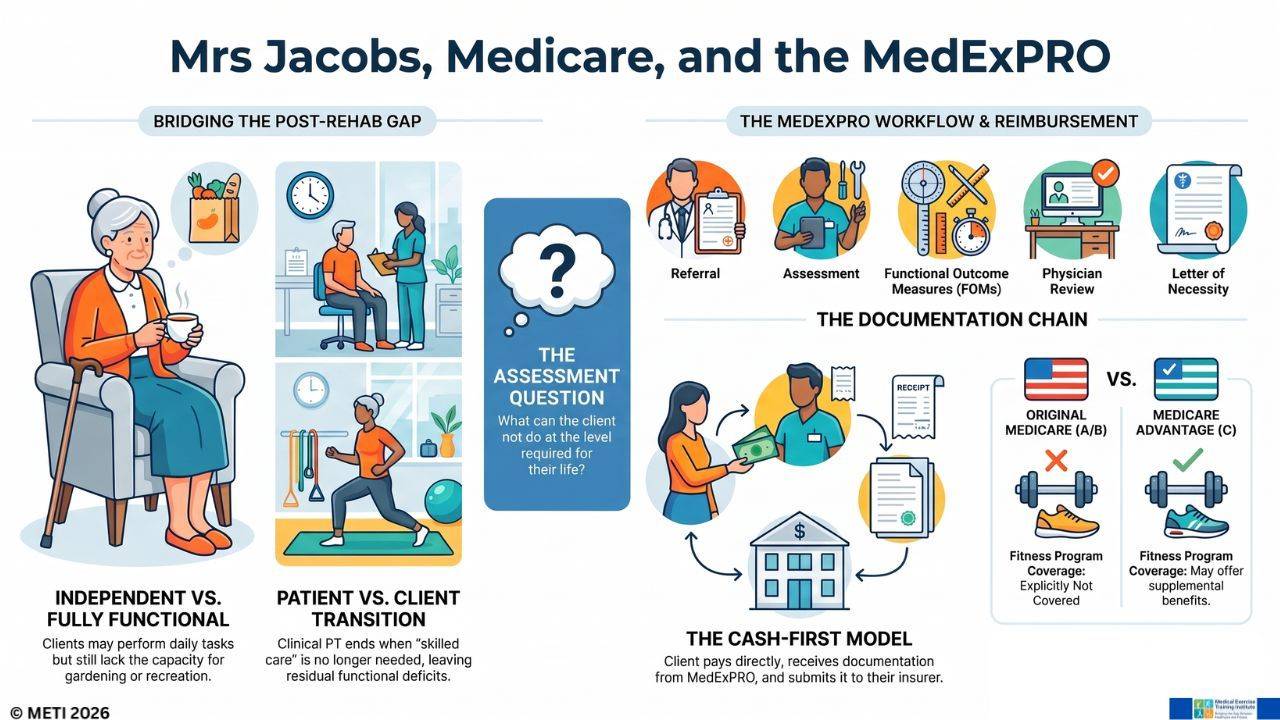
Understanding the Medicare Client, the Post-Rehabilitation Gap and Cash-First Reimbursement
Mrs. Jacobs is a 72-year-old retired professional who lives independently with her husband. She enjoys gardening, attending church, shopping, traveling, volunteering, and spending time with her grandchildren. She occasionally helps with administrative activities in a family business.
Several months ago, Mrs. Jacobs underwent a right total knee replacement. Her journey from surgery through rehabilitation and eventually into Medical Exercise Training provides an important lesson for every MedExPRO who works with Medicare-age clients.
The lesson is simple:
Being independent does not necessarily mean being fully functional.
Understanding that distinction—and understanding where Medicare ends and Medical Exercise Training begins—is essential to professional medical exercise practice.
Understanding Mrs. Jacobs' Medicare Coverage
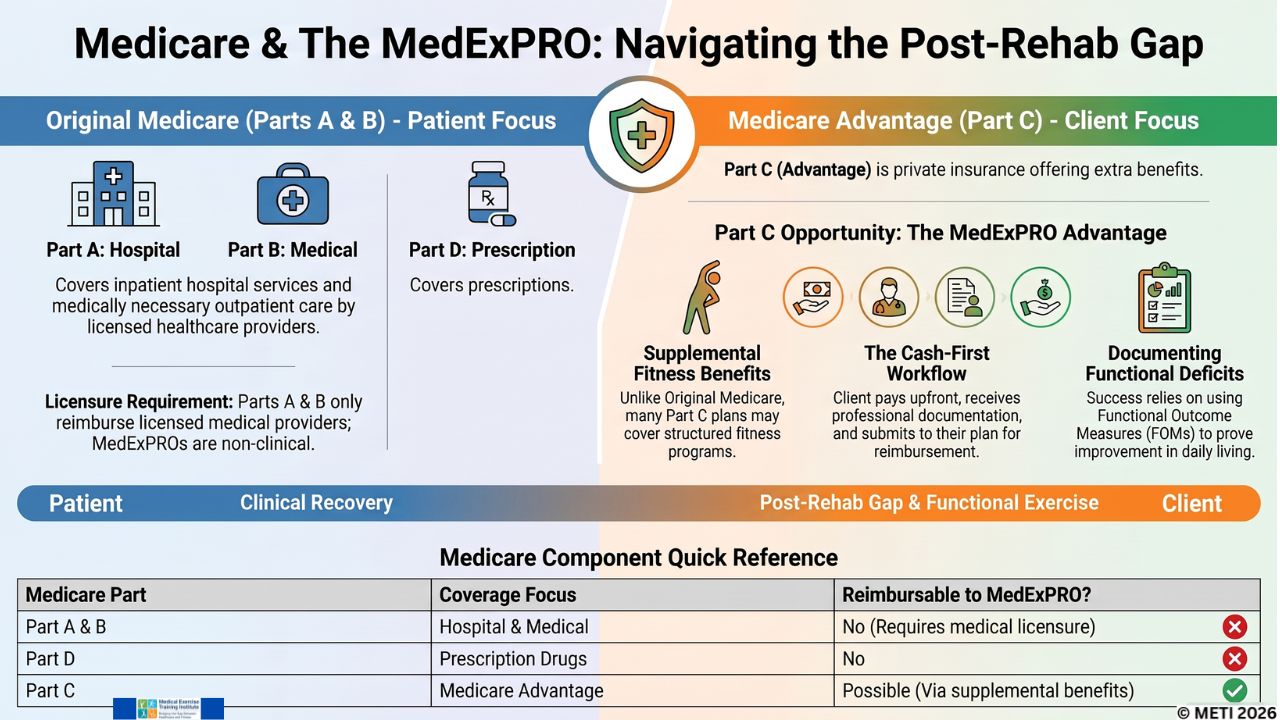
Mrs. Jacobs entered Medicare at age 65. Medicare consists of several components. Part A is hospital insurance and helps cover eligible inpatient hospital and related services. Part B is medical insurance and helps cover physician services, outpatient care, medically necessary services, preventive services and other qualifying healthcare services. Together, Parts A and B are commonly called Original Medicare. Part D provides prescription-drug coverage.
Medicare Advantage, or Part C, is an alternative way for beneficiaries to receive their Medicare benefits. Medicare Advantage plans are offered by Medicare-approved private insurance companies. They include Part A and Part B benefits and usually Part D, but they may also offer additional benefits not available through Original Medicare.
For this case study, Mrs. Jacobs has a fictional Medicare Advantage plan through Jones Insurance Company.
When Mrs. Jacobs underwent her knee replacement, she was clearly a patient. Her orthopedic surgeon diagnosed and medically managed her condition. Her surgical team performed the knee replacement, and licensed healthcare professionals provided the appropriate postoperative services.
She subsequently entered physical therapy. Her physical therapist addressed the impairments and functional limitations requiring skilled rehabilitation. Initially, Mrs. Jacobs had difficulty walking, transferring, negotiating stairs and performing normal daily activities.
Over time, she improved substantially. Eventually, her rehabilitation team determined that she no longer required the skilled rehabilitation services she had been receiving.
But Mrs. Jacobs was not back to normal.
Independent—But Not Fully Functional
Mrs. Jacobs could dress herself, bathe independently, prepare meals, walk around her home, drive and leave the house without assistance.
Yet when asked about her life, a different picture emerged.
She still had difficulty rising repeatedly from her low living-room chair. She could climb stairs but relied heavily on the railing. Her leg became fatigued during longer shopping trips. She could not comfortably get down toward the ground and return to standing, which prevented her from gardening.
Long periods of standing made volunteering difficult. She worried about walking through airports when traveling. She could not keep up with her grandchildren for an entire afternoon. Even the occasional administrative work she performed at the family business was affected by repeated transfers, walking and prolonged standing.
Mrs. Jacobs had achieved a significant level of independence, but she had not regained the functional capacity necessary for all of her home, recreational, community and occasional work-related activities.
This is the post-rehabilitation gap.
And this is where the MedExPRO may have an important role.
Mrs. Jacobs Becomes a Medical Exercise Client
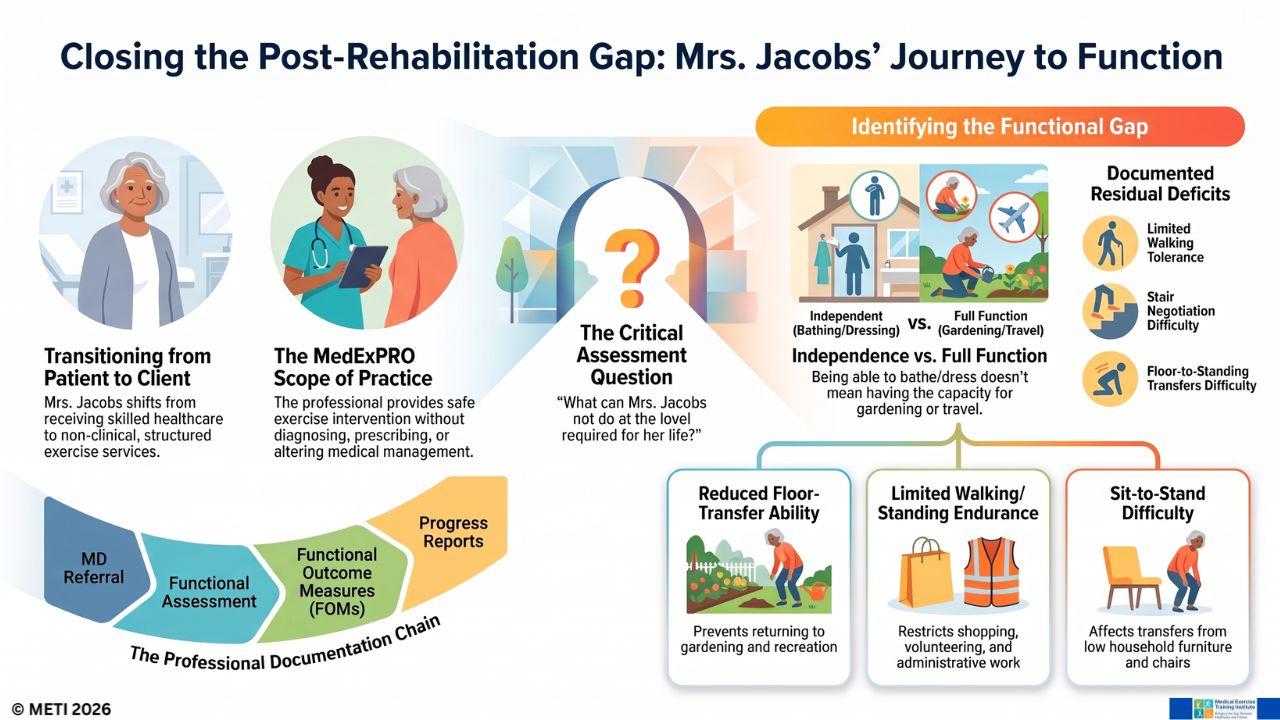
Mrs. Jacobs does not need an exercise professional pretending to continue physical therapy. She needs structured exercise to address residual functional deficits that are appropriate for exercise management.
Her physician provides a written referral for Medical Exercise Training/Functional Conditioning, twice weekly for six weeks.
At this point, Mrs. Jacobs transitions from primarily being a patient receiving skilled healthcare to being a client receiving non-clinical exercise services.
That distinction must remain clear.
The MedExPRO is not a licensed medical provider. The MedExPRO does not diagnose Mrs. Jacobs, provide physical therapy, prescribe treatment or alter her medical management. The MedExPRO's sole intervention is safe and appropriate exercise.
The physician referral does not change that scope.
The Assessment Starts With Function
The MedExPRO does not begin by asking, "What exercises should I give Mrs. Jacobs?"
The first question is:
What can Mrs. Jacobs not do at the level required for her daily life?
The assessment identifies residual limitations in repeated sit-to-stand performance, walking tolerance, stair negotiation, lower-extremity functional endurance and floor-to-standing activities.
Appropriate Functional Outcome Measures (FOMs) are then used to establish objective baseline findings.
Now there is a measurable relationship between Mrs. Jacobs' functional deficits and her life:
- Sit-to-stand difficulty affects transfers from household furniture.
- Reduced walking endurance affects shopping and community mobility.
- Stair difficulty affects home and community activities.
- Reduced standing tolerance affects volunteering and occasional work activities.
- Floor-transfer difficulty prevents her from returning fully to gardening and recreation.
The issue is no longer simply that Mrs. Jacobs needs "stronger legs."
She has documented residual functional deficits affecting meaningful activities of daily living and community participation.
The Findings Go Back to the Physician

With Mrs. Jacobs' authorization, the MedExPRO sends an Assessment Summary to her physician. It includes the referral, assessment findings, functional limitations, FOM results, functional goals and proposed Medical Exercise Training program.
Based on these findings and the physician's independent judgment, the physician may provide a Letter of Medical Necessity supporting the recommendation for structured functional conditioning.
This creates an important documentation chain:
Physician Referral → Assessment → Functional Deficits → FOMs → ADL Impact → Physician Review → Letter of Medical Necessity
But neither the referral nor the Letter of Medical Necessity guarantees insurance reimbursement.
That brings us to Medicare Advantage.
Why Medicare Advantage Matters
Original Medicare does not cover general gym memberships or fitness programs. Medicare's current guidance explicitly states that these are not covered by Original Medicare and that the beneficiary pays the costs of non-covered fitness services.
However, Medicare also specifically recognizes that Medicare Advantage plans may offer additional benefits, including fitness programs, that Original Medicare does not cover.
Therefore, the question is not:
"Does Medicare cover Medical Exercise Training?"
The appropriate question is:
"Does this client's specific Medicare Advantage plan contain a benefit under which these exercise services and this provider arrangement may qualify for reimbursement?"
For our hypothetical case, Mrs. Jacobs contacts Jones Insurance. Assume Jones Insurance determines that her particular Medicare Advantage plan contains an applicable supplemental benefit through which certain structured exercise services may be considered for reimbursement.
Jones Insurance still determines the requirements. Medicare Advantage plans can have their own networks, referral requirements, prior-authorization requirements, provider requirements and other rules. Medicare
The MedExPRO therefore verifies the plan requirements before representing the service as potentially reimbursable.
Introducing Cash-First Reimbursement
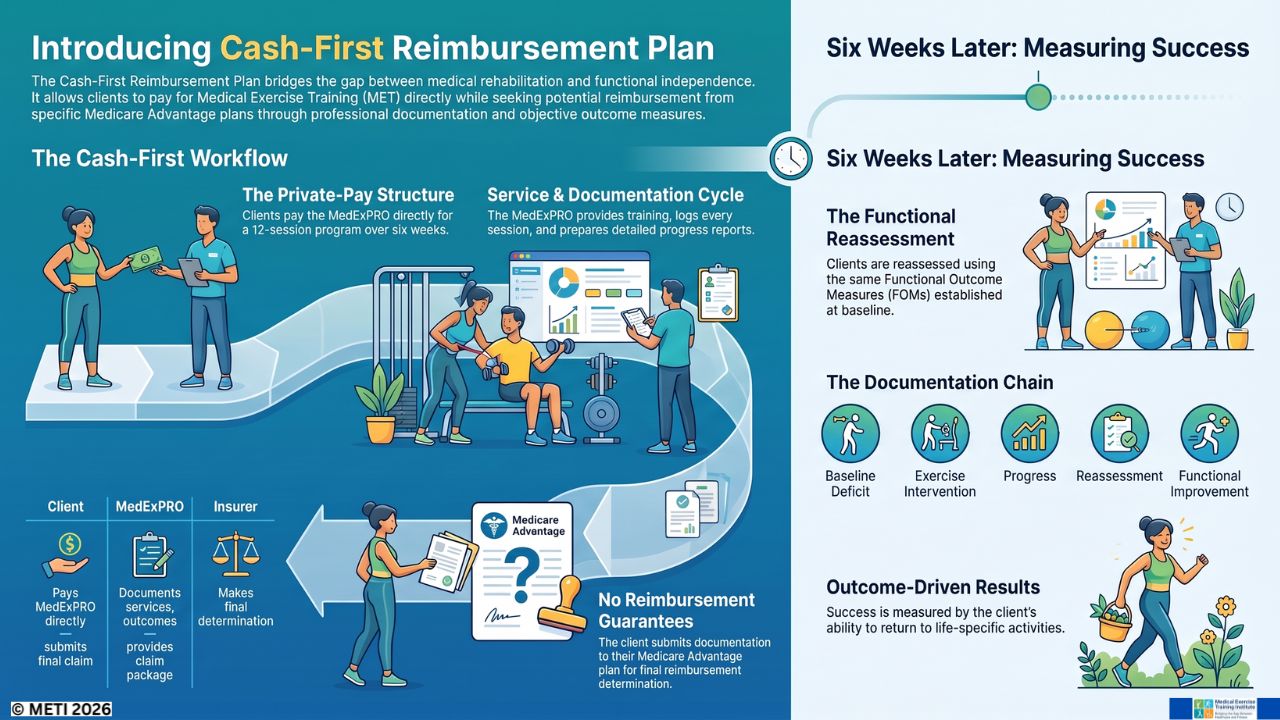
This is where the METI Cash-First Reimbursement Plan enters Mrs. Jacobs' story.
The MedExPRO does not attempt to bill Original Medicare as a Part B provider. Mrs. Jacobs remains a private-pay Medical Exercise Training client.
She begins a defined program of:
2 sessions per week × 6 weeks = 12 MET sessions.
Mrs. Jacobs pays the MedExPRO directly.
The MedExPRO provides the services, documents each session, prepares progress reports and reassesses the original functional deficits.
Mrs. Jacobs is then provided with the documentation required by her plan so she can submit her expenses for consideration for reimbursement.
The principle is:
Client Pays → MedExPRO Provides Services → MedExPRO Documents Services and Outcomes → Client Receives Documentation → Client Submits to Medicare Advantage Plan → Plan Determines Reimbursement
The MedExPRO never guarantees reimbursement.
Cash First means the client purchases the service directly and subsequently seeks reimbursement when the Medicare Advantage plan provides an applicable mechanism.
Six Weeks Later
At the end of six weeks, Mrs. Jacobs is reassessed using the same Functional Outcome Measures established at baseline.
She performs repeated sit-to-stand activities more efficiently. Her walking tolerance has increased. Stair negotiation has improved. She tolerates longer periods of standing. She has begun gardening again and recently completed a longer shopping trip without requiring her previous number of rest periods.
That is the outcome that matters.
The MedExPRO's documentation now demonstrates:
Baseline Functional Deficit → Exercise Intervention → Progress → Reassessment → Functional Improvement
Mrs. Jacobs receives the appropriate documentation to submit to Jones Insurance under its hypothetical reimbursement process. Jones Insurance—not METI, the physician or the MedExPRO—makes the final reimbursement determination.
The Lesson for the MedExPRO
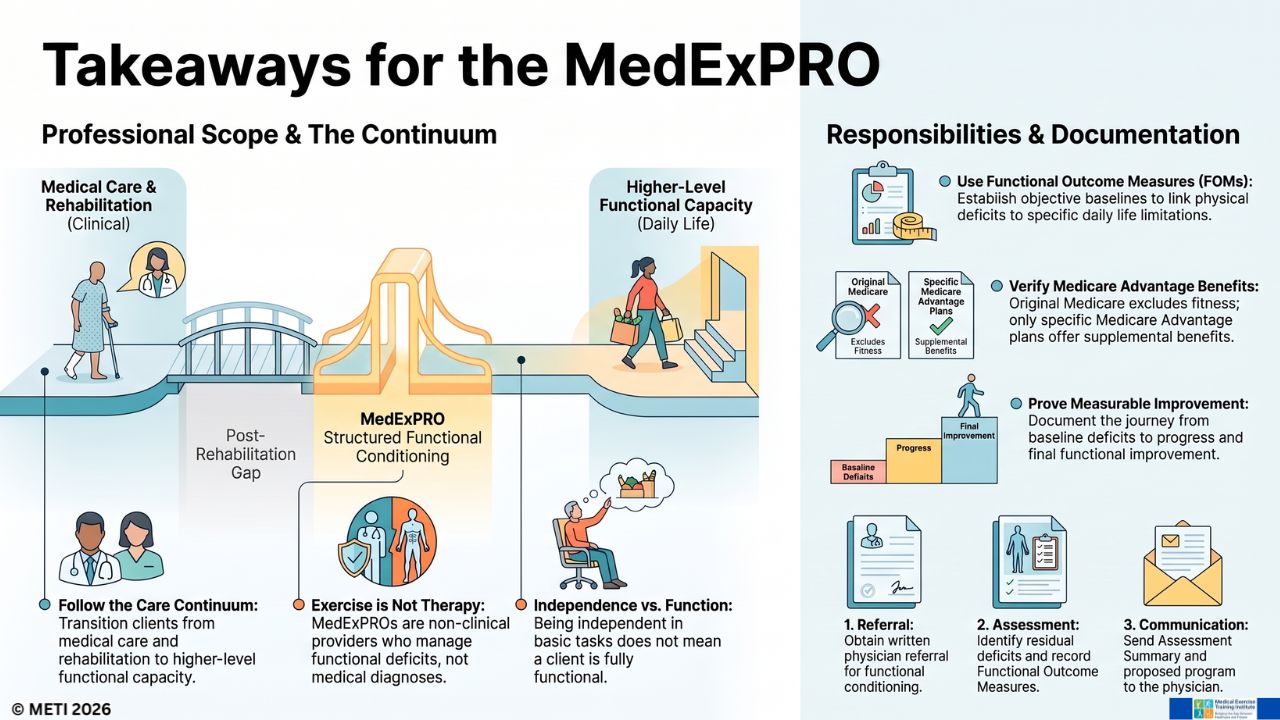
Mrs. Jacobs' story illustrates the continuum every MedExPRO should understand:
Medical Care → Rehabilitation → Functional Independence → Residual Functional Deficits → Medical Exercise Training → Higher-Level Function
Medical Exercise Training is not physical therapy. The MedExPRO is not a licensed medical provider. And Original Medicare does not provide a general fitness-program benefit.
But Medicare Advantage creates another possibility because individual plans may provide supplemental fitness benefits beyond Original Medicare. Those benefits and their requirements must be verified with the individual plan.
The MedExPRO's responsibility is to assess function, document functional deficits, use appropriate Functional Outcome Measures, communicate with the physician, provide safe and effective exercise, document progress and demonstrate measurable functional improvement.
Mrs. Jacobs entered this process as a patient requiring medical care. She completed rehabilitation as an independent individual who still had meaningful functional deficits. She then became a Medical Exercise Training client.
The goal of the MedExPRO was not simply to make Mrs. Jacobs more fit.
The goal was to help Mrs. Jacobs regain the functional capacity necessary to return to her life.
Get Medical Exercise Training guidelines and updates!
Build your practice with tips learned over 28+ years teaching MedXPROs around the world!!