
The 10 Pillars of Professional Practice: Moving Beyond Fitness with a Medical Flavor
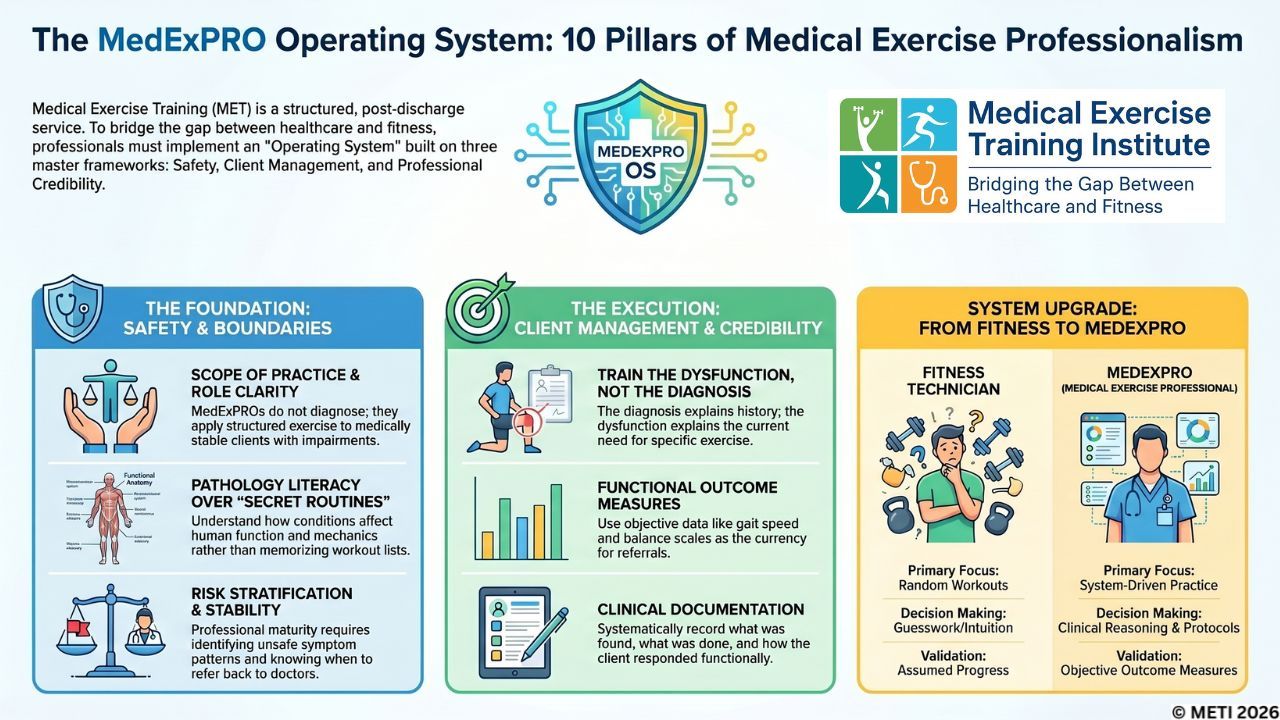
To transition fitness professionals from a "workout-centric" mindset to a system-driven, professional practice model by mastering the 10 key concepts of Medical Exercise Training.
Medical Exercise Training (MET) is not general fitness with a medical flavor. It is a structured, post-discharge, exercise-based professional service. To earn medical referrals and build a sustainable practice, the Medical Exercise Professional (MedExPRO) must move from technician thinking to professional practice ownership by installing systems for safety, client management, and professional credibility.
Professional Standard
Many fitness professionals believe that working with clients who have medical conditions simply requires knowing a few extra exercises. They look for the "secret routine" or a collection of specialized workouts.
But medical professionals do not refer to routines. They refer to systems.
If you want to bridge the gap between healthcare and fitness, you must move beyond the mentality of a general trainer and step into the role of a MedExPRO. That shift requires a disciplined mastery of 10 key concepts, skills, and frameworks that govern ethical, effective exercise management.
When you organize these 10 areas, they form the **MedExPRO Operating System**—built upon three master frameworks: Safety and Boundaries, Client Management, and Professional Credibility.
Framework 1: Safety and Boundaries
Before you design a single exercise progression, you must establish the professional perimeter. Without absolute role clarity, you become unsafe, overconfident, and confusing to the medical community.
- Scope of Practice and Role Clarity
This is the cornerstone of our entire profession. If your scope is distorted, everything else you do gets distorted. MedExPROs do not diagnose medical conditions, treat disease, or replace physical therapy. Our role is to apply structured exercise appropriately to a **medically stable client** with a history of medical conditions, impairments, or physical limitations. You must know exactly when to proceed, when to modify your approach, and when to refer the client back to their healthcare provider.
- Clinical Anatomy, Pathology, and Medical Condition Literacy
You do not need to think like a physician, but you must understand enough pathology to make intelligent exercise decisions. You need to understand how a condition affects the tissue or system involved, the mechanics of the dysfunction, and its typical progression pattern. You are not memorizing disease names for trivia; you are learning how pathology affects human function. For example, a hip replacement is not just a surgical history—it fundamentally alters gait mechanics, load tolerance, balance, and hip stability.
- Medical Stability, Contraindications, and Risk Stratification
Professional maturity means knowing when *not* to press forward. Before applying exercise, you must determine if the client is appropriate for exercise management at that specific time. This requires tracking symptom responses, understanding medication effects, and recognizing referral thresholds. You must know the difference between expected post-activity stiffness and an unsafe symptom pattern like sudden dizziness, neurological changes, or unexplained swelling.
Framework 2: Client Management
Once safety boundaries are established, client management ensures that your programming is driven by objective data rather than guesswork.
- Functional Assessment Framework
Medical Exercise Training must begin with a structured assessment. You need a repeatable method to evaluate posture, movement quality, gait, balance, mobility, and task tolerance. A medical diagnosis tells you the history, but it does not tell you how the individual moves today. Two clients with the exact same diagnosis may require completely different exercise approaches because their current functional presentations are entirely unique.
- Post-Rehab Dysfunction Recognition
This is one of the most critical conceptual shifts in our field. You must learn to separate the medical diagnosis from the remaining post-rehab dysfunction.
The diagnosis explains the history. The dysfunction explains the need for exercise.
MedExPROs do not train the diagnosis; they train the deficits left behind after medical treatment is complete. If a client has Parkinson’s disease, you are not treating the neurological pathology. You are addressing their loss of balance, asymmetrical loading, reduced movement amplitude, and elevated fall risk.
- Indicated vs. Contraindicated Exercise Reasoning
Knowing hundreds of exercises is common; knowing which ones are indicated for a specific dysfunction pattern is rare. Your exercise selection must be an exercise in professional reasoning. Stop asking, *"What exercises can I do for this condition?"* Start asking, *"What specific exercise serves this client's functional goal without increasing their structural risk?"*
- Progression Framework and Load Management
The client does not need random exercise; the client needs structured progression. Progression in Medical Exercise Training is not just about making a workout harder. It is about systematically advancing volume, intensity, complexity, range of motion, and environmental challenge to match the next level of function. A disciplined progression moves deliberately from a stable base to dynamic weight shifting, and ultimately to real-world task simulation.
Framework 3: Professional Credibility
The final framework transforms your technical expertise into a respected, verifiable professional service.
- Functional Outcome Measures and Reassessment
Functional outcomes are the currency of Medical Exercise Training.** To build professional credibility, you must use objective, repeatable measures such as gait speed, sit-to-stand timelines, balance scales, and tolerated duration of activity. If progress is not measured objectively, it is merely assumed—and assumed progress does not build referral trust with physicians.
- Documentation and Medical Communication
If it is not documented, it did not happen.* Your initial assessments, session logs, and progress summaries must be recorded systematically. Your documentation should clearly describe what was found, what was done, why it was done, and how the client responded functionally. This documentation must use objective, clinical reasoning without crossing into treatment language.
- Protocol-Based Critical Thinking
The final piece of the operating system combines structure with judgment. Protocols provide consistency across your practice, while critical thinking provides individualization for the person standing in front of you. Without protocols, your work becomes random; without critical thinking, your work becomes rigid.
The Practical Bottom Line
When you manage a client with a medical history, you are not just counting repetitions or delivering a workout. You are applying pathology awareness, risk management, functional reasoning, and professional judgment.
Medical professionals refer when they understand exactly what you do and trust how you operate. By mastering these 10 core pillars, you stop operating as a fitness technician and begin operating as a true professional practice owner.
Get Medical Exercise Training guidelines and updates!
Build your practice with tips learned over 28+ years teaching MedXPROs around the world!!