
The MedExPRO Operating System — From Architecture to Application
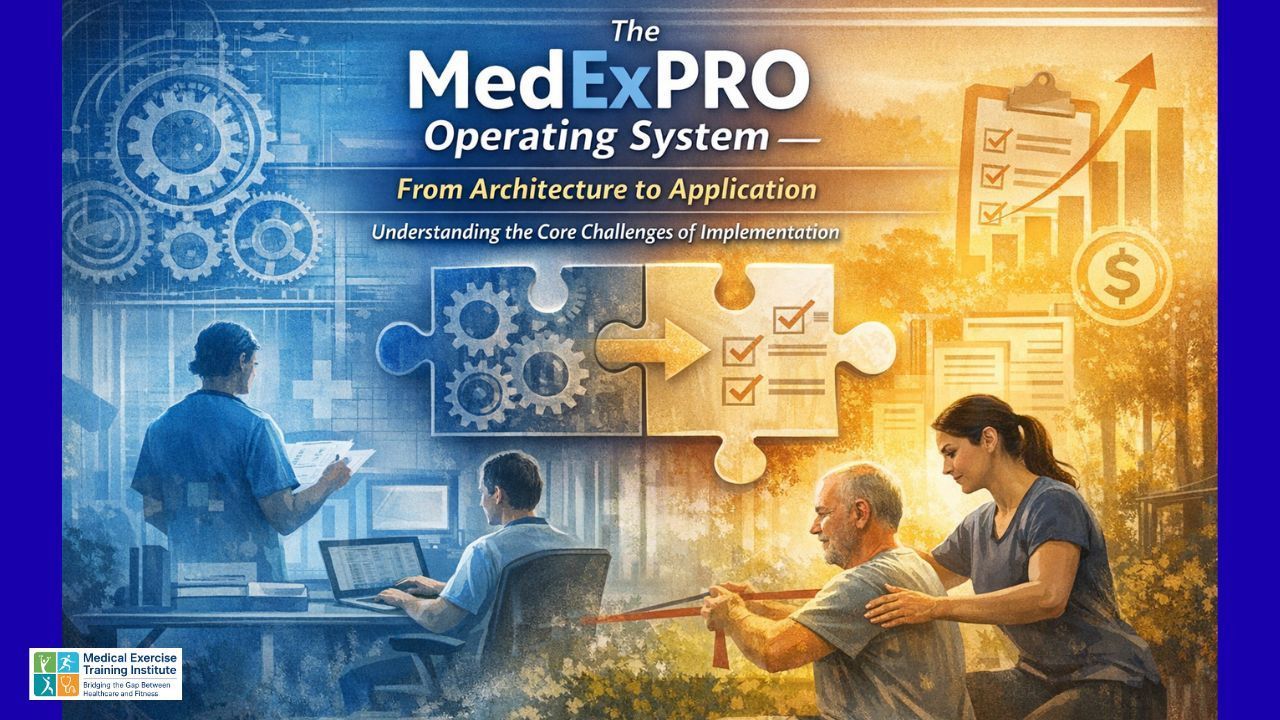
In the original MedExPRO Operating System: The Architecture of a Medical Exercise Practice, we established the professional blueprint required to transform exercise skills into a structured, defensible medical exercise practice. That article outlined the three interlocking frameworks, the client management engine, and the operational systems necessary to create consistency, measurable outcomes, and professional credibility.
Understanding that architecture is essential — but understanding alone does not create implementation.
As professionals begin applying the operating system in real practice environments, a new reality emerges. The frameworks make sense conceptually, yet the day-to-day experience reveals a series of obstacles that challenge consistency, confidence, and execution. These are not failures of the system — they are the natural friction points that occur whenever a professional transitions from improvisational fitness into structured medical exercise practice.
This follow-up article explores those realities by reframing the conversation from problems to Core Challenges — the predictable barriers professionals encounter as they move from understanding the operating system to truly living it in practice.
Core Challenges — Moving From Understanding to Implementation
Many professionals transitioning into medical exercise believe their biggest limitation is exercise knowledge. In reality, the challenge lies in translating structure into daily behavior.
Without fully installed systems:
- Practices remain personality-dependent
- Documentation becomes inconsistent
- Outcomes are difficult to demonstrate
- Medical relationships develop slowly
- Referrals remain unpredictable
Managing clients with chronic conditions requires more than understanding the operating system — it requires installing it operationally.
Three Essential Concepts That Solve the Problem
- The Three Interlocking Frameworks
- The Client Management Engine
- The Practice Infrastructure Systems
Together, these create a practice that is scalable, defensible, and referral-ready.
Concept 1 — The Three Interlocking Frameworks
A medical exercise practice requires three layers of governance that operate vertically to support the professional.
Enterprise Framework — Sustainability & Strategy
This is the leadership level governing financial planning, risk management, and strategic alliances. It shifts the professional from technician to owner mindset.
Without this framework, a professional remains a freelancer rather than a practice owner.
Practice Management Framework — Operations
This framework translates strategy into repeatable daily processes including workflows, documentation, and referral coordination. Healthcare systems partner with processes, not personalities.
Client Management Framework — Exercise Delivery
This governs how clients progress from medical clearance through discharge while ensuring exercise is applied as a dose-based modality rather than random activity.
Real-World Application
A professional may design excellent programs but struggle to retain clients or communicate progress to physicians. Installing these frameworks ensures consistency regardless of who delivers the service.
Concept 2 — The Client Management Engine
At the center of the operating system is the 6-Point Client Management System — the standard operating procedure for delivering care.
It prevents random exercise and ensures all critical clinical details are addressed.
The Six Points
- Clinical anatomy and pathology
- Contraindications
- Assessment
- Indicated activities
- Progression and functional goals
- Protocol-based approach
This system ensures exercise decisions are based on functional deficits and measurable goals rather than guesswork.
Real-World Application
A client post-joint replacement may appear ready for higher intensity training. Without systematic assessment and contraindication review, the program risks setbacks. The 6-Point system ensures decisions are evidence-based and defensible.
Concept 3 — The Practice Infrastructure Systems
While the 6-Point system manages clients, the operational backbone is formed by integrated practice systems that manage the business.
These systems create infrastructure required for referrals and reimbursement readiness.
Key systems include:
- Documentation
- Communication
- Medical relations
- Billing
- Staffing
- Marketing
- Client management
- Assessment
- Business development
Implementing these systems removes dependency on memory and ensures scalability.
Real-World Application
A practice receiving referrals must demonstrate consistent documentation, communication, and progress reporting. Without these systems, trust cannot be maintained.
Documentation and Communication — The Currency of Trust
In the operating system, documentation is not administrative work — it is proof of value and the foundation of professional credibility.
Key elements include:
- Intake screening
- Session logs
- 30-day progress reports
- Discharge summaries
These create transparency and demonstrate outcomes to referral sources.
Scope of Practice — The Exercise-Only Standard
The operating system functions strictly within a non-diagnostic scope, focusing solely on exercise as the modality for managing residual functional deficits.
This clarity protects the professional and builds trust within the healthcare continuum.
Revenue and Sustainability — The Practice Mindset
Transitioning to a medical exercise practice shifts revenue from transactional sessions to long-term management supported by referrals, outcome tracking, and diversified services.
Connecting to the Next Step
Understanding the operating system conceptually is only the beginning. Implementation requires structured guidance, feedback, and systems installation.
The MES Enterprise Cohort provides the environment to install these frameworks step-by-step while MES AI supports daily execution and decision-making.
Three Key Takeaways
- Medical exercise success depends on infrastructure, not exercise creativity.
- The operating system integrates strategy, operations, and client management into one architecture.
- Documentation and systems create credibility, referrals, and measurable outcomes.
Next Steps
- Identify which framework is currently weakest in your practice
- Review your client management workflow against the 6-Point system
- Evaluate your documentation consistency
- Begin installing one operations system this month
Call to Action
If you are ready to move from improvisational training to structured medical exercise practice, the MES Enterprise Cohort provides the roadmap and support to implement the MedExPRO Operating System while MES AI supports your daily execution.

Get Medical Exercise Training guidelines and updates!
Build your practice with tips learned over 28+ years teaching MedXPROs around the world!!