
Functional Outcome Measures (FOMs): The Currency of Trust
Most Medical Exercise Professionals believe they are outcome-driven.
They design intelligent programs.
They progress exercises appropriately.
They see improvement in their clients.
But when asked to prove it?
That’s where many practices quietly collapse.
A physician does not refer based on your passion.
An insurance carrier does not consider reimbursement based on your effort.
They respond to one thing:
Objective change
Functional Outcome Measures — FOMs — are the currency of trust in medical exercise training.
Without them, you are running sessions.
With them, you are building professional credibility.
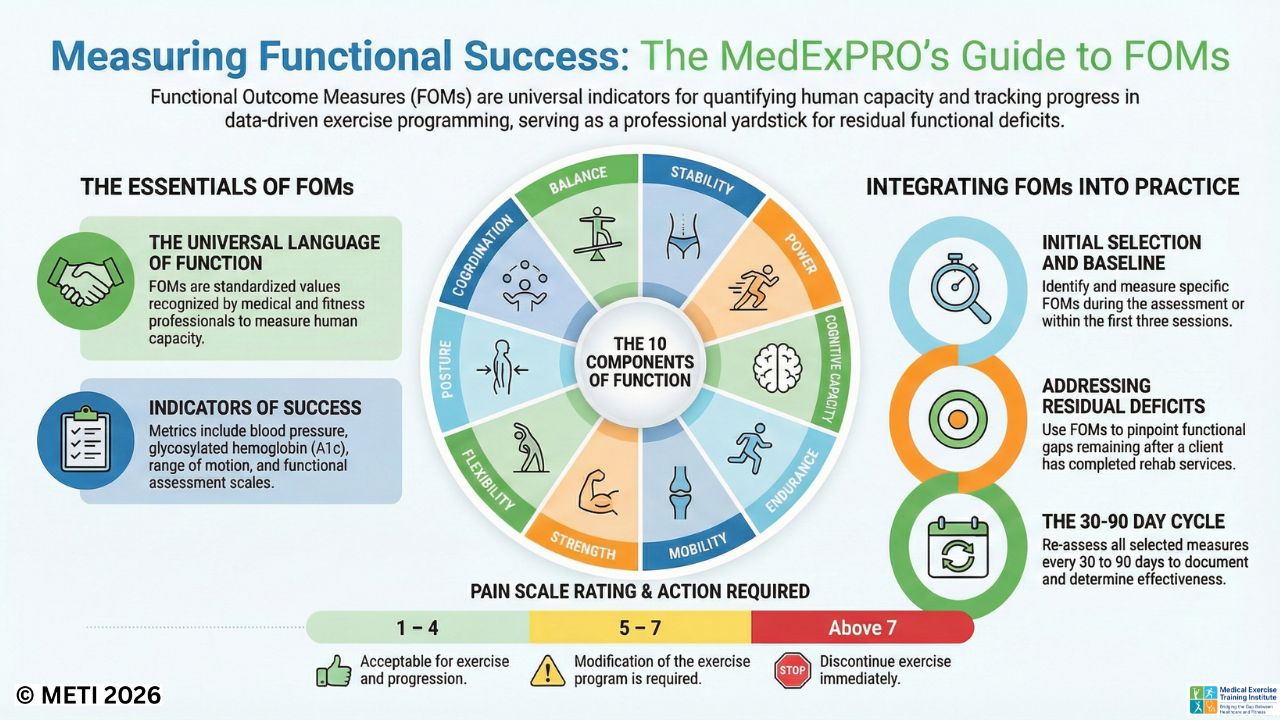
The Core Problem: Improvement Without Proof
Many MedExPROs rely on observation and client feedback:
- “They’re moving better.”
- “Pain has decreased.”
- “They feel stronger.”
Those statements may be true.
But they are not measurable.
In a healthcare-aligned environment, improvement must be quantifiable.
If it cannot be measured, it cannot be defended.
If it cannot be def...
MET 101 Tip #48 - Why Medical Exercise Protocols Are Non-Negotiable
Welcome back to the ME 101 series! In Tip 48, Dr. Mike tackles a foundational question for any Medical Exercise Professional (MedExPRO): What exactly is a Medical Exercise Training (ME) protocol?
If you want to transition successfully from general fitness to medical exercise, understanding and utilizing protocols is your absolute key to gaining credibility and building referral relationships.
What is an ME Protocol? At its core, a medical exercise training protocol is a defined set of guidelines and procedures used to manage exercise programming and progressions for a specific medical condition. Every aspect of medicine operates on protocols and standards. Therefore, if medical exercise is to be fully embraced by doctors, therapists, and healthcare systems, we must speak their language and utilize protocols.

The 8 Core Components of an ME Protocol: A proper ME protocol is not just a list of exercises. It is a comprehensive, step-by-step process that moves a client from initial ass...
The Client Management Engine That Eliminates Random Exercise
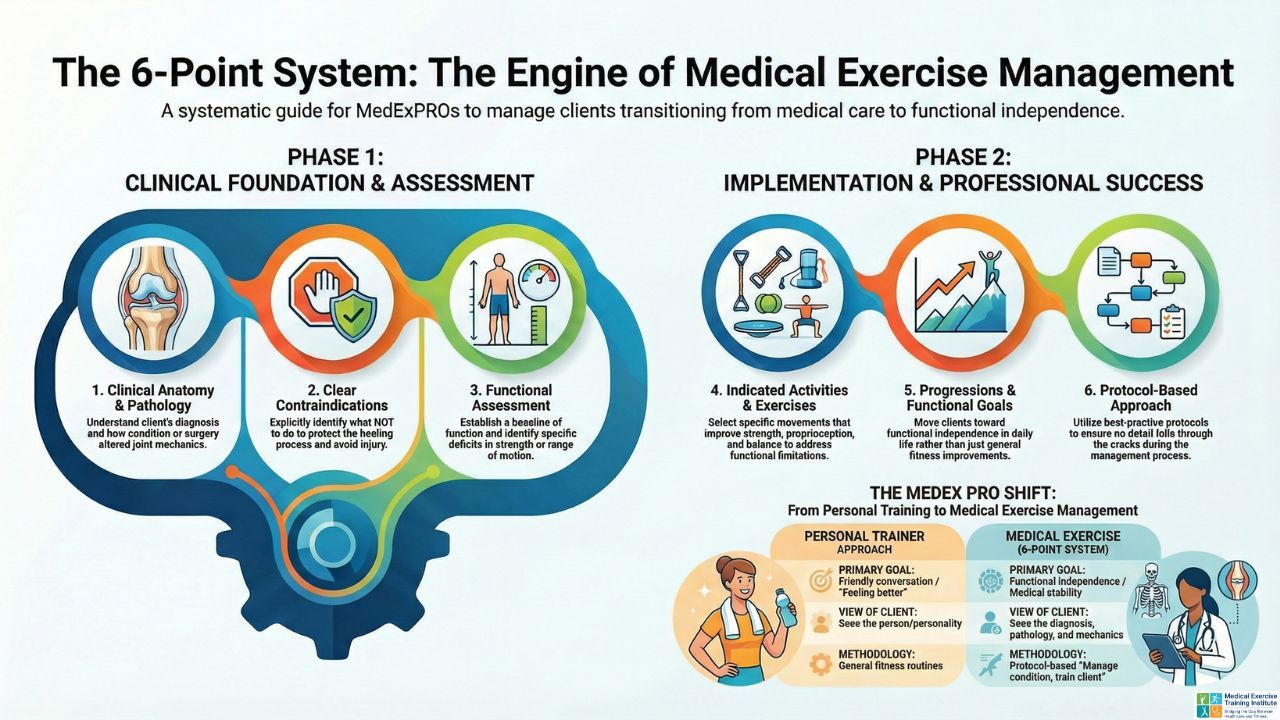
The 6-Point Client Management System
The healthcare landscape has shifted dramatically.
Decades ago, an individual recovering from a total hip replacement might receive two to three months of physical therapy. Today, many are discharged after only four to six visits. They leave therapy with lingering weakness, instability, and functional limitations—yet insurance says they are “done.”
That gap is where the Medical Exercise Professional steps in.
But let me be clear:
If you step into that gap without structure, you are not building a professional practice. You are gambling with someone’s recovery.
In the MedExPRO Operating System, the engine that drives safe, measurable, and referral-ready results is the 6-Point Client Management System.
This is not about adding more exercises.
This is about installing a system.
The Critical Mindset Shift
Before we discuss mechanics, we must discuss mindset.
A personal trainer may see “Mrs. Jacobs” — a pleasant 79-year-old who wants to get st...
The Three Frameworks That Turn Exercise Skills Into a Medical Exercise Practice

Most professionals entering medical exercise believe success comes from mastering programming techniques.
But the truth is far more structural — practices fail not because of poor exercise selection, but because they lack architecture.
The MedExPRO Operating System introduces three interlocking frameworks that transform a technician into a practice owner. These frameworks create the guidelines required to produce consistency, measurable outcomes, and professional credibility.
If you want a practice that physicians trust and clients rely on, these frameworks are not optional — they are foundational.
The Core Problem — Skill Without Structure
Many professionals operate with excellent exercise knowledge yet struggle with inconsistency, unpredictable revenue, and limited referrals.
Why? Because exercise skills alone cannot sustain a practice.
Without governance structures, decisions become reactive, operations become personality-dependent, and growth becomes impossible.
The operati...
MedExPRO....Are You Actually Referral and Reimbursement-Ready? Complete the Checklist
Hello MedExPRO,
Let me ask you a direct question.
Do you believe your practice is referral-ready?
Do you believe you are reimbursement-ready?
Most Medical Exercise Professionals think they are.
You manage complex clients.
You understand pathology.
You care deeply about safety.
You communicate professionally.
But here is the uncomfortable truth:
Good intentions and strong exercise knowledge do not make a practice referral-ready or reimbursement-ready.
Systems do.
Why This Matters (And Why Most Don’t Realize They’re Not Ready)
Most MedExPROs fear three things:
- Approaching physicians and being dismissed
- Talking about reimbursement and saying the wrong thing
- Accidentally stepping outside scope
So what do they do?
They avoid the conversation.
They hope referrals will “just happen.”
They tell clients, “You can try to submit this,” without structured documentation.
And they quietly wonder why medical professionals don’t consistently refer.
That is not a competence problem...
What It Means to Be Reimbursement-Ready—and How It Elevated Sarah’s Practice
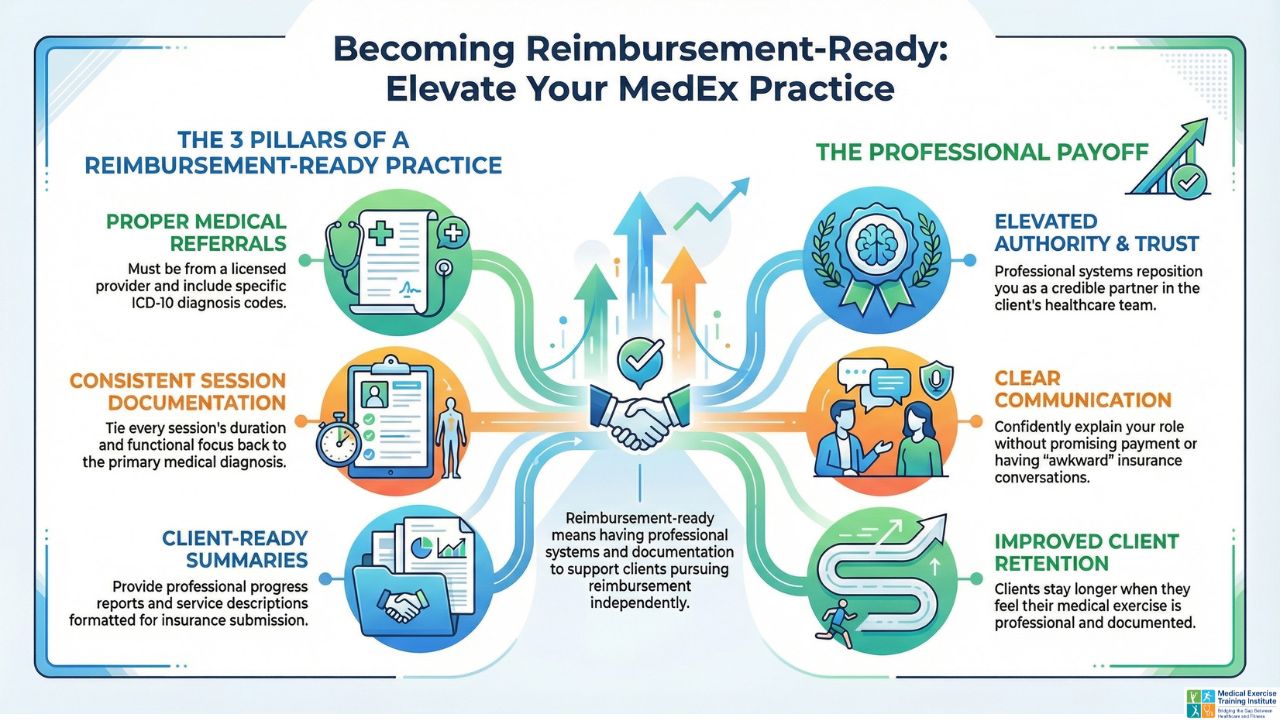
Reimbursement-ready does not mean billing insurance.
It means your practice has the documentation, language, and systems to support a client who chooses to pursue reimbursement.
Before the MES Enterprise Cohort, Sarah avoided these conversations.
After the cohort, she handled them with confidence.
What “Reimbursement-Ready” Means for a MedExPRO
A reimbursement-ready practice has:
- A proper medical referral
- Written by a licensed provider
- Specifies Medical Exercise Training or Functional Conditioning
- Includes a diagnosis and ICD-10 code
- Consistent session documentation
- Date, duration, and service description
- Functional focus tied to the diagnosis
- Objective indicators of progress
- Client-ready documentation
- Session summaries
- Progress reports
- Clear service descriptions appropriate for submission
Reimbursement-ready practices do not promise payment.
They provide professional clarity.
Why Reimbursement-Ready Changed Sarah’s Practice
Once Sarah became reimb...
Medical Exercise Professionals Are Expected to Have These Skills...Do You??
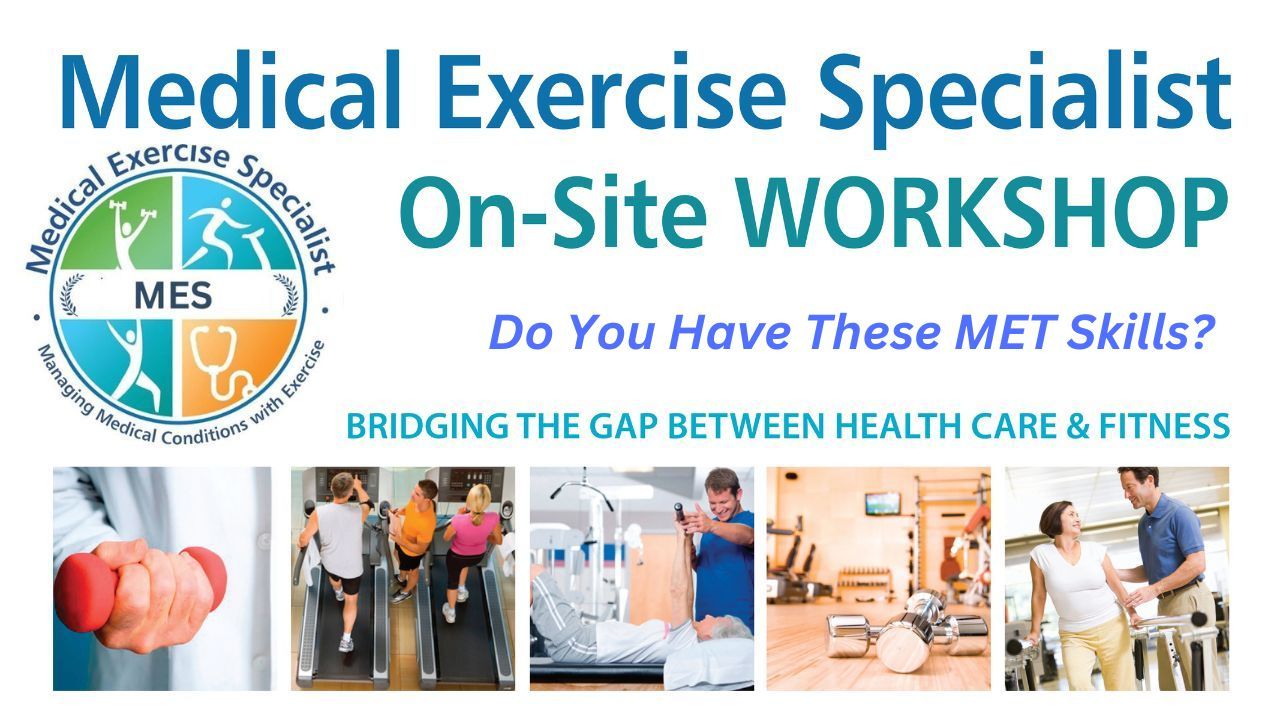
Most fitness and post-rehab professionals believe they are “working with medical clients.”
Very few can document the skills required to do so safely, ethically, and professionally.
That gap is exactly why the Medical Exercise Specialist (MES) On-Site Workshop exists.
The Reality of Medical Exercise Practice
Medical exercise is not defined by enthusiasm, experience, or certifications alone. It is defined by demonstrable competencies—the kind medical professionals assume you already possess when they trust you with a referred client.
The Medical Exercise Skills Checklist outlines more than 50 core competencies that a Medical Exercise Professional should be able to perform independently, confidently, and consistently. These are not “advanced” skills. They are baseline expectations in medical environments. Yet most professionals have never been formally trained in many of them.
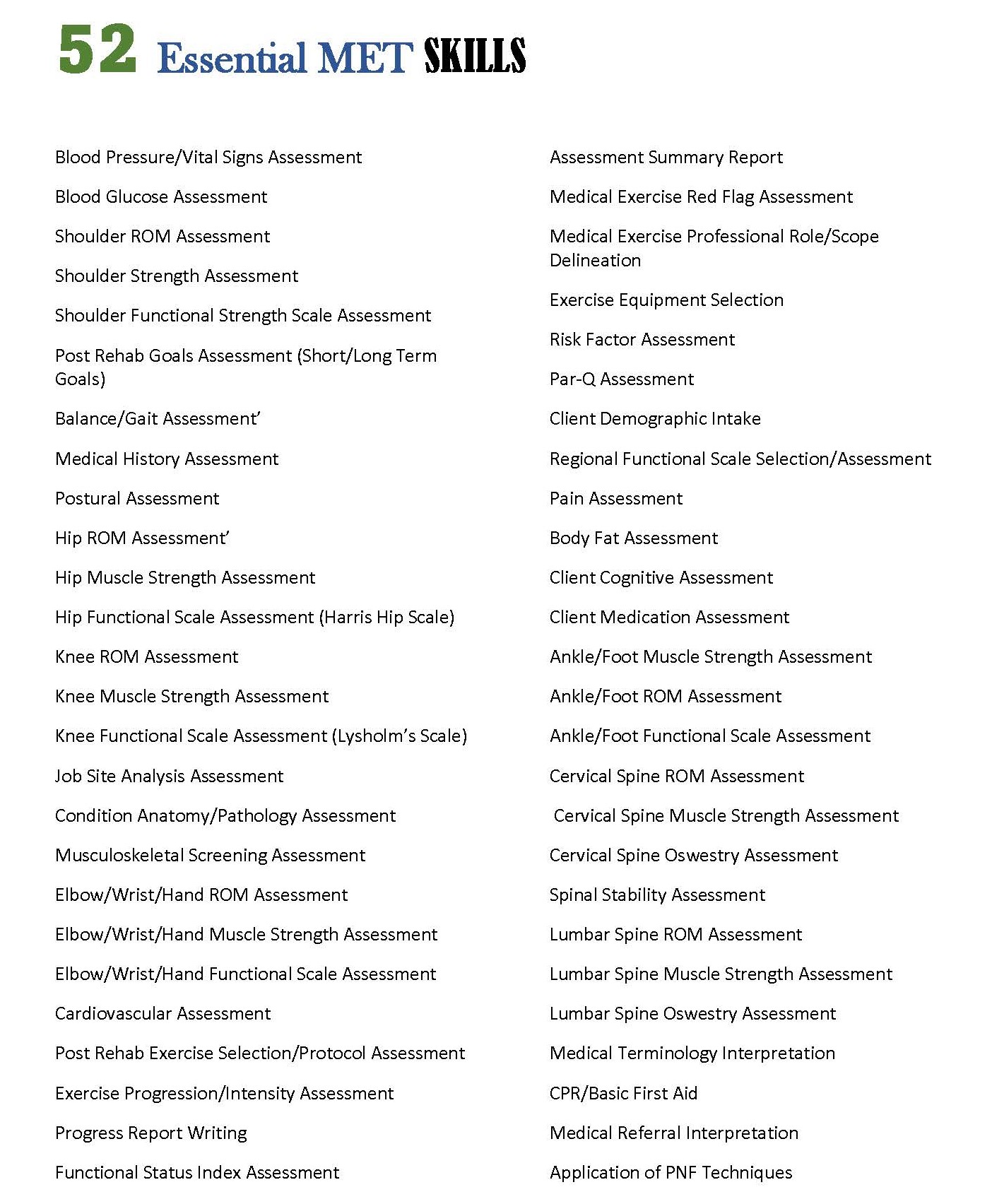
What the Skills Checklist Really Reveals
When professionals review this checklist honestly, a pattern em...
MET 101 eBook Tip 47: Managing Blood Pressure and Blood Glucose in MET
One of the most common—and unnecessary—sources of anxiety for Medical Exercise Professionals is knowing when it is safe to exercise a client with hypertension or diabetes. This uncertainty often leads to hesitation, avoidance, or overly conservative programming that limits outcomes.
Here’s the truth: medical providers expect and respect these conversations.
Physicians would much rather answer a clear, professional question about exercise parameters than discover later that decisions were made without guidance. Reaching out to clarify acceptable blood pressure or blood glucose ranges does not signal inexperience—it demonstrates professionalism, risk awareness, and respect for scope.
Every MedExPRO should begin a new client relationship by:
- Obtaining a written referral
- Confirming the diagnosis and ICD-10 code
- Requesting individualized exercise parameters for blood pressure and/or blood glucose
That said, there are general safety thresholds every MedExPRO must understand and be...
Medical Exercise Specialist Workshop 2026 Schedule - 2-Day Intensive
SCROLL TO BOTTOM TO REGISTER
| 🎯 Only 12 Seats | 🚨 2026 Workshop Schedule
⏱️ Stop Guessing. Start Bridging the Gap Between Healthcare & Fitness.
The Medical Exercise Specialist Workshop gives you the skills, systems, and credibility to manage medical clients, attract physician referrals, and grow a sustainable practice.
The Challenges Every MedExPRO Feels
If you’ve been in the fitness or rehab field for any length of time, you’ve probably felt these frustrations:
❌ You’re confident training healthy clients… but nervous with complex cases. When a client walks in with diabetes, osteoarthritis, or post-surgery clearance, do you find yourself second-guessing your program design?
⚠️ You’ve taken certifications… but still don’t have referrals. Too many MedExPROs think another certification will open doors — but doctors don’t care about your wall of certificates. They care about results, documentation, and professionalism.
😖 You want physician referrals… but don’t know what to say. Do y...
10 Reasons MedExPROs Struggle to Build Sustainable Practices
Why Skill Alone Is Never Enough?
Over the last 32 years, I’ve had the privilege of educating thousands of Medical Exercise Professionals around the world. I’ve seen exceptional clinicians. I’ve seen deeply committed professionals. I’ve seen individuals who truly change lives through exercise.
And yet—despite their knowledge, passion, and skill—many of those same professionals struggle to build sustainable, profitable medical exercise practices.
This isn’t because they don’t care.
It isn’t because they aren’t competent.
And it certainly isn’t because medical exercise “doesn’t work.”
It’s because medical exercise success is not a skills problem.
It’s a practice-development problem.
Over three decades, the same issues appear again and again. Different cities. Different countries. Different certifications. Same outcomes.
Below are the 10 most common reasons Medical Exercise Professionals struggle to build strong practices—and how those problems are directly addressed inside the MES E...