
Medical Exercise Training Ultimate Fall Risk Assessment - Tinetti Balance/Gait Scale
Get the Podcast Here
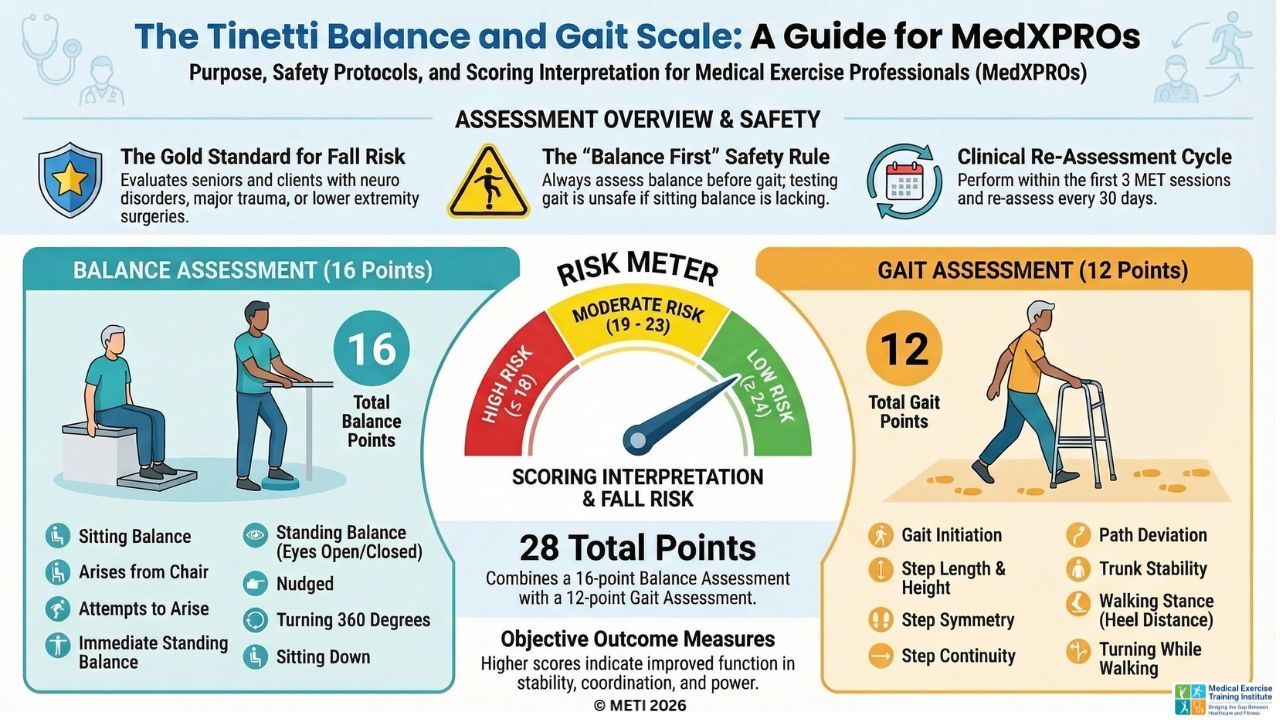
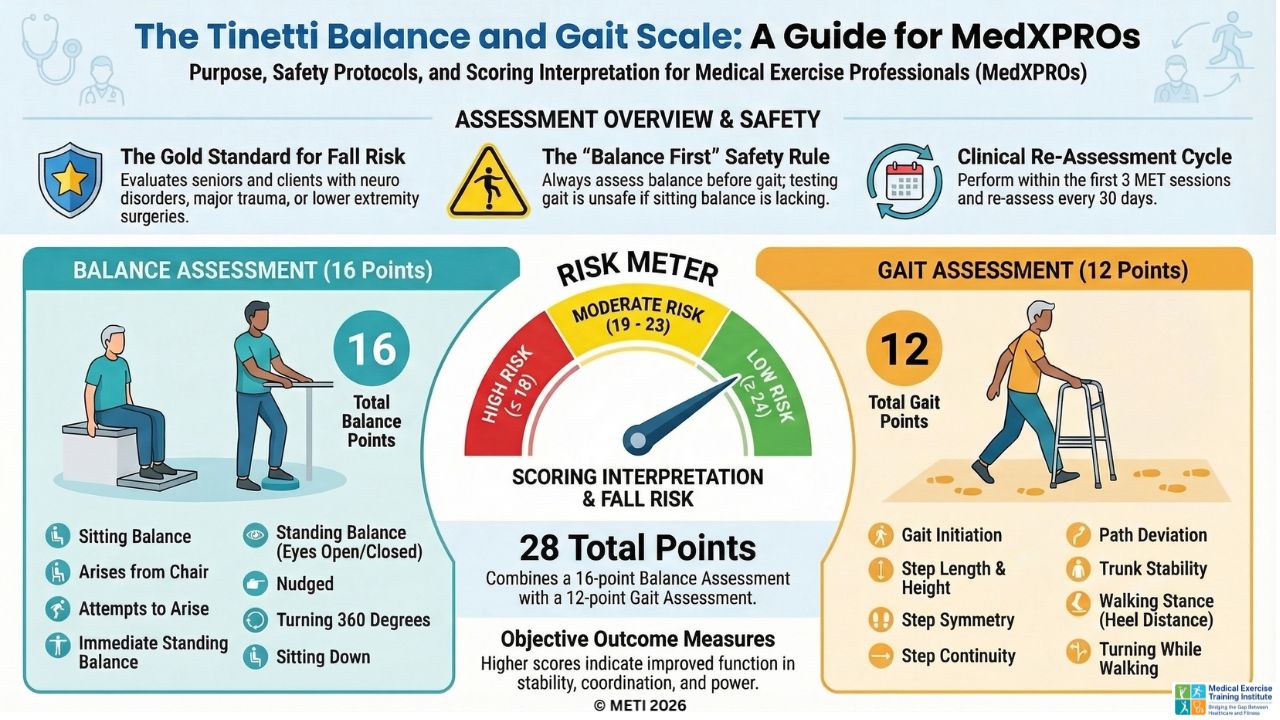
The Tinetti Gait and Balance Scale is one of the most frequently used and critical functional assessment tools for Medical Exercise Professionals (MedXPROs) working with aging populations and those with neurological challenges. Specifically, this scale is ideal for seniors, clients utilizing an ambulatory assistive device, or individuals with a history of a cerebrovascular accident (CVA/stroke), Multiple Sclerosis, Parkinson’s disease, lower extremity surgery, or major trauma. Rather than just evaluating isolated strength, the Tinetti Scale provides a comprehensive snapshot of how a client's body functions in motion and at rest, accurately determining their precise risk for falls.
This objective assessment is divided into two distinct components: Balance and Gait, yielding a maximum combined score of 28 points. The Balance assessment must always be performed first; if a client lacks independent sitting balance, progressing to gait testing may be highly unsafe.
The Balance component is graded out of 16 possible points. It systematically evaluates a client's stability through nine targeted movements. MedXPROs assess the client's sitting balance, their ability to arise from a chair (including the number of attempts needed), and immediate standing balance within the first five seconds. Furthermore, it tests dynamic standing balance by evaluating how the client reacts to being gently nudged on the sternum, standing with their eyes closed, and turning 360 degrees.
The Gait component is graded out of 12 possible points. This section requires the client to walk while the professional observes specific biomechanical factors. Key areas of evaluation include the immediate initiation of gait (looking for hesitancy), step length, step height, and foot clearance. MedXPROs also look for step symmetry, continuity between steps, marked deviations in the walking path, and whether the client experiences trunk sway or relies on walking aids.
By tracking these specific movements and assigning them a numerical value, MedXPROs can accurately classify a client as being at high, moderate, or low risk for falls. Conducting this assessment every 30 days provides an objective measure of functional improvement, easily communicable to physicians and insurance carriers.
To help you seamlessly integrate this tool into your practice, here is the step-by-step procedure for properly administering and documenting this assessment, in accordance with standard Medical Exercise Training (MET) protocols.
Tinetti ME, Williams TF, Mayewski R, Fall Risk Index for elderly patients based on number of chronic disabilities. Am J Med 1986:80:429-434
The Tinetti Balance and Gait Scale Procedure
- Assess Balance First: Always begin with the Balance component; if the client lacks independent sitting balance, it may be highly unsafe to progress to gait testing.
- Grade Balance (16 points max): Evaluate the client's stability through nine targeted movements, including sitting balance, arising from a chair, immediate standing balance, dynamic standing (reacting to a sternum nudge), standing with eyes closed, and turning 360 degrees.
- Grade Gait (12 points max): Observe the client walking to evaluate gait initiation, step length and height, foot clearance, step symmetry, continuity, deviations in the walking path, and trunk sway or use of walking aids.
- Document Initial Findings: Record the results and score on the specific regional/functional assessment form, and transfer these findings to your Medical Exercise Assessment Summary Form, making sure to store the original.
- Share with Providers: Share the Summary Form with the client's physician and insurance carrier as appropriate.
- Ongoing Tracking: Update the functional outcome measures continuously in the Medical Exercise Session Log.
- 30-Day Reassessment: Re-administer the assessment every 30 days, record the updates in a Medical Exercise Progress Report, and share this report with the referring physician or insurance carrier.
Click Here to Download the Tinetti Balance & Gait Scale
Get Medical Exercise Training guidelines and updates!
Build your practice with tips learned over 28+ years teaching MedXPROs around the world!!